

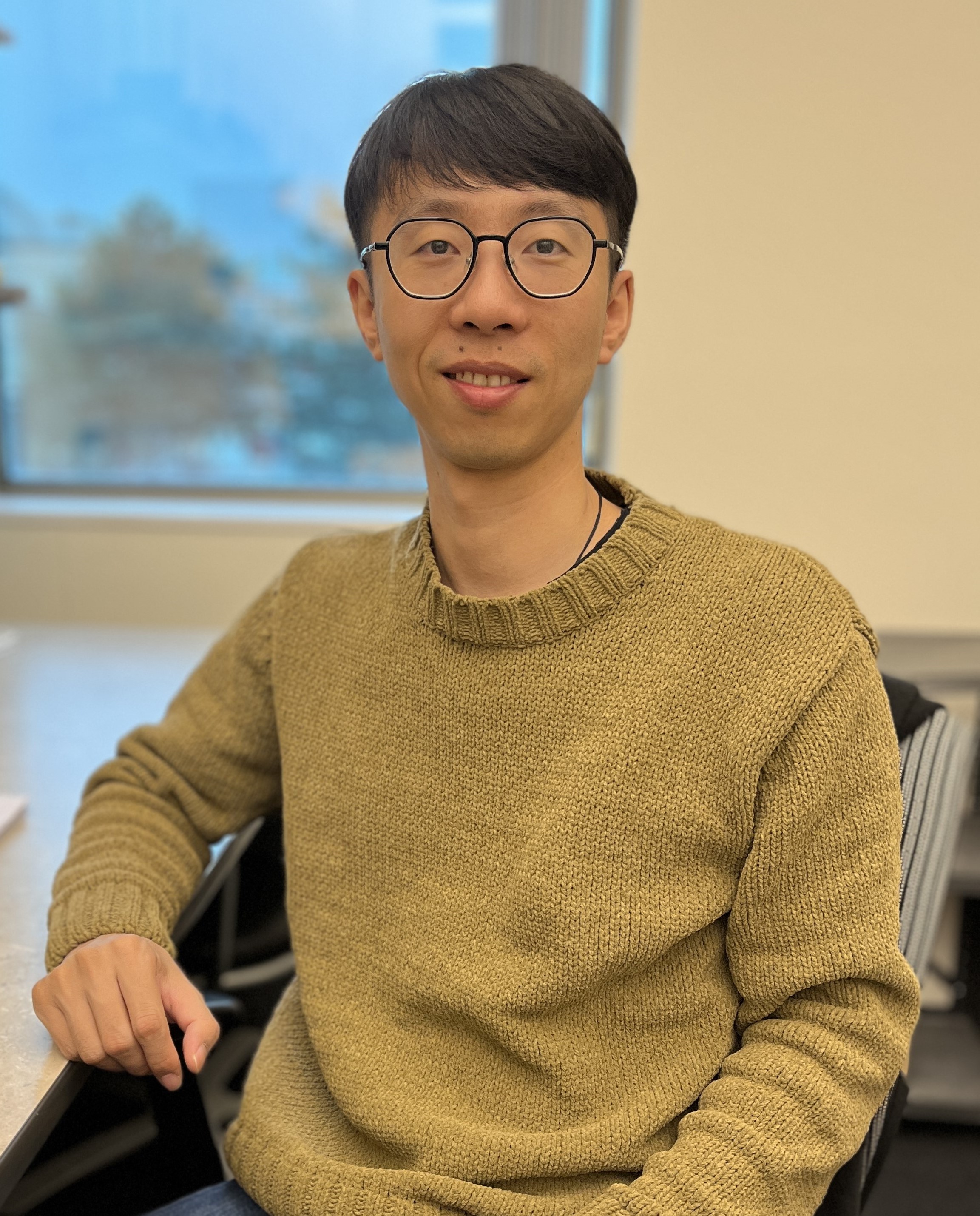
 Bo Sun
· 3 previous affiliations
- University of OttawaSince 2025
- Assistant Professor · Since 2025
- University of Waterloo2023–2025
- Postdoc · 2023–2025
- PhD student · 2013–2018
6 other authors named Bo Sun: Bo Sun (Meta (United States) · 46 papers), Bo Sun (Adobe Systems (United States) · 8 papers), Bo Sun (Google (United States) · Waymo Research · 8 papers), Bo Sun (1 paper), Bo Sun (Chinese Academy of Sciences · 1 paper), and 1 more
Research Overview
Bo Sun focuses on the intersection of algorithmic theory and networked systems, developing online decision-making frameworks with provable performance guarantees. His work primarily addresses resource allocation and optimization challenges in energy systems, such as smart grids and electric vehicle networks, as well as in computing infrastructures including cloud and mobile edge computing. His recent research explores learning-augmented algorithms that integrate machine learning predictions into traditional competitive analysis to improve average-case performance while maintaining worst-case robustness.
Research Trajectory
The evolution of Sun’s research reflects a transition from general engineering optimization and software process management toward a rigorous theoretical focus on online algorithms and their applications in modern infrastructure. His earliest work, dating back to 2003, examined the Personal Software Process (PSP) and its role in enhancing the Capability Maturity Model (CMM) for software engineering. By 2011, his focus shifted toward transportation and logistics optimization, utilizing metaheuristics such as ant colony algorithms to solve regional bus scheduling problems involving complex constraints like depot capacity and fueling requirements. This period also included contributions to the mechanical optimization of robotic systems, specifically the leg mechanisms of hydraulic-actuated quadruped robots.
In the mid-2010s, Sun’s work began to concentrate on the emerging challenges of the smart grid and energy management. He addressed the modeling of multi-dimensional flexibility in demand-side management, proposing market designs that allow aggregators to submit parametric reward functions representing aggregate load flexibilities. This period marked a significant shift toward treating energy assets as flexible resources that require sophisticated real-time coordination. By 2020, this interest expanded into the logistics of electric vehicle (EV) infrastructure, where he investigated the dual challenges of long-term inventory planning and short-term real-time routing for battery-swapping station networks.
Since 2021, Sun’s research has matured into a focused investigation of online competitive algorithms, particularly those augmented by machine learning. This current phase is characterized by a move toward more abstract and mathematically rigorous problem formulations, such as online conversion, search, and knapsack problems. He has pioneered methods for balancing "consistency" (performance when predictions are accurate) and "robustness" (performance when predictions are poor), establishing Pareto-optimal trade-offs that define the theoretical limits of learning-augmented decision-making. His most recent work extends these principles to include uncertainty quantification and algorithmic fairness, ensuring that online resource allocation is not only efficient and robust but also equitable across different user groups.
Current Directions
Sun’s current research program is organized around three primary pillars: learning-augmented competitive analysis, uncertainty-aware online decision-making, and fair resource allocation in networked systems.
In the domain of learning-augmented algorithms, Sun focuses on the "consistency-robustness" framework. Traditional online algorithms are designed for the worst case, which often leads to overly conservative performance in practice. Conversely, pure machine learning approaches lack guarantees when data distributions shift. Sun’s work bridges this gap by designing algorithms that leverage "succinct" predictions—such as a single estimated value or a predicted price—to achieve near-optimal performance under favorable conditions without sacrificing the safety net provided by competitive analysis.
A second major direction involves uncertainty quantification (UQ). Recognizing that machine learning predictions are rarely perfect, Sun investigates how algorithms can intelligently use the confidence intervals or error bounds provided by UQ tools. This allows for more nuanced decision-making where the algorithm’s reliance on a prediction is dynamically scaled based on the quantified uncertainty of that prediction.
Finally, Sun is increasingly active in the area of algorithmic fairness within online systems. This includes addressing "time fairness" in sequential decision-making and "group fairness" in resource allocation. His work in this area seeks to encode fairness constraints directly into the mechanism design and competitive analysis of online problems, ensuring that individual welfare and group equity are maintained alongside system-wide efficiency.
Representative Work
Pareto-Optimal Learning-Augmented Algorithms for Online Conversion Problems establishes a unified algorithmic framework for both integral and fractional conversion problems, such as the 1-max-search and one-way trading problems. As the lead author, Sun introduced a class of online threshold-based algorithms (OTA) that incorporate machine-learned predictions. The work is significant for achieving the Pareto-optimal trade-off between consistency and robustness, proving that no online algorithm can surpass the performance bounds established by this framework. This paper marked a critical point in Sun's trajectory toward formalizing the integration of AI/ML tools into competitive analysis.
Online Algorithms with Uncertainty-Quantified Predictions explores the frontier of decision-making under quantified uncertainty. In this first-author paper, Sun addresses the reality that machine learning predictions are often accompanied by error estimates. The research develops a methodology for online algorithms to utilize these uncertainty metrics to improve decision quality. By moving beyond point-estimate predictions to uncertainty-aware models, the work provides a more resilient foundation for online systems operating in volatile environments.
Data-driven Online Slice Admission Control and Resource Allocation for 5G and Beyond Networks applies Sun’s theoretical expertise to the practical domain of telecommunications infrastructure. As lead author, he introduced OSARA, a framework that jointly optimizes slice admission and resource allocation in real-time. The framework utilizes a differentiable, data-driven model combined with dynamic pricing strategies. The work demonstrates a substantial improvement in worst-case performance over standard heuristics while providing theoretical revenue guarantees, illustrating the application of his online decision-making theories to 5G network slicing.
Posted Price Mechanisms for Online Allocation with Diseconomies of Scale addresses the online k-selection problem in scenarios where marginal production costs increase with volume. As the second author, Sun contributed to the development of a novel randomized dynamic pricing mechanism. This work is notable for providing tighter lower bounds on the competitive ratio than previous deterministic approaches, particularly in settings with finite inventories. It reflects Sun’s ongoing interest in the economic and mechanism design aspects of online resource allocation.
Inventory Planning and Real-Time Routing for Network of Electric Vehicle Battery-Swapping Stations focuses on the operational challenges of EV refueling infrastructure. The research targets two distinct timescales: long-term inventory planning for battery stocks and short-term real-time routing for vehicles. This work exemplifies Sun’s ability to handle multi-scale optimization problems in energy systems, decoupling the complexities of battery charging from the immediate needs of vehicle refueling to improve the overall efficiency of battery-swapping networks.
Near-Optimal Consistency-Robustness Trade-Offs for Learning-Augmented Online Knapsack Problems investigates the use of simple, succinct predictions to solve the online knapsack problem. In this collaborative work, Sun participated in the design of a family of algorithms that blend predictive insights with robust strategies. The research demonstrates that even minimal predictive information can be leveraged to achieve near-optimal performance, provided the blending mechanism is theoretically grounded to protect against prediction errors.
Profile updated
Loading new papers…
Other researchers whose papers cluster into the same research directions — a proxy for overlapping technical interests and shared intellectual neighborhoods.
See something wrong? Report a mistake