

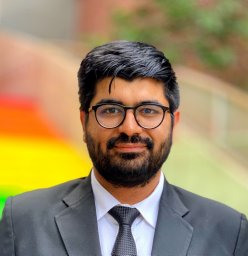
 Bhuvesh Kumar
· 8 previous affiliations
- Snap Inc.Since 2024
- Research Scientist · Since 2024
- Current
- TikTok2023–2024
- Machine Learning Engineer · 2023–2024
- ByteDance (China)2023–2024
- Researcher · 2023–2024
- Georgia Institute of Technology2017–2022
- PhD student · 2017–2022
- Applied Scientist · 2021
- Research Scientist · 2021
- Research Scientist · 2020
- Bachelor of Technology (B.Tech.), Computer Science and Engineering · 2013–2017
Research Overview
Bhuvesh Kumar focuses on the theoretical foundations of learning systems, mechanism design, and large-scale recommendation systems. His work explores how machine learning algorithms can make effective, robust, and responsible decisions in complex environments shaped by strategic human behavior and economic factors. Recently, he has investigated generative recommendation and representation learning using multimodal user interaction data.
Research Trajectory
During his doctoral studies at the Georgia Institute of Technology, Kumar's early research examined the intersection of machine learning and economics. He contributed to work in the area of Explainable Social Choice and Transparent Voting, specifically addressing how to learn Bayesian-optimal revenue-maximizing auctions. In Learning Auctions with Robust Incentive Guarantees (2019), he and his collaborators tackled the problem of strategic overfitting in online settings, where buyers participating in multiple rounds might manipulate a learning algorithm's trajectory to secure more favorable prices in the future.
Expanding his focus to the security and reliability of sequential decision-making, Kumar explored vulnerabilities in multi-armed bandit algorithms. He participated in developing novel attack methodologies within the research direction of Black-Box Data Poisoning for Online Reinforcement Learning. The resulting paper, Observation-Free Attacks on Stochastic Bandits (2021), demonstrated that data corruption attacks could be successfully executed without observing the algorithm's realized behavior. This work identified sufficient conditions that render a stochastic bandit algorithm susceptible to adversarial manipulations.
In 2022, Kumar led several projects addressing optimization under constraints and adversarial conditions. In the area of Robust Bidding for Non-Stationary Real-Time Auctions, he introduced theoretical guarantees for end-to-end budget management in online advertising. His paper Optimal Spend Rate Estimation and Pacing for Ad Campaigns with Budgets combined offline spend plan estimation with online pacing algorithms. This work advanced the broader direction of Adaptive Pacing and Throttling for Repeated Auctions by demonstrating how advertisers can achieve vanishing regret even when market conditions shift abruptly or change smoothly over time.
Concurrently, he investigated label-efficient learning in adversarial environments. He developed ActiveHedge: Hedge meets Active Learning, an algorithm that integrates active learning into the classic "prediction with expert advice" setting. By utilizing a brief burn-in phase to identify informative examples, the method achieves minimax optimal regret while querying a significantly reduced fraction of labels. He also contributed to distributed machine learning systems, co-developing Accelerated Federated Optimization with Quantization. This research introduced FedAQ, an algorithm that merges acceleration techniques with quantization to reduce communication overhead, achieving linear speedups with fewer communication rounds in large-scale federated networks.
Synthesizing his work on learning systems and economic incentives, Kumar authored Sequential Decision Making with Strategic Agents and Limited Feedback (2023). This work formalized the challenges of deploying sequential learning methods in complex multi-agent systems where participants behave strategically to optimize personal objectives, bridging classical stochastic and adversarial models with partial feedback constraints. Building on these foundations, he advanced the research direction of Incentive-Compatible Multi-Armed Bandits by designing mechanisms capable of handling multiple simultaneous challenges. In On the Robustness of Epoch-Greedy in Multi-Agent Contextual Bandit Mechanisms, he explored how to construct robust online advertising auctions that maintain performance despite strategic bidding, the need for personalized user data, and the presence of malicious click fraud.
Following his doctoral research, Kumar transitioned to industry roles, serving as a Machine Learning Scientist at TikTok and subsequently as a Research Scientist at Snap Inc. His continued interest in the intersection of privacy and economics is evident in his recent collaborative work. In Private Mechanism Design via Quantile Estimation (2025), Kumar and his co-authors introduced a computationally efficient framework for learning Myerson auctions while maintaining pure differential privacy. By reducing the complex task of auction design to private quantile estimation, the approach achieves near-optimal revenue for both bounded and unbounded bidder distributions with minimal computational overhead.
Current Directions
Recent work investigates the intersection of privacy, mechanism design, and large-scale recommendation systems. The most recent papers in the evidence address the challenge of learning optimal economic mechanisms—such as revenue-maximizing auctions—under strict differential privacy constraints, ensuring that strategic environments can be optimized without compromising individual participant data. Additionally, his current research explores generative recommendation and representation learning, focusing on how multimodal user interaction data can be leveraged to improve the performance, personalization, and sequential understanding of large-scale recommendation systems.
Profile updated
Loading new papers…
Other researchers whose papers cluster into the same research directions — a proxy for overlapping technical interests and shared intellectual neighborhoods.
See something wrong? Report a mistake