

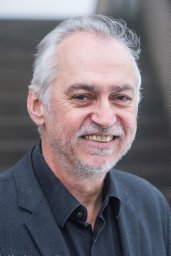
 Bernhard Nebel
· 7 previous affiliations
- University of FreiburgSince 1996
- Emeritus · Since 2022
- Professor · Since 1996
- Current
- Full Professor · 1996–2022
- Universität Ulm1993–1996
- Associate Professor · 1993–1996
- Senior Researcher · 1989–1993
- IBM1988–1989
- Guest Researcher · 1988–1989
- Doktor (Ph.D.), Informatik · 1989
- Technische Universität Berlin1985–1988
- Researcher · 1985–1988
- Universität Hamburg1975–1980
- Diplom-Informatiker, Informatik · 1975–1980
Research Overview
Bernhard Nebel focuses on artificial intelligence planning, knowledge representation, and the computational complexity of reasoning systems. His trajectory spans foundational theoretical work on nonmonotonic logic and planning domain description languages to collaborative applications in autonomous robotics. Most recently, his focus has expanded to include brain-computer interfaces for robotic service assistants.
Research Trajectory
Nebel’s early research investigated the theoretical limits and computational complexity of knowledge representation systems. A significant portion of this foundational work aligns with the research direction of Tractable Reasoning through Syntactic Logic Fragments, exploring how expressive logical frameworks can be constrained to remain computationally feasible. In 1999, as the second author of Preferred Arguments are Harder to Compute than Stable Extension, Nebel and his colleagues analyzed an abstract framework for nonmonotonic reasoning. They extended logic programming semantics—specifically admissible and preferred arguments—to other formalisms like circumscription and default logic. The study demonstrated that credulous reasoning under these newer semantics did not mitigate the computational problems of nonmonotonic reasoning, proving that it shares the same worst-case complexity as standard stable extensions.
During this period, Nebel’s theoretical interests also encompassed temporal reasoning, engaging with the broader area of Tractable Subclasses for Qualitative Temporal Reasoning and the research direction of Enforcing Global Consistency in Temporal Relation Extraction. These themes reflect a sustained focus on managing the computational overhead of complex logical relationships.
In the early 2000s, Nebel’s focus shifted heavily toward artificial intelligence planning, specifically addressing the semantics and efficiency of planning languages. This work connects closely to the theme of Reasoning about Action and Change with Conditional Effects. As the senior researcher and principal investigator, Nebel co-authored the 2003 conference paper In Defense of PDDL Axioms, which was later expanded into the 2005 journal article In defense of PDDL axioms. At the time, there was significant debate in the AI community regarding whether explicit support for PDDL-like axioms and derived predicates was necessary for planners handling real-world domains, with some arguing they should simply be compiled away. Nebel’s team proposed an adequate semantics for these axioms and provided a formal proof that compiling them away is impossible if the growth of plans and domain descriptions is restricted to be polynomial. This theoretical result, backed by experimental confirmation, established that handling axioms natively inside a planner is essential for performance.
By 2010, Nebel’s work began to address the practical challenges of deploying planning systems in dynamic, uncertain environments. As a co-author of Planning and Failure Detection, he contributed to research on how intelligent agents can manage limited perceptions and environmental volatility. The paper explored mechanisms for agents to actively reduce uncertainty through deliberative exploration, cooperation, and the continuous monitoring of failures. This applied perspective on planning also touches upon the broader challenges found in the area of Soft Temporal Constraints for Flexible Scheduling and the theme of Pareto Dominance Pruning for Multi-Objective Search, where rigid classical models must be adapted for messy, real-world execution.
In the late 2010s, Nebel’s trajectory evolved toward highly collaborative, applied robotics. Participating as a middle author in a large research team, he contributed to the development of accessible interfaces for autonomous systems. The 2017 conference paper Acting thoughts: Towards a mobile robotic service assistant for users with limited communication skills introduced a novel framework allowing paralyzed users to interact with a robotic assistant using a closed-loop brain-computer interface (BCI). This research was subsequently matured in the 2019 journal publication A service assistant combining autonomous robotics, flexible goal formulation, and deep-learning-based brain-computer interfacing. The system integrated deep learning for online BCI control, menu-driven language generation based on referring expressions, and modular ROS-based mobile robot interaction, demonstrating a significant shift from abstract planning theory to the physical deployment of assistive technologies.
Current Directions
Based on the most recent papers in the evidence from 2017 and 2019, Nebel’s current research directions center on human-robot interaction and the application of deep learning to assistive technologies. Recent work investigates the integration of brain-computer interfaces with autonomous robotic service assistants. This research addresses the critical challenge of providing reliable control modalities for users with severe motor and communication impairments. By moving beyond traditional touch, speech, or gesture commands, these recent projects focus on closed-loop neural control, flexible goal formulation, and the practical deployment of modular robotic systems in real-world environments.
Profile updated
Loading new papers…
Other researchers whose papers cluster into the same research directions — a proxy for overlapping technical interests and shared intellectual neighborhoods.
See something wrong? Report a mistake