

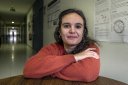
 Beatriz Seoane
· 6 previous affiliations
- Universidad Complutense de MadridSince 2020
- Associate Professor · Since 2024
- Principal Researcher · 2020–2023
- PhD student · 2020–2013
- Máster en Física Fundamental, Física Fundamental · 2008–2009
- Chair Junior Professor · 2023–2024
- Université Paris-Saclay2023–2024
- Principal Researcher · 2023–2024
- Sorbonne Université2018–2020
- Postdoctoral Research Scientist · 2018–2020
- École Normale Supérieure - PSL2015–2018
- Marie Curie fellow · 2015–2018
- Sapienza University of Rome2013–2015
- Postdoc · 2013–2015
Research Overview
Beatriz Seoane focuses on the statistical physics of complex and disordered systems, applying theoretical frameworks from condensed matter to problems in structural biology, epidemiology, and generative machine learning. Her work is centered on the characterization of complex free-energy landscapes, specifically how the dynamics of "sluggish" systems—such as spin glasses and structural glasses—can be modeled and understood through the lens of equilibrium physics and many-body interactions. Recently, she has extended these physical principles to the field of artificial intelligence, developing methods to interpret the internal representations of Restricted Boltzmann Machines (RBMs) and improve their training efficiency through physics-inspired optimization.
Research Trajectory
The early phase of Seoane's research was rooted in the fundamental physics of disordered systems. This work primarily addressed the challenges of materials that fail to reach equilibrium, focusing on the phenomenon of Mapping Glassy Aging to Finite Size Equilibrium. By investigating spin glasses and colloidal systems, she explored how materials "age" over time, evolving their internal structures across vast timescales. A significant portion of this effort was dedicated to understanding Kinetic Arrest as a Barrier to Thermodynamic Phase Transitions, where the kinetic barriers of a system prevent it from reaching its thermodynamically favored crystalline state, resulting in the amorphous structures characteristic of glasses.
In the early 2020s, Seoane transitioned toward applying statistical physics methodologies to high-dimensional biological and epidemiological data. During the COVID-19 pandemic, she developed scaling frameworks to address the limitations of incomplete surveillance data. This work involved Demographic Normalization in Epidemiological Analysis, which is critical for understanding mortality risks across different demographic structures. Her research in this period also addressed the temporal decay of biological signals, such as Correcting Seroreversion Bias in Serological Surveillance, a necessary step for accurate seroprevalence modeling when individual immunity levels decline over time.
Concurrently, Seoane began investigating the role of structural disorder in molecular biology. She explored how atomic flexibility and "soft" disorder within protein structures serve as a roadmap for molecular interactions. This research suggested that disordered regions are not merely structural anomalies but functional components that guide the hierarchical assembly of complex protein chains. This period marked a shift toward using large-scale structural databases to extract statistical patterns of interaction, laying the groundwork for her subsequent focus on generative modeling.
Since 2023, Seoane's work has increasingly focused on the intersection of statistical physics and machine learning. She has specialized in the study of Restricted Boltzmann Machines (RBMs), treating them as physical systems whose parameters can be mapped onto many-body Hamiltonians. This approach seeks to resolve The Log-Likelihood Perceptual Gap, where standard statistical metrics fail to capture the qualitative features learned by a generative model. Her recent contributions include developing Flow Based Sampling for Lattice Field Theory and using the learning dynamics of RBMs to perform unsupervised hierarchical clustering. She has also participated in research regarding associative memories, contributing to the understanding of how power-law feature statistics influence the reconstruction gaps in these models.
Current Directions
Seoane’s current research program is dedicated to the interpretability and optimization of generative neural networks. A primary objective is the "decoding" of RBMs, moving beyond the view of these models as black boxes. By implementing direct mappings between RBM parameters and effective Ising or Potts spin Hamiltonians, her work allows for the extraction of high-order (many-body) interactions from categorical data. This has direct applications in structural biology, where these models can predict protein structural contacts with higher accuracy than traditional pairwise methods.
Another major focus is the technical challenge of training energy-based models on highly structured data. Seoane is developing methods to mitigate the "critical slowdown" associated with second-order phase transitions during the Markov chain Monte Carlo (MCMC) simulations used in RBM training. Her recent work employs convex optimization procedures to integrate the principal directions of a dataset into low-rank RBM architectures, significantly improving sampling speed and accuracy. This line of inquiry aims to bridge the gap between the rigorous theoretical requirements of statistical mechanics and the practical demands of modern machine learning.
Representative Work
Spin glasses, the quantum annealing, colloidal glasses and crystals: exploring complex free-energy landscapes This foundational work explores the complex free-energy landscapes of disordered materials. It examines the "sluggish" dynamics of systems that refuse to reach equilibrium, providing a comprehensive analysis of how spin glasses and colloidal glasses navigate their internal states. The research emphasizes the interplay between quantum annealing and classical glassiness, establishing the theoretical basis for Seoane's later work in complex system modeling.
A scaling approach to estimate the COVID-19 infection fatality ratio from incomplete data In this first-author study, Seoane identifies a universal scaling law in the age-specific fatality rates of SARS-CoV-2. By applying this scaling framework, the paper bypasses the biases inherent in early-pandemic testing data to provide more robust estimates of the Infection Fatality Ratio (IFR). The work highlights the significant under-reporting of deaths among elderly populations and demonstrates the utility of statistical physics in public health crises.
The complexity of protein interactions unravelled from structural disorder This research analyzes over 130,000 protein structures to demonstrate that regions of high atomic flexibility—referred to as soft structural disorder—act as dynamic templates for protein-protein interactions. As the lead author, Seoane shows that these flexible zones predict binding sites and influence the sequential order of complex molecular assembly, suggesting that disorder is a key regulatory mechanism in biological systems.
Report on 2309.02292v2 Serving as the senior author, Seoane provides a mathematical framework to translate the parameters of Restricted Boltzmann Machines into the language of many-body physics. This paper addresses the interpretability problem in generative modeling by offering a precise recipe to map neural network weights onto physical Hamiltonians, allowing researchers to understand exactly what a model has learned about the underlying data distribution.
Fast, accurate training and sampling of Restricted Boltzmann Machines This paper introduces an innovative training method for RBMs that addresses the critical slowdown often encountered when modeling highly structured data. As the senior author, Seoane presents a convex optimization procedure that integrates the principal directions of a dataset into a low-rank RBM. This approach enables more effective mixing of MCMC simulations, leading to faster and more accurate generative modeling.
On the role of non-linear latent features in bipartite generative neural networks In this senior-author publication, Seoane investigates the statistical physics of disordered systems as applied to bipartite generative networks. The study provides a rigorous analysis of why certain RBM architectures are more effective at capturing and retaining complex data features. By examining the role of non-linear latent features, the work contributes to the theoretical understanding of memory and generalization in neural networks.
Profile updated
Loading new papers…
Other researchers whose papers cluster into the same research directions — a proxy for overlapping technical interests and shared intellectual neighborhoods.
See something wrong? Report a mistake