

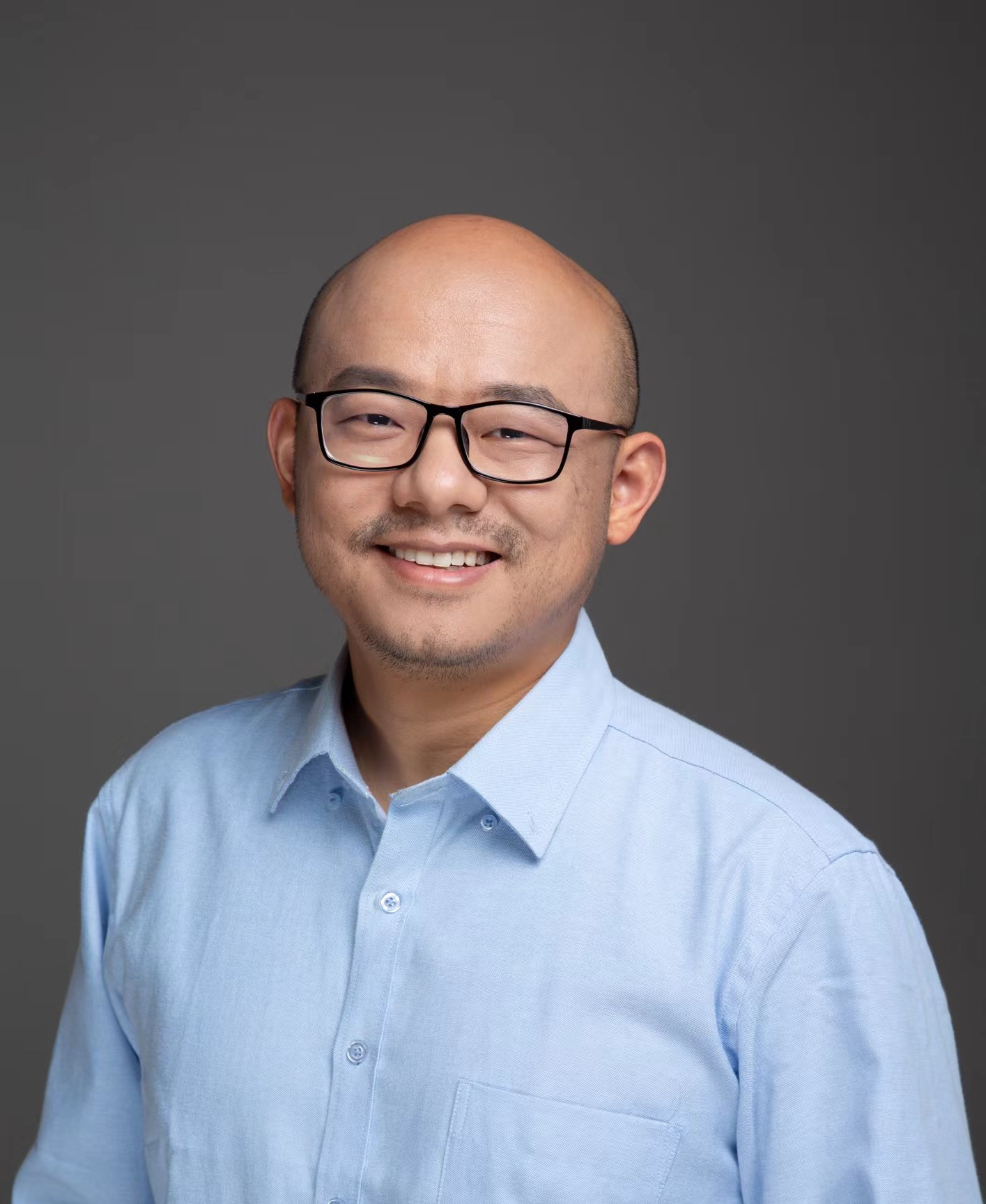
 Baojian Zhou
· 4 previous affiliations
- Fudan UniversitySince 2020
- Assistant Professor · Since 2020
- Stony Brook University2020–2021
- Postdoc · 2020–2021
- PhD student · 2014–2020
- Beihang University2011–2014
- MS student · 2011–2014
Research Overview
Baojian Zhou focuses on large-scale graph mining, mathematical optimization, and machine learning. His trajectory spans from graph-structured sparse optimization and online decision-making to the development of sublinear local algorithms for massive networks. Most recently, his work investigates accelerated iterative solvers for graph diffusion and the application of large language models to numerical computation.
Research Trajectory
Baojian Zhou's early research concentrated on sparsity-constrained optimization, particularly when the underlying constraints are defined by complex graph structures. In 2016, he and his collaborators introduced A Generalized Matching Pursuit Approach for Graph-Structured Sparsity, presenting an efficient approximation algorithm—GRAPH-MP—for optimizing general nonlinear functions subject to graph-structured sparsity models. This work contributed to the broader research direction of Adaptive Sparse Estimation with Unknown Sparsity. During the same period, he explored related applications in Graph-Structured Sparse Optimization for Connected Subgraph Detection. Recognizing the need to scale these methods for increasingly large datasets, he subsequently developed Stochastic Iterative Hard Thresholding for Graph-structured Sparsity Optimization (2019), which leveraged cheap per-iteration updates to make graph-structured sparsity optimization amenable to large-scale data analysis.
Expanding into high-dimensional online learning, Zhou addressed the challenges of imbalanced classification in streaming data. He proposed a novel algorithm, FTRL-AUC, in Online AUC Optimization for Sparse High-Dimensional Datasets (2020) to directly optimize the Area Under the ROC Curve (AUC) while maintaining sparse solutions and low per-iteration costs. He later returned to the theoretical foundations of this metric in Does It Pay to Optimize AUC? (2023), proving that linear AUC optimization is NP-complete and demonstrating that exact optimization on training data does not always yield better test-set performance than standard regularized classifiers.
In parallel, Zhou's focus expanded to the dynamics and geometry of massive networks. To track the evolution of specific entities across millions of documents, he developed the DynamicPPE framework in Subset Node Representation Learning over Large Dynamic Graphs (2021), advancing the research area of Temporal Alignment for Dynamic Graph Embeddings. He also investigated projection-free optimization techniques, introducing inner-product-based approximations in Approximate Frank-Wolfe Algorithms over Graph-structured Support Sets (2022) to achieve accelerated convergence rates for NP-hard sub-problems.
By 2023 and 2024, a major theme of Zhou's work became the design of sublinear local algorithms for massive graphs. He tackled the computational bottlenecks of exact matrix inversions in Fast Online Node Labeling for Very Large Graphs (2023), utilizing a generalized local push approximation to achieve microsecond-level prediction speeds. This approach intersected with the broader area of Variance Reduction for Stochastic Graph Neural Networks. He continued to optimize fundamental graph metrics in Accelerating Personalized PageRank Vector Computation (2023). Building on these local computation strategies, he and his collaborators introduced a framework for localizing graph diffusion solvers in Faster Local Solvers for Graph Diffusion Equations (2024), achieving significant speedups by restricting computation to small, active subsets of nodes. This was further formalized in Iterative Methods via Locally Evolving Set Process (2024), which allowed standard iterative solvers like Chebyshev and Heavy-Ball to operate locally on massive graphs without requiring monotonic residual reduction.
Current Directions
The most recent papers in the evidence indicate a dual focus on accelerating fundamental graph algorithms and exploring the numerical capabilities of large language models. In the area of The Computational Cost of High Precision, Zhou's group introduced the Accelerated Evolving Set Processes (AESP) framework in Accelerated Evolving Set Processes for Local PageRank Computation (2025). This work achieves provable acceleration for local Personalized PageRank computation, improving the dependence on the damping factor while maintaining sublinear time complexity independent of the total graph size.
Concurrently, his research has expanded into scientific computing with From Text to Trajectories: GPT-2 as an ODE Solver via In-Context (2025). This work demonstrates that transformer models can function as high-performance numerical solvers for Ordinary Differential Equations, learning meta-algorithms through in-context learning that rival classical methods in stability and generalization.
Profile updated
Loading new papers…
Other researchers whose papers cluster into the same research directions — a proxy for overlapping technical interests and shared intellectual neighborhoods.
See something wrong? Report a mistake