

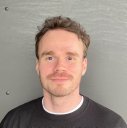
 Bálint Máté
· 5 previous affiliations
- Angstrom AICurrent
- Current
- Intern · 2025
- University of Geneva2020–2024
- PhD student · 2020–2024
- Intern · 2024
- Intern · 2023
Research Overview
Bálint Máté focuses on generative modeling, sampling techniques, and free-energy estimation for complex physical systems. His trajectory bridges foundational machine learning methods, such as normalizing flows and continuous generative models, with applications in quantum field theory and molecular dynamics. His most recent work investigates the intersection of diffusion models and thermodynamic integration to accelerate the simulation of molecular systems and chemical reactions.
Research Trajectory
Early work addressed foundational algorithmic efficiency in machine learning. With collaborators, he introduced Priming PCA with EigenGame, presenting a two-step algorithm that accelerates approximate Principal Component Analysis. By utilizing a preliminary approximation to find a rough subspace before performing exact PCA within that lower-dimensional space, the method achieves significant speedups over existing rules without sacrificing accuracy.
His focus subsequently expanded to generative modeling architectures with Flowification: Everything is a normalizing flow. This work enriches standard neural network architectures with a stochastic inverse pass, addressing the traditional limitations of neural networks which typically lack a notion of an inverse or a likelihood contribution. This architectural flexibility contributes to the research area of Spectral Parameterization for Deep Learning.
A major thematic shift occurred toward sampling from unnormalized energy functions, particularly Boltzmann distributions. In Deformation Theory of Boltzmann Distributions, he studied how to sample from a target distribution by first sampling from an initial distribution and applying a transformation. By deriving an equation that relates this transformation to a family of unnormalized log-likelihoods, the work demonstrated improved performance in learning Boltzmann distributions for lattice field theories, touching on the broader area of Gaussian Closed Forms for Entropic Optimal Transport.
This theoretical foundation was expanded in Learning Deformation Trajectories of Boltzmann Densities and Learning Interpolations between Boltzmann Densities. These papers introduce training objectives for continuous normalizing flows that operate entirely without samples, relying instead on an energy function. By interpolating between a target energy and a generalized Gaussian, the method finds a time-dependent vector field that transports samples along a family of densities while satisfying the continuity equation. This significantly advanced the research direction of Generative Modeling from Unnormalized Energy Functions and the related area of Robust Variational Objectives for Multimodal Target Distributions.
Parallel to his work in generative modeling, he explored alternative neural network training paradigms and physics simulations. He participated in extending the Forward-Forward algorithm to graph-structured data in Graph Neural Networks Go Forward-Forward, offering a greedy, layer-by-layer alternative to backpropagation that aligns with the research area of Local Plasticity for Biologically Plausible Deep Learning. Additionally, he collaborated on SUPA: A Lightweight Diagnostic Simulator for Machine Learning in Particle Physics, developing a surrogate particle propagation simulator to provide simpler, interpretable benchmarks for high-energy physics modeling.
Returning to fundamental physics applications, he framed the sampling of discrete field configurations as an operator learning task in Multi-Lattice Sampling of Quantum Field Theories via Neural Operator-based Flows. By approximating a time-dependent operator to map functional distributions, this work provides new mechanisms for sampling quantum field theories, contributing to the area of Accelerating Lattice Field Theory with Generative Flows.
More recently, the trajectory has centered on computational chemistry and molecular dynamics. He developed methods combining physics-based thermodynamic integration with neural networks in Solvation Free Energies from Neural Thermodynamic Integration and Neural Thermodynamic Integration: Free Energies from Energy-based Diffusion Models. These works use energy-based diffusion models to learn alchemical pathways via score matching, significantly reducing the computational cost of estimating free energy differences and solvation free energies in systems like Lennard-Jones fluids and aqueous solutions.
Continuing this focus on molecular systems, he contributed to Enhancing Diffusion-Based Sampling with Molecular Collective Variables, which introduces the Well-Tempered Adjoint Schrödinger Bridge Sampler. By integrating diffusion-based machine learning with classical enhanced sampling techniques, the method applies a repulsive bias to steer samplers away from previously visited states, accelerating the discovery of rare molecular configurations and enabling the simulation of complex chemical reactions.
Current Directions
The most recent work in the evidence focuses on the intersection of generative AI and computational chemistry, specifically targeting the accelerated simulation of molecular systems. A primary theme is the use of energy-based diffusion models to estimate free energy differences and solvation free energies, modernizing traditional thermodynamic integration with neural networks. Additionally, current research investigates enhanced sampling techniques that combine diffusion models with classical biasing methods to efficiently explore complex probability landscapes. This approach aims to overcome the timescale limitations of standard molecular dynamics, enabling the accurate simulation of rare events such as bond breaking and complex chemical reactions.
Profile updated
Loading new papers…
Other researchers whose papers cluster into the same research directions — a proxy for overlapping technical interests and shared intellectual neighborhoods.
See something wrong? Report a mistake