

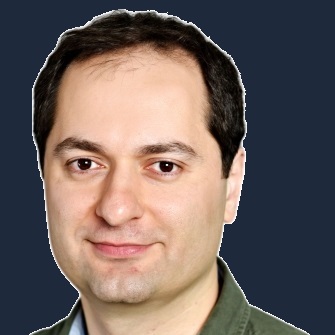
 Babak Taati
· 6 previous affiliations
- KITE Research InstituteSince 2012
- Barbara G. Stymiest Chair in Rehabilitation Technology Research · Since 2025
- Senior Scientist · Since 2023
- Principal Researcher · Since 2012
- University of TorontoSince 2012
- Associate Professor, Affiliated Scientist · Since 2023
- Associate Professor · 2012–2023
- Computer Science - Computer Vision · 2007–2008
- Associate Professor · Since 2023
- Assistant Professor · 2017–2023
- University Health Network2012–2023
- Scientist · 2012–2023
- AMS Healthcare2021
- AMS Healthcare Fellow · 2021
- Queen's University2003–2008
- Ph.D., Computer Vision · 2003–2008
Research Overview
Babak Taati focuses on computer vision, machine learning, and their applications in healthcare and rehabilitation. His early work developed robust local shape descriptors for object recognition, which evolved into a sustained focus on automated health monitoring for older adults, particularly those with dementia. His current research investigates generative AI and synthetic data to improve algorithmic fairness and clinical reasoning in medical vision systems.
Research Trajectory
His early research in computer vision focused on 3D object recognition and pose determination. He introduced highly descriptive, high-dimensional local shape descriptors to establish point correspondences and recover poses in range data, detailing this approach in Variable Dimensional Local Shape Descriptors for Object Recognition in Range Data.
By the late 2010s, his focus shifted toward the intersection of computer vision and clinical healthcare, specifically addressing the needs of older adults and individuals with neurological disorders. Recognizing that standard vision models often fail on clinical populations, he investigated performance disparities in Limitations and Biases in Facial Landmark Detection D An Empirical Study on Older Adults with Dementia.. This critical evaluation paved the way for developing specialized, unobtrusive monitoring systems for long-term care settings. To address the challenge of recognizing pain in patients who cannot self-report, he developed automated assessment tools in Unobtrusive Pain Monitoring in Older Adults With Dementia Using Pairwise and Contrastive Training. Expanding this effort to other conditions, his group released a public dataset and evaluated convolutional neural networks for analyzing oro-facial gestures in patients with amyotrophic lateral sclerosis (ALS) and stroke in A New Dataset for Facial Motion Analysis in Individuals With Neurological Disorders.
Moving beyond facial analysis, he expanded his clinical vision research to encompass full-body motion and gait. He leveraged spatial-temporal graph convolutional networks (ST-GCNs) with self-supervised pretraining to predict clinical scores from video in Estimating Parkinsonism Severity in Natural Gait Videos of Older Adults With Dementia. To improve the underlying pose estimation technology required for these assessments, he designed a hybrid architecture that captures both global and local joint dependencies in MotionAGFormer: Enhancing 3D Human Pose Estimation with a Transformer-GCNFormer Network. These methodological improvements directly informed applied clinical systems, such as the predictive models developed in Ambient Monitoring of Gait and Machine Learning Models for Dynamic and Short-Term Falls Risk Assessment in People With Dementia, which utilize longitudinal mobility data to estimate short-term fall risks in long-term care residents.
Recently, his work has heavily emphasized generative AI to overcome the chronic data scarcity and demographic biases inherent in medical datasets. Contributing to the broader research direction of Bridging the Pathological Domain Gap in Motion Analysis, he developed GAITGen: Disentangled Motion-Pathology Impaired Gait Generative Model - Bringing Motion Generation to the Clinical Domain. This framework generates realistic 3D gait sequences by disentangling general motion dynamics from Parkinson's-specific symptoms. He applied similar generative strategies to facial pain assessment, creating large-scale, demographically balanced synthetic datasets to train fairer clinical models. This is detailed in SynPAIN: A Synthetic Dataset of Pain and Non-Pain Facial Expressions and further advanced using 3D facial modeling and diffusion models in Pain in 3D: Generating Controllable Synthetic Faces for Automated Pain Assessment.
In parallel with his clinical applications, he continues to advance core computer vision and foundation model architectures, focusing on efficiency and reasoning. He proposed a unified, computationally efficient approach to visual attention modeling using long-range state space models in SUM: Saliency Unification through Mamba for Visual Attention Modeling. To improve generative models without additional training, he introduced Token Perturbation Guidance for Diffusion Models, a plug-and-play method that shuffles intermediate representations during inference. Addressing the quadratic scaling costs of Vision-Language Models (VLMs), he demonstrated that dropping similar tokens outperforms merging strategies in Similarity-Aware Token Pruning: Your VLM but Faster. His recent work also explores reinforcement learning for visual reasoning; in Puzzle Curriculum GRPO for Vision-Centric Reasoning, he utilized self-supervised puzzles to boost VLM reasoning without human-curated labels. Further optimizing inference, he developed LoopFormer: Elastic-Depth Looped Transformers for Latent Reasoning via Shortcut Modulation, allowing models to dynamically adjust computational effort based on a user-defined budget. Additionally, he collaborated on full-scene image restoration techniques, utilizing facial degradation as a perceptual cue in Face2Scene: Using Facial Degradation as an Oracle for Diffusion-Based Scene Restoration.
Taati's recent efforts increasingly target inference efficiency and resolution extrapolation across Diffusion Transformers (DiTs) and multimodal foundation models. For high-resolution generation with DiTs, they developed AReA: Adaptive Receptive-Field Attention for Efficient High-Resolution Diffusion Transformers, a training-free attention mechanism whose receptive field contracts from global downsampling to shrinking local windows as denoising proceeds, and SEGA: Spectral-Energy Guided Attention for Resolution Extrapolation in Diffusion Transformers, which dynamically scales attention across positional embedding components guided by the latent's spatial-frequency structure. They also contributed to accelerating DiT sampling through frequency-domain prediction in SpecKCast: Spectral Kalman Forecasting for Diffusion Acceleration, using discrete cosine transforms and Kalman filters to forecast intermediate outputs. In the multimodal realm, Taati co-developed AVIS: Adaptive Test-Time Scaling for Vision–Language Models to jointly optimize visual token pruning and test-time reasoning rollouts per query, and introduced SCOPD: Sparse-Context On-Policy Self-Distillation for Efficient Vision-Language Models, which trains pruned student models using on-policy self-distillation from full-context teacher supervision to bridge the gap between visual token retention and reasoning utilization.
Current Directions
The most recent papers in the evidence highlight two primary research directions. First, he is actively investigating the use of generative AI and synthetic data to augment clinical datasets. By utilizing diffusion models and 3D modeling to generate controllable, demographically balanced synthetic faces and pathological gait sequences, this work aims to mitigate algorithmic bias and improve the robustness of automated health assessments for older adults and non-verbal patients.
Second, they develop more efficient and capable architectures for core vision and multimodal reasoning tasks. This includes designing dynamic attention mechanisms and frequency-domain forecasting to scale and accelerate Diffusion Transformers, as well as adaptive pruning and self-distillation strategies that lower the inference and test-time scaling costs of Vision-Language Models.
Profile updated
Loading new papers…
Other researchers whose papers cluster into the same research directions — a proxy for overlapping technical interests and shared intellectual neighborhoods.
See something wrong? Report a mistake