

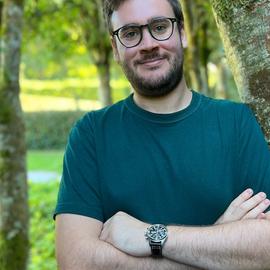
 Athanasios Vlontzos
· 9 previous affiliations
- Hologen AISince 2026
- Researcher · Since 2026
- HologenSince 2026
- Senior Research Scientist · Since 2026
- Monzo Bank UKCurrent
- Current
- Researcher · 2025–2026
- Monzo Bank2025–2026
- Lead AI / Machine Learning Scientist · 2025–2026
- Spotify (Sweden)2022–2025
- Researcher · 2022–2025
- Zeit Medical2019–2022
- Advisor to the CEO · 2021–2022
- Principal Researcher · 2019–2022
- Imperial College London2014–2022
- Teaching Scholar · 2018–2022
- Master's Degree, Electrical and Electronics Engineering · 2014–2018
- Researcher · 2020
- Researcher · 2017
Research Overview
Athanasios Vlontzos focuses on the intersection of causal inference, medical image analysis, and deep learning. His early work developed probabilistic and reinforcement learning methods for computer vision tasks, before shifting toward embedding causal structures and physical constraints into neural networks. Currently, he investigates counterfactual inference and the identifiability of causal effects in the presence of latent confounding.
Research Trajectory
Athanasios Vlontzos began his research trajectory with a strong focus on medical image analysis and computer vision, developing novel deep learning techniques to extract structural information from complex data. He introduced a multi-agent reinforcement learning approach for anatomical landmark detection in Multiple Landmark Detection using Multi-Agent Reinforcement Learning. By utilizing a Deep Q-Network (DQN) architecture with implicit inter-communication, this work leveraged the interdependent nature of human anatomy to automate a traditionally tedious annotation process. He also explored probabilistic methods to reconstruct volumetric images from 2D projections in 3D Probabilistic Segmentation and Volumetry from 2D Projection Images, utilizing fast end-to-end training of 2D-3D convolutional networks to recover vital diagnostic biomarkers lost during standard X-ray imaging. Around this time, he contributed to unsupervised methods for human pose estimation across varying body compositions, such as infants and adults, framing the task as a learnable template matching problem in Unsupervised Human Pose Estimation Through Transforming Shape Templates.
Expanding beyond standard vision tasks, he investigated the mathematical properties of data representations, using persistent homology to preserve database hierarchy and connectivity in Topological Data Analysis of Database Representations for Information Retrieval. Concurrently, his focus shifted toward integrating physical and causal constraints into machine learning models. He proposed a theoretical framework for causal future prediction by embedding spatiotemporal information into a Minkowski space-time in Causal Future Prediction in a Minkowski Space-Time. This approach utilized the concept of a light cone from special relativity to restrict and traverse the latent space, demonstrating applications in causal image synthesis and video frame prediction.
He subsequently formalized the application of causal analysis to medical imaging to address natural biases, domain shifts, and dataset curation challenges. This included a systematic review of the field through the lens of Technology Readiness Levels in A Review of Causality for Learning Algorithms in Medical Image Analysis and an investigation into the causal effects of dataset interventions on image classification performance in Is More Data All You Need? A Causal Exploration.
A major theme of his subsequent research has been counterfactual inference and the development of architectures that respect causal mechanisms. He introduced "deep twin networks" to learn causal mechanisms that satisfy counterfactual ordering in Estimating the probabilities of causation via deep monotonic twin networks, work that intersects with hybrid training ratios for robust neural networks. He later extended this architecture to handle categorical variables in Estimating categorical counterfactuals via deep twin networks, addressing the challenge of ensuring trustworthy counterfactual inference when causal mechanisms cannot be uniquely determined from observations alone. Continuing in the domain of visual synthesis, he participated in a large-scale evaluation of generative models in Benchmarking Counterfactual Image Generation. This collaborative effort examined how well image modifications respect underlying causal constraints in the absence of observable ground truths, contributing to broader efforts in causal algorithmic recourse, scaling generative models, and embedding causal structures into neural network architectures.
His most recent work investigates the theoretical limits and identifiability of causal estimates. In The Hardness of Validating Observational Studies with Experimental Data, he and his collaborators proved fundamental limits on the ability to use small-scale experimental data to correct biases in large observational datasets. This research advances multi-head architectures for individual treatment effect estimation and contributes directly to the broader research area of Learning Individual Treatment Effects Under Counterfactual Unobservability. Further addressing unobserved confounding, he contributed to Identifiable Estimation of Causal Concept Effects under Visual Latent Confounding. This work formalized visual latent confounding and introduced a latent-variable model to learn identifiable confounder representations from images, enabling more accurate auditing of classifiers.
Current Directions
The most recent papers in the evidence address the theoretical and practical challenges of causal inference under unobserved confounding. Recent work investigates the fundamental limits of supplementing observational data with experimental trials, exploring when and how causal effect estimates can be falsified using the framework of impossible inference. Additionally, he is focused on the identifiability of causal concept effects in computer vision. By developing latent-variable models to capture high-dimensional visual signatures that act as confounders, this line of research aims to improve the auditing of classifiers and the assessment of bias in complex image datasets.
Profile updated
Loading new papers…
Other researchers whose papers cluster into the same research directions — a proxy for overlapping technical interests and shared intellectual neighborhoods.
See something wrong? Report a mistake