

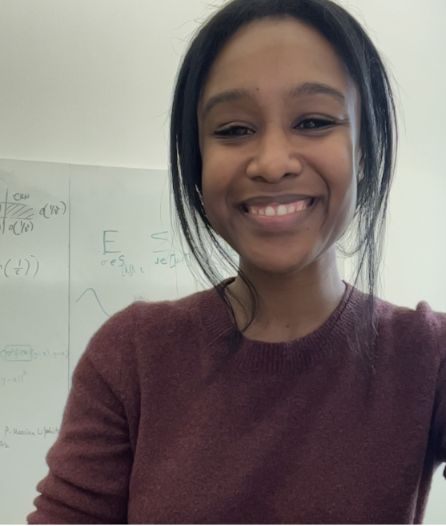
 Ashia C. Wilson
· 3 previous affiliations
- Massachusetts Institute of TechnologySince 2021
- Assistant Professor · 2021–2028
- Microsoft Research Asia (China)2018–2020
- Postdoc · 2018–2020
- PhD student · 2012–2018
Research Overview
Ashia C. Wilson focuses on optimization, machine unlearning, and the evaluation of algorithmic fairness and reliability. Her early work explored scalable Bayesian inference and the continuous-time dynamics of accelerated optimization methods. More recently, her research addresses the societal impacts of machine learning, emphasizing privacy-preserving algorithms, robust clinical evaluation, and the mitigation of algorithmic homogenization.
Research Trajectory
Early in her career, Wilson participated in the area of Scalable Bayesian Inference via Stochastic Gradient MCMC. With collaborators, she co-authored Streaming Variational Bayes (2013), introducing the SDA-Bayes framework for the streaming, distributed, and asynchronous computation of Bayesian posteriors. She subsequently led research on optimization dynamics, publishing The Marginal Value of Adaptive Gradient Methods in Machine Learning (2017). This work demonstrated that adaptive optimization methods, such as Adam and AdaGrad, can find drastically different and sometimes less generalizable solutions compared to standard stochastic gradient descent in overparameterized settings.
Wilson later deepened the theoretical understanding of accelerated optimization. In A Lyapunov Analysis of Accelerated Methods in Optimization (2022), she established an equivalence between Nesterov's estimate sequences and a family of Lyapunov functions in both continuous and discrete time, simplifying the analysis of optimal convergence properties. She expanded on this continuous-time perspective in A variational perspective on accelerated methods in optimization (2022), introducing the "Bregman Lagrangian" to show how various accelerated algorithms arise from discretizing a common underlying continuous-time dynamic.
Around the same time, Wilson began significant work in data deletion, contributing to research directions such as Certified Machine Unlearning via Weight Perturbation, Scalable Data Deletion via Approximate Machine Unlearning, and Data Influence Functions for Parameter Estimation. In collaboration, she developed Algorithms that Approximate Data Removal: New Results and Limitations (2022), which provided a memory-efficient online unlearning algorithm targeting empirical risk minimization models with non-smooth regularizers. Her group has continued to investigate vulnerabilities in generative models, specifically in the area of Overcoming Hyperparameter Sensitivity in Machine Unlearning. The paper Unstable Unlearning: The Hidden Risk of Concept Resurgence in Diffusion Models (2025) revealed that successfully unlearned concepts can reappear after subsequent fine-tuning on unrelated data, posing challenges for AI alignment.
In parallel with her work on unlearning, Wilson's lab has advanced privacy-preserving machine learning. In The Gaussian Mixing Mechanism: Renyi Differential Privacy via Gaussian Sketches (2025), her team provided a tighter privacy analysis for Gaussian sketching under Rényi Differential Privacy, yielding faster and more accurate private baselines for linear and logistic regression. She furthered this research with Near-Optimal Private Linear Regression via Iterative Hessian Mixing (2026), introducing an algorithm that combines iterative optimization with Gaussian sketching to achieve tighter theoretical error bounds by removing dimension-dependent factors. Her ongoing interest in optimization also led to Adaptive acceleration without strong convexity priors or restarts (2025), which introduced NAG-free, an algorithm capable of adaptively estimating strong convexity parameters to improve convergence rates.
A major theme of Wilson's recent trajectory focuses on algorithmic fairness, evaluation, and societal impact. Her group addressed resource allocation in Position: Scarce Resource Allocations That Rely On Machine Learning Should Be Randomized (2024), arguing that deterministic top-k algorithms are fundamentally unfair and proposing weighted randomization to reduce systemic exclusion. She also explored the reliability of language models in As an AI Language Model, “Yes I Would Recommend Calling the Police”: Norm Inconsistency in LLM Decision-Making (2025), highlighting demographic biases and norm inconsistencies in LLM recommendations for high-stakes scenarios.
Critiquing standard evaluation metrics, her lab published Aligning Evaluation with Clinical Priorities: Calibration, Label Shift, and Error Costs (2025), which introduced the Bounded DCA Log Score to better reflect clinical realities like shifting disease prevalences and asymmetric error costs. This consequentialist approach to evaluation was formalized more broadly in A Consequentialist Critique of Binary Classification Evaluation: Theory, Practice, and Tools (2026), advocating for proper scoring rules over traditional metrics like accuracy and AUC-ROC. Finally, addressing AI safety at scale, her team developed novel assessment methods in Evaluation without Generation: Non-Generative Assessment of Harmful Model Specialization with Applications to CSAM (2026), utilizing Gaussian probing of internal model activations to detect harmful fine-tuning without the risks of generating illicit material.
Current Directions
The most recent papers in the evidence indicate a strong focus on the rigorous evaluation of machine learning models and the development of privacy-preserving algorithms. Recent work investigates the alignment of evaluation metrics with real-world consequences, particularly in high-stakes domains like clinical diagnostics and binary classification. This includes designing bounded scoring rules that explicitly account for asymmetric error costs, calibration, and shifting prevalences. Additionally, current research addresses AI safety and differential privacy, focusing on non-generative methods to probe models for harmful specialization and advancing iterative optimization techniques to improve the utility and theoretical bounds of private linear regression.
Profile updated
Loading new papers…
Other researchers whose papers cluster into the same research directions — a proxy for overlapping technical interests and shared intellectual neighborhoods.
See something wrong? Report a mistake