

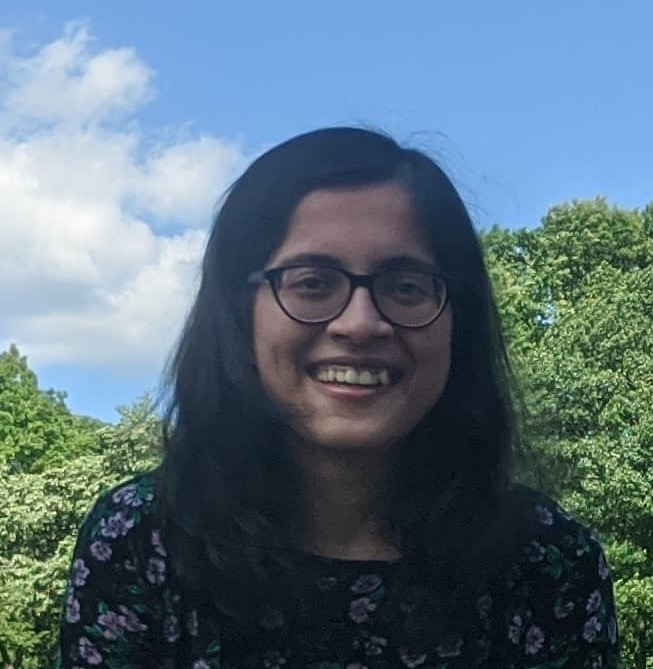
 Arundhati Banerjee
· 3 previous affiliations
- Amazon (United States)Since 2025
- Researcher · Since 2025
- Current
- Carnegie Mellon University2019–2025
- PhD student · 2019–2025
- Undergrad student · 2014–2019
Research Overview
Arundhati Banerjee focuses on multi-agent systems, active search algorithms, and adaptive mechanism design. Her work addresses the challenges of decentralized decision-making and uncertainty in robotic exploration, while also developing meta-learning frameworks to align the behavior of strategic agents. Recently, she has concentrated on robust, few-shot adaptable mechanisms for complex multi-agent environments.
Research Trajectory
In 2022, Banerjee investigated the complexities of autonomous agents locating targets in unknown environments, a domain known as active search. A primary challenge in this area is managing the trade-offs between exploration, exploitation, and the operational costs of sensing actions. In Cost Aware Asynchronous Multi-Agent Active Search, she introduced an online algorithm that enables agents to make adaptive, cost-aware decisions. By integrating principles from Thompson Sampling for search space exploration with Monte Carlo methods, this approach facilitates decentralized multi-agent decision-making without relying on the myopic heuristics that often limit traditional active search models.
Alongside cost considerations, active search systems must navigate multiple forms of environmental ambiguity. In Multi-Agent Active Search using Detection and Location Uncertainty, Banerjee addressed the tendency of prior robotics research to engineer away detection uncertainty by thresholding probabilities to zero or one. Her work explicitly modeled both detection and location uncertainty, allowing agents to adapt more robustly to their observation histories during critical tasks such as search and rescue missions or wildlife patrolling. Further expanding on decentralized coordination, she collaborated on Decentralized Multi-Agent Active Search for Sparse Signals, which focused on aerial robots detecting sparse targets like gas leaks or radiation sources. This research proposed algorithms that allow multiple robots to independently make data-collection decisions, circumventing the connectivity maintenance issues that frequently disrupt centrally coordinated systems.
In 2023, Banerjee's research expanded to encompass mechanism design, specifically exploring how rules and rewards can be structured to shape the behavior of intelligent agents in settings like auctions or economic simulations. This work contributes to the broader research direction of Learning and Incentives for Strategic Agents. In MERMADE: $K$-shot Robust Adaptive Mechanism Design via Model-Based Meta-Learning, she developed a framework to address the reality that real-world agents often learn and behave differently than simulated counterparts. The MERMADE framework allows a mechanism designer to create robust, cost-efficient rules that generalize to agents with unseen learning strategies using only a few observations.
She extended these concepts in MERMAIDE: Learning to Align Learners using Model-Based Meta-Learning, which investigates how a principal can efficiently intervene on the rewards of a previously unseen learning agent to induce desirable outcomes. This research aligns with the area of Meta-Reinforcement Learning for Fast Multi-Agent Adaptation. By minimizing the number of costly interventions required, the MERMAIDE approach trains a principal to quickly adapt to out-of-distribution agents, providing a critical capability for real-world applications where the principal may not know the exact learning behavior or internal rewards of the participants.
Returning to the physical domain of robotic exploration, Banerjee also advanced her earlier work on decentralized systems. In Decentralized and Asynchronous Multi-Agent Active Search and Tracking when Targets Outnumber Agents, she introduced DecSTER, an algorithm designed for scenarios where the number of targets exceeds the number of searching agents. This work, which intersects with the research direction of Posterior Sampling for Exploration in Reinforcement Learning, effectively balances the exploration of unknown areas with the exploitation of known target information in a fully asynchronous manner, outperforming existing methods in simulated environments.
Current Directions
The most recent papers in the evidence, published in 2023, indicate a dual focus on aligning the behavior of independent learning agents and scaling decentralized search algorithms. In the domain of mechanism design, current work investigates how model-based meta-learning can be used to create robust, few-shot adaptable interventions. These frameworks aim to guide out-of-distribution agents toward desirable outcomes without requiring exhaustive knowledge of their internal reward structures or learning strategies. Concurrently, in the realm of physical multi-agent systems, recent efforts address the complexities of asynchronous search and tracking, particularly in resource-constrained environments where targets outnumber the available autonomous agents.
Profile updated
Loading new papers…
Other researchers whose papers cluster into the same research directions — a proxy for overlapping technical interests and shared intellectual neighborhoods.
See something wrong? Report a mistake