

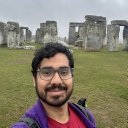
 Arnab Maiti
· 5 previous affiliations
- GigaSince 2026
- Research Engineer · Since 2026
- University of WashingtonSince 2022
- PhD student · 2022–2027
- Current
- Visiting Researcher · 2024
- Dual Degree (Bachelors+Masters), Computer Science and Engineering · 2017–2022
- Undergraduate Representative · 2021–2022
- Research Project · 2019–2022
- Research Project · 2019–2022
Research Overview
Arnab Maiti focuses on the design and analysis of algorithms at the intersection of game theory and learning theory. His trajectory spans foundational work in multi-armed bandits and computational social choice to the sample complexity of finding equilibria in matrix games. Recently, his research investigates multi-agent learning dynamics, bandit feedback, and equilibrium computation in complex strategic environments.
Research Trajectory
His early algorithmic work explored memory-constrained learning environments. In 2021, he established tight guarantees for regret minimization and best-arm identification in Multi-Armed Bandits with Bounded Arm-Memory: Near-Optimal Guarantees for Best-Arm Identification and Regret Minimization, notably proving an $\Omega(T^{2/3})$ cumulative regret lower bound for single-pass algorithms. Following this, his research addressed computational social choice and fair resource allocation. In Universal and Tight Online Algorithms for Generalized-Mean Welfare, he and his collaborators introduced a unified algorithmic framework for the online fair division of divisible goods, aiming to maximize p-mean welfare. This work contributed to the broader area of Nash Social Welfare Maximization.
By 2023, the trajectory moved deeply into game theory, specifically focusing on the sample and query complexity of finding equilibria in two-player zero-sum matrix games. He investigated the query complexity of identifying all Nash equilibria in Query-Efficient Algorithms to Find the Unique Nash Equilibrium in a Two-Player Zero-Sum Matrix Game, seeking to bridge the gap between known $\Omega(n^2)$ lower bounds for general matrices and $O(n)$ bounds for special classes. Expanding on the dynamics of game convergence, he derived instance-dependent bounds that order game matrices by their convergence rates under a stochastic observation model in Instance-dependent Sample Complexity Bounds for Zero-sum Matrix Games. Addressing environments with noisy feedback, he explored the theoretical boundaries of equilibrium computation in On the Limitations and Possibilities of Nash Regret Minimization in Zero-Sum Matrix Games under Noisy Feedback, work that intersects with the research direction of Two-Phase Strategies for Complex Bandit Optimization.
In 2024, he continued to refine the sample complexity of identifying pure strategy Nash equilibria under noise, presenting a near-optimal algorithm in Near-Optimal Pure Exploration in Matrix Games: A Generalization of Stochastic Bandits & Dueling Bandits. His interest in query complexity also extended to social choice theory, specifically finding the optimal set of vertices in implicitly defined tournaments, as detailed in Query complexity of tournament solutions. Concurrently, he investigated cooperation in networked systems through the lens of the Binary Networked Public Goods Game. This included analyzing the computational complexity of finding stable outcomes in On Parameterized Complexity of Binary Networked Public Goods Game and incorporating player altruism to predict behavior on specific network structures, such as trees and complete graphs, in On Binary Networked Public Goods Game with Altruism.
Moving into 2025 and 2026, his work increasingly tackles complex learning dynamics and adversarial environments. He proposed a computationally efficient algorithm for minimizing regret against adaptive adversaries in Efficient Near-Optimal Algorithm for Online Shortest Paths in Directed Acyclic Graphs with Bandit Feedback Against Adaptive Adversaries. Applying machine learning concepts to classical economic theory, he analyzed how different types of no-regret learners impact price competition and the Bertrand Paradox in Revisiting the Bertrand Paradox via Equilibrium Analysis of No-regret Learners. This research demonstrated that while simple no-external-regret learners can implicitly sustain high prices, stronger no-swap-regret learners drive prices down to marginal cost. Most recently, he developed an uncoupled learning algorithm guaranteeing last-iterate convergence to Nash equilibria in bilinear saddle-point games under bandit feedback, achieving a convergence rate of $\tilde{O}(T^{-1/4})$ in Efficient Uncoupled Learning Dynamics with $\tilde{O}\left(T^{-1/4}\right)$ Last-Iterate Convergence in Bilinear Saddle-Point Problems over Convex Sets under Bandit Feedback.
Current Directions
The most recent papers in the evidence indicate a strong focus on multi-agent learning dynamics and equilibrium computation under limited feedback. Recent work investigates how independent learning agents converge to equilibria in complex, adversarial, or noisy environments. This includes developing uncoupled learning algorithms that achieve last-iterate convergence in bilinear saddle-point problems using only bandit feedback, as well as designing efficient algorithms for online shortest path problems against adaptive adversaries. Additionally, his current research explores the intersection of machine learning and economic theory, analyzing how the deployment of autonomous pricing agents—specifically those utilizing no-external-regret versus no-swap-regret learning algorithms—affects market competition and tacit collusion.
Profile updated
Loading new papers…
Other researchers whose papers cluster into the same research directions — a proxy for overlapping technical interests and shared intellectual neighborhoods.
See something wrong? Report a mistake