

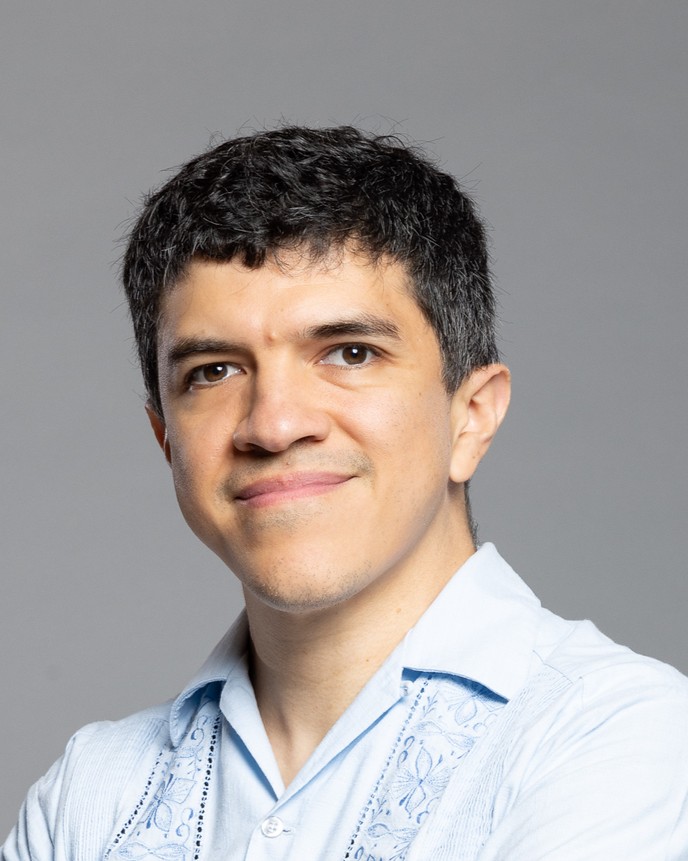
 Armando Solar-Lezama
· 1 previous affiliation
- Massachusetts Institute of TechnologySince 2008
- Full Professor · Since 2008
Research Overview
Armando Solar-Lezama focuses on program synthesis, neurosymbolic programming, and the intersection of artificial intelligence with formal programming systems. His foundational work established sketching and syntax-guided techniques to automate software development by combining partial implementations with rigorous specifications. More recently, his research investigates how large language models and machine learning can be integrated with symbolic reasoning to build robust, interpretable systems for software engineering and sequential decision-making.
Research Trajectory
His early research laid the groundwork for modern program synthesis by introducing techniques that allow developers to write incomplete code that the compiler automatically completes. This approach was formalized in Combinatorial sketching for finite programs (2006), where he introduced the SKETCH language. By providing a partial implementation alongside a mathematical specification of the desired functionality, programmers could rapidly develop highly tuned implementations, such as cryptographic codes, with formal correctness guarantees. He later participated in defining the core computational framework for this growing field in Syntax-guided synthesis. (2013), which established the SyGuS problem by combining a background theory, a semantic correctness specification, and a syntactic template to constrain the space of possible programs.
Applying synthesis and program analysis to systems performance, his group developed Sloth: being lazy is a virtue (when issuing database queries). (2014). This work addressed the latency caused by network round trips in web applications by automatically identifying opportunities to batch database queries, overcoming the limitations of manual batching and traditional static analysis.
Around 2018, his trajectory expanded to integrate machine learning into the synthesis process, a shift he outlined in a comprehensive overview, Search-based program synthesis. (2018). Collaborating on Learning Libraries of Subroutines for Neurally-Guided Bayesian Program Induction (2018), he contributed to the area of Neuro-Symbolic Search for Program Synthesis and the broader direction of Hierarchical Program Synthesis via Library Learning. This research demonstrated how an algorithm could jointly learn a domain-specific language and train a neural network to efficiently search for programs, effectively building a library of reusable components for tasks like text editing and symbolic regression. He further advanced this intersection by developing systems designed to write code automatically from human-provided specifications, such as natural language and examples, in Learning to Infer Program Sketches (2019).
In 2020, he explored the application of synthesis to control strategies in Interpretable, Verifiable, and Robust Reinforcement Learning via Program Synthesis. This work proposed programmatic policies—control strategies expressed as human-readable code—as an alternative to black-box neural networks, yielding agents that are inherently interpretable, amenable to formal safety verification, and significantly more robust in novel environments. This line of library learning culminated in his participation in DreamCoder: bootstrapping inductive program synthesis with wake-sleep library learning (2021), a system that iteratively bootstraps a library of program components and a neural search policy through approximate Bayesian learning and E-graph matching.
Applying synthesis to complex geometric domains, his group developed JoinABLe: Learning Bottom-up Assembly of Parametric CAD Joints (2022), contributing to the research direction of Learning on Boundary Representation Graphs. The framework automatically assembles CAD parts into functional joints by operating directly on native geometric graphs, matching the accuracy of professional human designers without requiring manual object labels. Returning to mathematical reasoning, he introduced MathDSL: A Domain-Specific Language for Concise Mathematical Solutions Via Program Synthesis (2024), which leverages the DreamCoder architecture to solve linear equations with high accuracy and human-like conciseness using minimal training data.
In 2025, his work increasingly focused on the capabilities, evaluation, and integration of large language models (LLMs) within software engineering and neurosymbolic systems. He developed Neurosymbolic World Models for Sequential Decision Making, introducing a framework that learns to model complex environments as neurosymbolic finite state machines in an unsupervised manner, drastically improving the sample efficiency of reinforcement learning agents. Simultaneously, he investigated the integration of LLMs with traditional static analysis in CALLME: Call Graph Augmentation with Large Language Models for Javascript, addressing the challenge of dynamic property accesses to accurately construct call graphs and detect security vulnerabilities. He also co-authored Tasks, Challenges, and Paths Towards AI for Software Engineering, a position paper outlining a taxonomy and identifying key bottlenecks in the automation of software engineering. To rigorously evaluate language models, he designed Randomly Sampled Language Reasoning Problems Reveal Limits of LLMs, using deterministic finite automata to test language understanding while circumventing the risk of dataset recall.
His most recent work in 2026 continues to refine the architecture and application of AI models. He proposed MeMo: Memory as a Model, a modular framework that updates LLMs with new knowledge via a dedicated, smaller memory model, bypassing the need to modify the main executive model and improving robustness against retrieval noise. In the realm of formal program analysis, he introduced ABSINT-AI: Agentic Heap Abstractions for Abstract Interpretation, using LLMs as agents to guide heap abstraction strategies based on semantic cues, reducing false positives while maintaining formal soundness. Finally, he explored interpretable representations in Sparling: End-to-End Spatial Concept Learning via Extremely Sparse Activations, demonstrating that neural networks can learn intermediate spatial motifs from end-to-end supervision using adaptive sparsity, recovering latent causal factors without explicit concept labels.
Current Directions
The most recent papers in the evidence address the intersection of large language models, formal program analysis, and neurosymbolic architectures. Recent work investigates how LLMs can be augmented with modular memory systems to capture complex cross-document relationships without altering the underlying model weights. In parallel, his group is exploring how LLMs can act as agents to guide complex static analysis tasks, such as optimizing heap abstraction in JavaScript to balance precision and scalability.
Additionally, his current research probes the fundamental reasoning limits of language models by generating novel language tasks via deterministic finite automata. He is also advancing neurosymbolic world models that decompose environments into interpretable finite state machines for sequential decision-making, and developing methods for spatial concept learning through extremely sparse activations, aiming to extract interpretable latent variables from raw, unlabelled data.
Profile updated
Loading new papers…
Other researchers whose papers cluster into the same research directions — a proxy for overlapping technical interests and shared intellectual neighborhoods.
See something wrong? Report a mistake