

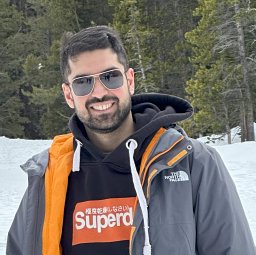
 Aref Azizpour
· 5 previous affiliations
- Drexel UniversitySince 2022
- PhD student · 2022–2027
- Current
- University of Tehran2020–2022
- Graduate Researcher · 2021–2022
- MS student · 2020–2022
- Sensifai2020–2021
- Machine Learning Engineer · 2020–2021
- Rahbin Sanat Nasir2019–2020
- Machine Learning Engineer · 2019–2020
- K.N.Toosi University of Technology2014–2019
- Undergrad student · 2014–2019
Research Overview
Aref Azizpour focuses on the detection and attribution of AI-generated media, with a particular emphasis on the forensic analysis of synthetic images and videos. His work addresses the challenges of generalization in digital forensics, developing methods that can adapt to the rapid emergence of new generative models and the specific artifacts they leave behind. Azizpour’s research explores the intersection of computer vision and security, focusing on how forensic traces differ across modalities and how detectors can be trained to recognize unseen generators using limited or self-supervised data.
Research Trajectory
Azizpour’s research trajectory is defined by a progression from supervised adaptation techniques to more generalized, self-supervised forensic frameworks. In 2024, his work focused on the immediate practical challenges of the generative AI boom: the speed at which new generators are released and the expansion of synthetic content from static images into the temporal domain of video. During this period, he investigated how existing detection systems fail when confronted with novel architectures and how the forensic traces in synthetic video differ fundamentally from those in synthetic images.
By 2025, his work shifted toward addressing the limitations of supervised learning in forensics. Recognizing that training detectors on a fixed set of synthetic images often leads to poor performance on "unseen" generators, he began exploring methods that do not rely on synthetic training data at all. This evolution represents a move toward zero-shot detection and open-set source attribution, utilizing self-supervised learning to model the underlying microstructures of images. This trajectory reflects a broader academic shift in the field from reactive detection (responding to specific known generators) to proactive, foundational forensics (modeling the intrinsic properties of real versus synthetic content).
Current Directions
Azizpour’s current research focuses on three primary areas: continual learning for forensic adaptation, the distinct forensic signatures of synthetic video, and the use of self-supervised "forensic self-descriptions."
In the domain of adaptation, Azizpour has addressed the problem of "catastrophic forgetting" and the data scarcity associated with newly emerged generators. His work in this area involves developing frameworks that allow detectors to learn from minimal samples of new synthetic data without losing the ability to detect older generators. This is achieved through ensemble methods and transfer learning, ensuring that forensic tools remain relevant as generative technology evolves.
In video forensics, Azizpour has contributed to identifying the unique challenges posed by synthetic motion. His research indicates that the traces left by video generators are substantially different from those found in static image generators, rendering standard image-based detectors ineffective for video content. This work also examines the robustness of forensic traces against common post-processing techniques, such as H.264 re-compression, which is a critical factor for real-world deployment on social media platforms.
Most recently, Azizpour has explored the concept of forensic microstructures—subtle, pixel-level patterns that are unique to the image creation process. By shifting the focus to these microstructures, his work aims to enable zero-shot detection and clustering of images from unknown sources. This approach is particularly significant because it leverages self-supervised learning on real images, reducing the dependency on large, labeled datasets of synthetic images that may quickly become obsolete.
Representative Work
In E3: Ensemble of Expert Embedders for Adapting Synthetic Image Detectors to New Generators Using Limited Data, Azizpour (as first author) introduced a continual learning framework designed to update synthetic image detectors. The "Ensemble of Expert Embedders" (E3) addresses the dual challenges of rapid generator emergence and limited data availability. The method employs transfer learning to develop specialized embedders for new forensic traces, allowing for accurate detection even when very few training samples are available from a new generator. This work is foundational to his focus on the temporal adaptation of forensic tools.
Azizpour also participated in research regarding the transition from image to video forensics in Beyond Deepfake Images: Detecting AI-Generated Videos. This study demonstrates that synthetic video generators introduce traces that are distinct from those found in images, explaining why traditional image detectors often fail in a video context. The research shows that these video-specific traces can be learned and used for reliable detection and source attribution, even after the videos have undergone H.264 compression. This work highlights the necessity of modality-specific forensic techniques.
In Forensic Self-Descriptions Are All You Need for Zero-Shot Detection, Open-Set Source Attribution, and Clustering of AI-generated Images, Azizpour (as second author) contributed to a novel approach that models forensic microstructures. Rather than training on synthetic images, this method uses self-supervised learning on real images to extract residuals that capture pixel-level patterns unique to the creation process. This allows for zero-shot detection and the ability to cluster images from unknown generators, addressing the "open-set" problem where the detector must handle sources it has never encountered during training. This work represents a significant methodological shift toward more generalized forensic models.
Profile updated
Loading new papers…
Other researchers whose papers cluster into the same research directions — a proxy for overlapping technical interests and shared intellectual neighborhoods.
See something wrong? Report a mistake