

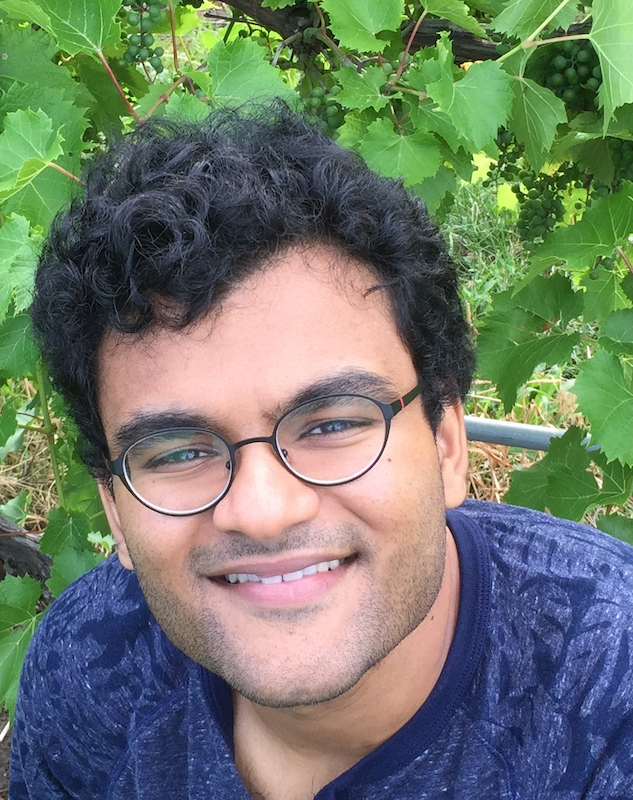
 Ardhendu Tripathy
· 6 previous affiliations
- OpsCanvasSince 2024
- AI Lead · Since 2024
- Assistant Professor · 2020–2024
- University of Wisconsin–Madison2018–2020
- Postdoctoral Research Associate · 2018–2020
- Iowa State University2012–2018
- Graduate Research Assistant · 2012–2018
- Summer Intern · 2017
- Bachelor of Technology (B.Tech.), Electrical, Electronics and Communications Engineering · 2008–2012
Research Overview
Ardhendu Tripathy focuses on the theoretical foundations and algorithmic design of machine learning, drawing on optimization, signal processing, and information theory. His trajectory spans early work in network coding and privacy-preserving representations to extensive contributions in sequential analysis and multi-armed bandits. Currently, his research addresses adaptive sampling, active learning, and black-box optimization techniques that efficiently manage computational overhead and data heterogeneity.
Research Trajectory
Early in his career, Tripathy explored high-resolution signal processing techniques. With collaborators, he developed Robust Multi-Source Localization Over Planar Arrays Using MUSIC-Group Delay Spectrum (2014), which introduced a novel method for resolving the azimuth and elevation angles of closely spaced sources using a minimal number of sensors by leveraging the group delay of the MUltiple SIgnal Classification (MUSIC) phase spectrum.
By 2017, his focus expanded to the intersection of machine learning, information theory, and data privacy. He introduced Privacy-Preserving Adversarial Networks, a framework that utilizes minimax games and adversarially-trained neural networks to approximate information-theoretic bounds. This work demonstrated how to release useful data while concealing sensitive attributes without prior knowledge of the underlying distribution, contributing to the broader research areas of Quantifying Privacy Leakage with Information Theory and Adversarial Minimax Optimization for Privacy Preserving Representations, as well as intersecting with the field of Differential Privacy Beyond the Independence Assumption.
Concurrently, Tripathy investigated the theoretical limits of network coding. In Sum-Networks From Incidence Structures: Construction and Capacity Analysis (2018), he described an algorithm for constructing families of sum-network instances using incidence structures and evaluated their computation capacity. He further formalized these concepts in Zero-error Function Computation on a Directed Acyclic Network (2018), which provided a systematic analysis of the average-case communication rates required to compute functions over directed acyclic graphs.
A major theme in his subsequent work is sequential analysis, particularly multi-armed bandits and adaptive sampling. In 2019, he co-authored MaxGap Bandit: Adaptive Algorithms for Approximate Ranking, which formulated a problem of adaptively sampling from unknown distributions to find the largest gap between adjacent means, allowing for efficient item clustering without full sorting. He continued to refine pure-exploration bandit problems in Finding All $\epsilon$-Good Arms in Stochastic Bandits (2020), addressing a critical gap in the literature for applications like clinical trials where identifying all viable candidates is necessary. This work advanced the research direction of Adaptive Sampling Around Decision Boundaries.
Expanding on adaptive sampling, Tripathy made significant contributions to active learning by bridging active hypothesis testing and active regression. His paper Generalized Chernoff Sampling for Active Learning and Structured Bandit Algorithms (2020) extended Chernoff’s asymptotically optimal sampling strategy, providing non-asymptotic sample complexity bounds that outperformed existing methods. This directly addressed challenges in the research direction of Solving the Cold Start Problem in Active Learning. He later expanded this framework in Chernoff Sampling for Active Testing and Extension to Active Regression (2022), applying the extended sampling techniques to actively learn neural network models and estimate parameters with bounded error.
To handle the computational complexities of these adaptive methods, Tripathy developed the Bandit-Cover-Tree framework in Nearest neighbor search under uncertainty (2021). By combining hierarchical data structures with multi-armed bandit adaptive sampling, the framework enabled nearest neighbor searches using only a noisy stochastic oracle while maintaining high accuracy and speed, managing issues related to the research direction of The Computational Overhead of Adaptive Sampling. Alongside his work in active learning, Tripathy has contributed to statistical inference, as seen in Optimal Confidence Sets for the Multinomial Parameter (2021), which developed new theory for constructing minimum average volume confidence sets for categorical data.
Most recently, his research has branched into applied healthcare modeling and black-box optimization. In the clinical domain, he explored the integration of regional health data into predictive models with Using Geographic Location-based Public Health Features in Survival Analysis (2023), demonstrating that features like the Expected Survival Rate improve the accuracy of both statistical and deep learning survival models. He subsequently led research on Addressing Data Heterogeneity in Federated Learning of Cox Proportional Hazards Models (2024), which proposed methods to mitigate data diversity across hospitals while preserving patient privacy in federated survival analysis.
In the optimization domain, Tripathy has focused on improving the efficiency of evaluating complex systems. His work on Adaptive Partitioning Schemes for Black-Box Optimization (2024) developed algorithms that learn effective domain partitioning schemes using flexible surrogate models like neural networks to minimize simple regret. He advanced this approach in Adaptive Partitioning Schemes for Optimistic Optimization (2025), utilizing neural networks to identify low-dimensional subspaces and adaptively partition the search space, achieving faster convergence in tasks such as hyperparameter tuning and large language model quantization.
Current Directions
Tripathy’s most recent work investigates the geometry and efficiency of black-box optimization. He is actively developing "Optimistic Optimization" algorithms that use neural networks to discover low-dimensional structures within complex, gradient-free systems. By adaptively partitioning the search space based on these learned geometries, his methods aim to significantly reduce the number of function evaluations required for tasks like hyperparameter tuning and model quantization.
Another active thread in his research addresses the intersection of privacy, data heterogeneity, and clinical predictive modeling. Recent papers explore federated learning frameworks specifically tailored for survival analysis, such as Cox Proportional Hazards models. This work focuses on developing patient-centric strategies that maintain high utility and accuracy across diverse hospital datasets without compromising decentralized patient privacy.
Profile updated
Loading new papers…
Other researchers whose papers cluster into the same research directions — a proxy for overlapping technical interests and shared intellectual neighborhoods.
See something wrong? Report a mistake