

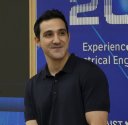
 Arda Senocak
· 2 previous affiliations
- Assistant Professor · Since 2025
- Current
- Assistant Professor · 2025
- Postdoc · 2022–2025
- PhD student · 2016–2022
- MS student · 2013–2015
Research Overview
Arda Senocak focuses on multimodal learning and machine perception, specifically developing models that integrate visual and auditory inputs to understand complex environments. His trajectory spans foundational work in unsupervised sound source localization to advanced cross-modal alignment techniques. Currently, he investigates audio-visual large language models and robust representation learning for dynamic sensory integration.
Research Trajectory
Beginning in 2018, Senocak's research established foundational methods for associating visual events with their corresponding sounds. He introduced an unsupervised algorithm in Learning to Localize Sound Source in Visual Scenes, which utilized a two-stream network with an attention mechanism to localize sound sources purely by observing audio-visual pairs.
Building on this foundation, his work evolved to address the complexities of cross-modal semantic understanding and noise robustness. In 2023, he developed approaches to handle semantically mismatched audio-visual events—such as silent objects or off-screen sounds—in Sound Source Localization is All about Cross-Modal Alignment. During this period, he also explored contrastive learning techniques for robust localization in MarginNCE: Robust Sound Localization with a Negative Margin.
Concurrently, Senocak and his collaborators investigated the efficiency and adaptability of Audio Spectrogram Transformers (ASTs). He participated in developing training procedures that allow models to operate across various patch sizes without architectural changes, as detailed in FlexiAST: Flexibility is What AST Needs. This work contributed to the research direction of Weight Sharing for Elastic Multi-Platform Deployment. The focus on efficient architectures continued with From Coarse to Fine: Efficient Training for Audio Spectrogram Transformers and ElasticAST: An Audio Spectrogram Transformer for All Length and Resolutions. The latter introduced sequence packing and masked attention to handle variable-length audio, advancing areas such as Sequence Packing for Efficient Training and Inference and Sequence Packing for Efficient Variable Length Processing. Exploring alternative architectures for audio representation, he also contributed to Audio Mamba: Bidirectional State Space Model for Audio Representation Learning.
A major theme in his recent trajectory involves leveraging large-scale foundation models for audio-visual tasks. He demonstrated how to repurpose vision-language models for audio applications in Can CLIP Help Sound Source Localization?, translating audio signals into tokens comprehensible to CLIP's text encoder. This approach, which achieved precise object-sound grounding without text input, aligns with the broader area of End-to-End Optimization for Multimodal Representation Learning. He subsequently expanded this framework in Hearing and Seeing Through CLIP: A Framework for Self-Supervised Sound Source Localization, demonstrating its efficacy across interactive and multi-source localization tasks.
In 2025, Senocak's collaborative work expanded into complex scene analysis and generative modeling. He contributed to a mix-and-separate framework capable of disentangling overlapping speech and non-speech sounds in Seeing Speech and Sound: Distinguishing and Locating Audio Sources in Visual Scenes. Additionally, he participated in advancing open-domain video-to-audio generation through a flow-based, model-guided objective in Model-Guided Dual-Role Alignment for High-Fidelity Open-Domain Video-to-Audio Generation. Addressing the reliability of emerging multimodal systems, he co-authored AVHBench: A Cross-Modal Hallucination Benchmark for Audio-Visual Large Language Models, which evaluates how models misinterpret audio-visual cues, contributing to the research direction of Selective Fusion for Robust Multimodal Understanding.
Current Directions
The most recent papers in the evidence indicate a strong focus on the reliability and advanced capabilities of multimodal foundation models. Recent work investigates the evaluation of Audio-Visual Large Language Models (AV-LLMs), specifically addressing cross-modal hallucinations where models incorrectly infer auditory or visual events based on mismatched sensory inputs. Additionally, current research addresses complex, real-world audio-visual environments by developing frameworks to disentangle overlapping speech and non-speech sounds within a single visual scene. Another active area involves high-fidelity generative tasks, such as open-domain video-to-audio generation, utilizing self-distilled objectives to improve data efficiency and alignment between visual conditioning and synthesized audio.
Profile updated
Loading new papers…
Other researchers whose papers cluster into the same research directions — a proxy for overlapping technical interests and shared intellectual neighborhoods.
See something wrong? Report a mistake