

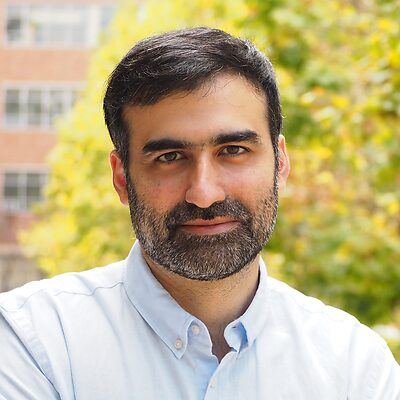
 Arash A. Amini
· 5 previous affiliations
- DiscoverSince 2014
- Associate Professor · Since 2021
- Assistant Professor · 2014–2021
- Current
- University of Michigan2011–2014
- Postdoc · 2011–2014
- PhD student · 2006–2011
- Sharif University of Technology2000–2006
- MS student · 2004–2006
- Undergrad student · 2000–2004
Research Overview
Arash A. Amini focuses on high-dimensional statistics, network inference, and graphical models. His trajectory spans the fundamental limits of sparse recovery and community detection to the development of scalable algorithms for complex data structures. Recently, his work addresses causal discovery, kernel methods, and multi-user contextual bandits on graphs.
Research Trajectory
His early research investigated the fundamental limits of recovering sparse structures from high-dimensional data. In High-dimensional analysis of semidefinite relaxations for sparse principal components (2008), he established statistical and computational trade-offs for sparse principal component analysis, demonstrating how semidefinite programming approaches compare to simpler thresholding methods. Moving into network analysis, he developed scalable methods for community detection. With collaborators, he introduced a fast pseudo-likelihood approach in Fitting community models to large sparse networks, contributing to the research direction of Robust Initialization for Centroid Based Clustering. This work provided an efficient Expectation-Maximization framework capable of handling millions of nodes in sparse regimes. He subsequently advanced the theoretical guarantees for community recovery by proposing a tighter semidefinite programming relaxation in On semidefinite relaxations for the block model, which accommodated weakly assortative network structures.
In 2019, his focus expanded across several domains of high-dimensional statistics and machine learning. A major line of work addressed the learning of directed acyclic graphs (DAGs). In Globally optimal score-based learning of directed acyclic graphs in high-dimensions, he and his co-authors analyzed score-based estimators for sparse Gaussian DAGs, proving that logarithmic sample complexity suffices without relying on strong faithfulness assumptions. This paper advanced several key areas, including Nonconvex Regularization for Unbiased Sparse Recovery, Causal Discovery via Sparsest Markov Representations, and Logarithmic Sample Complexity for High Dimensional Graphical Models. He participated in modeling high-dimensional dependencies in Sparse Multivariate Bernoulli Processes in High Dimensions, contributing to the broader area of Statistical Learning Theory for Dependent Dynamical Systems.
During this period, he also formalized theoretical bounds for kernel-based algorithms, providing concentration guarantees for random kernel matrices in Concentration of kernel matrices with application to kernel spectral clustering. In network modeling, he co-developed a framework for bipartite networks that incorporates node covariates to uncover one-to-one community matchings in Matched Bipartite Block Model with Covariates. Additionally, he contributed to Bayesian nonparametrics by developing an exact slice sampler for the Hierarchical Dirichlet Process in Exact slice sampler for Hierarchical Dirichlet Processes, bypassing the computational bottlenecks of infinite-dimensional inference.
His subsequent research deepened the theoretical understanding of clustering and graphical models. In Label consistency in overfitted generalized $k$-means, his collaborative work established model-free conditions under which overfitted clustering algorithms still recover a refinement of the true labels. Returning to Bayesian networks, he co-authored Optimizing Regularized Cholesky Score for Order-Based Learning of Bayesian Networks, introducing a hybrid global-local search method that optimizes over node orderings to efficiently learn network structures.
In 2022, his work on conditional independence yielded two significant contributions. He investigated when Gaussian graphical models perfectly encode conditional independence structures in On perfectness in Gaussian graphical models. Recognizing the limitations of faithful graphical representations, he also introduced a non-graphical decomposition based on subset lattices in A non-graphical representation of conditional independence via the neighbourhood lattice. Concurrently, he analyzed the generalization properties of kernel methods, demonstrating in Target alignment in truncated kernel ridge regression how the alignment between target functions and kernels influences convergence rates under spectral truncation. In 2023, he led research on aggregating multiple clustering outputs, framing the unsupervised matching problem as finding a Fréchet mean in Statistical Guarantees for Consensus Clustering.
The most recent phase of his trajectory addresses complex alignment and sequential decision-making problems. In Network two-sample test for block models, he collaborated on tackling the computationally demanding task of comparing two network structures without known vertex correspondence. He then directed the development of a geometric algorithm for trajectory seriation in Trajectory Seriation via Spectral Tangent Alignment and Global Embedding, utilizing local PCA and sign-synchronization to recover latent orders from noisy high-dimensional curves. Expanding into reinforcement learning, he co-authored Laplacian Kernelized Bandit, which introduced a unified framework for multi-user contextual bandits on graphs, leveraging Reproducing Kernel Hilbert Space properties to achieve regret bounds under strong homophily.
Current Directions
The most recent papers in the evidence address the intersection of geometric data analysis, network alignment, and sequential decision-making. Current work investigates methods for comparing complex network structures in the absence of vertex correspondence, a critical challenge in structural graph analysis. Additionally, recent research explores manifold approximation techniques for recovering latent structures in high-dimensional spaces, as well as the design of scalable contextual bandit algorithms that leverage graph-based regularization to optimize multi-user decision processes.
Profile updated
Loading new papers…
Other researchers whose papers cluster into the same research directions — a proxy for overlapping technical interests and shared intellectual neighborhoods.
See something wrong? Report a mistake