

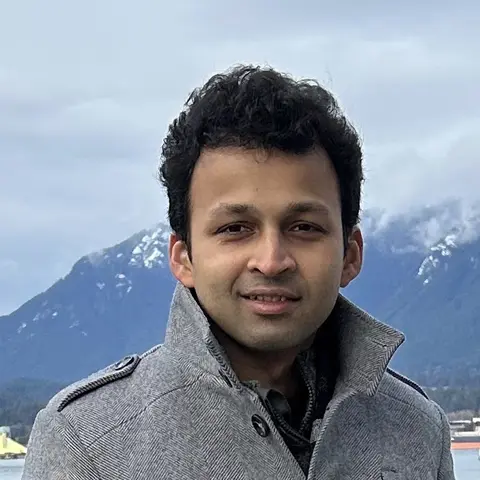
 Apratim Bhattacharyya
· 4 previous affiliations
- Qualcomm (United States)Since 2022
- Researcher · Since 2022
- Qualcomm AI ResearchCurrent
- Current
- University of Tübingen2021–2022
- Postdoc · 2021–2022
- Max Planck Institute for Informatics2016–2021
- PhD student · 2016–2021
Research Overview
Apratim Bhattacharyya focuses on neural reasoning, embodied systems, and generative models, with an emphasis on enabling artificial agents to anticipate and interact with dynamic environments. His trajectory spans early work in sequence modeling and uncertainty estimation for autonomous driving to recent advances in multi-modal large language models. Currently, he investigates real-time, situated human-AI interaction and grounded reasoning in continuous video streams.
Research Trajectory
Bhattacharyya’s early research concentrated on sequence modeling and algorithmic data mining, beginning with foundational work on Efficiently Summarising Event Sequences with Rich Interleaving Patterns (2017). Shortly thereafter, his focus shifted toward the challenges of autonomous driving in highly dynamic urban environments, where anticipating the future states of a scene is critical for safety. In 2018, he developed models for Long-Term On-Board Prediction of People in Traffic Scenes Under Uncertainty, jointly predicting ego motion and pedestrian trajectories over extended time horizons. Recognizing that real-world scenarios induce complex, multi-modal distributions over future events, he subsequently introduced a Gaussian Latent Variable model in Accurate and Diverse Sampling of Sequences Based on a "Best of Many" Sample Objective to improve sequence extrapolation and uncertainty modeling.
Continuing his work on predictive modeling for autonomous systems, Bhattacharyya advanced the research direction of Mitigating Compounding Errors in Autoregressive Physical Simulators with his 2019 work, Bayesian Prediction of Future Street Scenes using Synthetic Likelihoods. He then expanded his methodological scope to generative architectures, introducing the mAR-SCF model in Normalizing Flows With Multi-Scale Autoregressive Priors (2020). This approach replaced standard Gaussian priors with multi-scale autoregressive priors across image channels, achieving state-of-the-art density estimation while maintaining faster sampling times than traditional autoregressive models. Around the same time, he applied deep conditional generative modeling to software engineering in SampleFix: Learning to Correct Programs by Efficient Sampling of Diverse Fixes, addressing the ambiguity of programmer intent by learning a distribution over potential code repairs.
Returning to the domain of intelligent vehicles in 2021, he addressed the complex negotiations between self-driving cars and pedestrians in crowded city centers. In Euro-PVI: Pedestrian Vehicle Interactions in Dense Urban Centers, he and his collaborators introduced a new dataset alongside a Joint-$\beta$-cVAE model that utilized a shared latent space to predict the trajectories of multiple interacting agents simultaneously.
By 2023, Bhattacharyya’s research expanded into the capabilities of multi-modal large language models (LLMs). He explored autoregressive visual modeling by framing image generation as a sequence-to-sequence problem in Painter: Teaching Auto-regressive Language Models to Draw Sketches, training models to predict virtual brush strokes with a visual feedback loop. He then focused on improving how these models process and reason about continuous visual data. In Look, Remember and Reason: Grounded Reasoning in Videos with Language Models (2024), he demonstrated that training LLMs on low-level surrogate tasks—such as object tracking and re-identification—forces the models to ground their high-level reasoning in fine-grained spatiotemporal details, significantly improving performance on complex video benchmarks.
This interest in grounded, real-time video understanding naturally progressed into evaluating how AI systems interact with humans in situated environments. Contributing to the broader area of Full-Duplex Interaction via Specialized LLM Control Tokens, he helped introduce the QEVD benchmark in What to Say and When to Say it: Live Fitness Coaching as a Testbed for Situated Interaction (2024), challenging models to move beyond turn-based prompting and proactively deliver feedback based on live user activity.
In 2026, his work further scrutinized the real-time reliability of vision-language models. He investigated the temporal reasoning gap in situated conversations with Can Vision-Language Models Answer Face to Face Questions in the Real-World?, revealing that even advanced models struggle with the timing required for human-like, face-to-face interaction. Building on the need for asynchronous AI assistants, he introduced the LiveCook benchmark in Can Multi-Modal LLMs Provide Live Step-by-Step Task Guidance? to test models on detecting user execution errors and providing immediate corrections during continuous video streams. Concurrently, he advanced the research direction of Hybrid Uncertainty Estimation for Large Language Models with Enhancing Hallucination Detection through Noise Injection. This work proposed a training-free method to capture epistemic uncertainty by injecting noise into hidden layers during inference, significantly improving the identification of fabricated responses.
Current Directions
The most recent work in the evidence focuses on the reliability, temporal reasoning, and real-time capabilities of multi-modal large language models in situated environments. A major theme is the transition from traditional, turn-based prompting toward open-ended, asynchronous human-AI interaction. This involves developing and benchmarking systems capable of monitoring live video streams, understanding fine-grained atomic actions, and proactively delivering timely feedback or step-by-step guidance without waiting for explicit user queries.
Additionally, current efforts address the critical challenge of model hallucination and reliability in open-ended generation. Recent projects explore scalable methods to estimate epistemic uncertainty—such as noise-injected sampling techniques—aiming to align model confidence with predictive accuracy and ensure that AI assistants can reliably flag their own knowledge gaps during real-world deployments.
Profile updated
Loading new papers…
Other researchers whose papers cluster into the same research directions — a proxy for overlapping technical interests and shared intellectual neighborhoods.
See something wrong? Report a mistake