

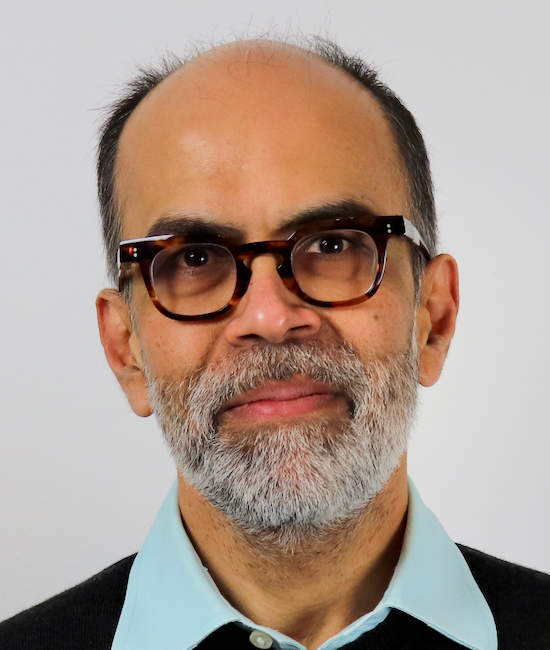
 Anupam Gupta
· 3 previous affiliations
- Google (United States)Since 2023
- Researcher · Since 2023
- New York UniversitySince 2024
- Full Professor · Since 2024
- Carnegie Mellon University2003–2023
- Full Professor · 2003–2023
Research Overview
Anupam Gupta focuses on theoretical computer science, with an emphasis on approximation algorithms, metric embeddings, and algorithms for uncertain environments. His trajectory spans foundational work in network design and dimensionality reduction to advanced frameworks for stochastic and online optimization. Recently, his research addresses robust contextual pricing, multi-platform autobidding, and length generalization in transformer architectures.
Research Trajectory
Early work established a foundation in geometric and metric methods for theoretical computer science. He explored how to represent complex distances in simpler spaces, notably in Embedding Tree Metrics Into Low Dimensional Euclidean Spaces. This interest in metric properties extended to dimensionality reduction, where he contributed to An elementary proof of a theorem of Johnson and Lindenstrauss. Concurrently, he developed randomized approximation algorithms for NP-hard network design problems, improving performance guarantees for connected facility location and virtual private network design in Simpler and better approximation algorithms for network design.
Moving into the mid-2000s, the focus expanded to algorithms operating under uncertainty. He introduced frameworks for two-stage stochastic optimization, such as in Boosted sampling: approximation algorithms for stochastic optimization, where elements are chosen before actual requirements materialize. This naturally progressed into online algorithms, where decisions must be made sequentially without knowledge of the future. A major contribution in this space was Chasing Convex Bodies with Linear Competitive Ratio, which provided an algorithm with an improved competitive ratio for responding to a sequence of convex bodies online. This work aligns with the broader research direction of Smoothed Online Convex Optimization.
By 2024, his work on stochastic and online covering problems had deepened significantly. In Set Covering with Our Eyes Wide Shut, he improved universal algorithms for the stochastic set cover problem. He also investigated the trade-offs between sequential and parallel decision-making in The Power of Adaptivity for Stochastic Submodular Cover, demonstrating that a small number of adaptive rounds can nearly match fully sequential strategies. This contributes to the research area of Adaptivity Gaps in Stochastic Combinatorial Optimization and the related direction of The Adaptivity Gap in Stochastic Optimization. Additionally, he participated in research on neural network architectures, specifically addressing the area of Length Generalization in Transformer Architectures by modifying positional encodings to solve extended arithmetic problems in Position Coupling: Improving Length Generalization of Arithmetic Transformers Using Task Structure.
The most recent phase of his trajectory in 2025 shows a prolific output across optimization, pricing, and learning-augmented algorithms. He introduced a generalized framework for resource allocation under uncertainty in Configuration balancing for stochastic requests. In the realm of digital economics, he developed tighter regret bounds for setting product prices when buyers are irrational or data is corrupted in Robust Contextual Pricing, and designed efficient algorithms for maximizing advertiser value across multiple platforms in Multi-Platform Autobidding with and without Predictions.
He also continued to advance foundational combinatorial optimization. He introduced a structural iterative rounding framework that improves approximation ratios for knapsack median problems in Structural iterative rounding for generalized k-median problems. Addressing correlated data in online decisions, he proved strong performance guarantees for matroid constraints using pairwise-independent data in Pairwise-independent contention resolution. Further expanding his work on online systems, he provided Tight Results for Online Convex Paging. Finally, he unified approaches to random-order online covering problems using online convex optimization techniques in A Learning Perspective on Random-Order Covering Problems, and tackled the challenge of maintaining covers over time without revoking previous decisions in The Online Submodular Cover Problem, contributing to the broader area of Generalizing Combinatorial Optimization to Complex Matroid Constraints.
Current Directions
Recent work investigates the intersection of machine learning and traditional online algorithms, particularly through learning-augmented frameworks and robust optimization. The most recent papers in the evidence address complex resource allocation and covering problems under uncertainty, utilizing techniques from online convex optimization to achieve tight competitive ratios. This includes designing algorithms for multi-platform autobidding that leverage potentially imperfect predictions, as well as establishing robust contextual pricing models that withstand adversarial data corruption. Additionally, current research continues to advance foundational combinatorial optimization, focusing on structural iterative rounding for clustering problems and managing adaptivity gaps in stochastic environments.
Profile updated
Loading new papers…
Other researchers whose papers cluster into the same research directions — a proxy for overlapping technical interests and shared intellectual neighborhoods.
See something wrong? Report a mistake