

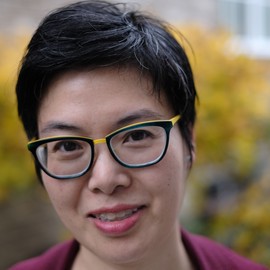
 Ann B. Lee
3 previous affiliations
- Carnegie Mellon University2005–2020
- Associate Professor · 2010–2020
- Assistant Professor · 2005–2010
- Yale University2002–2005
- Postdoc · 2002–2005
- Brown University1995–2002
- PhD student · 1995–2002
Research Overview
Ann B. Lee focuses on statistical methodology for complex physical science data, trustworthy scientific inference, and uncertainty quantification. Her early work explored the nonlinear statistics of natural images and dimensionality reduction techniques for unstructured data. Currently, she develops rigorous frameworks for likelihood-free inference, calibrated predictive distributions, and simulation-based inference applied to domains like astronomy and severe weather forecasting.
Research Trajectory
Ann B. Lee’s research trajectory begins with early work in the statistics of natural images and dimensionality reduction, gradually evolving into a sustained focus on likelihood-free inference and conditional density estimation for the physical sciences. In her initial research, she developed a scale-invariant version of Matheron’s dead leaves model to account for occlusions and replicate the elementary statistics of natural images in Occlusion Models for Natural Images: A Statistical Study of a Scale-Invariant Dead Leaves Model. She subsequently explored the space of high-contrast patches from optical and 3D range images, demonstrating that the majority of data points concentrate in clusters and non-linear low-dimensional manifolds in The Nonlinear Statistics of High-Contrast Patches in Natural Images.
Building on these insights into intrinsic data geometry, her focus expanded to broader dimensionality reduction techniques. With collaborators, she provided a unified framework for dimensionality reduction, graph partitioning, and data set parameterization based on Markov random walks in Diffusion Maps and Coarse-Graining: A Unified Framework for Dimensionality Reduction, Graph Partitioning, and Data Set Parameterization. She then introduced Treelets | A Tool for Dimensionality Reduction and Multi-Scale Analysis of Unstructured Data, a method designed to handle high-dimensional, unstructured data sets with hundreds or thousands of variables, such as gene expression or text data.
Moving into the 2010s, her work increasingly addressed the challenges of estimating probability distributions in high dimensions, laying the groundwork for her later contributions to simulation-based inference. She helped develop a fully nonparametric density ratio estimator that leverages the eigenfunctions of a kernel-based operator to reflect underlying data geometry in High-Dimensional Density Ratio Estimation with Extensions to Approximate Likelihood Computation. Continuing this trajectory, she contributed to the creation of an open-source library that extends random forests to estimate full conditional probability distributions in RFCDE: Random Forests for Conditional Density Estimation, optimizing tree splits directly for conditional density loss.
By 2020, her research heavily emphasized the validation and rigorous application of approximate likelihoods and emulators in computationally intensive scientific domains. She introduced a statistical framework combining local two-sample tests with global goodness-of-fit tests to pinpoint where emulator models fail in Validation of Approximate Likelihood and Emulator Models for Computationally Intensive Simulations, advancing the broader research direction of Statistical Power Decay in High Dimensional Testing. Concurrently, her research group established methods for parameter estimation and hypothesis testing when likelihoods are intractable. In Confidence Sets and Hypothesis Testing in a Likelihood-Free Inference Setting, she formalized frequentist coverage for likelihood-free inference, a key contribution to the area of Frequentist Coverage for Bayesian Credible Intervals. She further addressed the bottlenecks of high-dimensional data and costly simulations in Approximate Bayesian Computation (ABC) by integrating a nonparametric conditional density estimation framework in ABC–CDE: Toward Approximate Bayesian Computation With Complex High-Dimensional Data and Limited Simulations.
Her methodological advances in density estimation have been accompanied by rigorous diagnostic tools and high-impact applications in the physical sciences. She participated in framing local model coverage as a regression problem to identify specific feature-space failures in Diagnostics for conditional density models and Bayesian inference algorithms, contributing to the research area of Localized Diagnostics for Statistical Model Criticism. Applying these statistical frameworks to meteorology, her group developed interpretable models to identify convective patterns preceding dangerous storm events in Identifying Distributional Differences in Convective Evolution Prior to Rapid Intensification in Tropical Cyclones. This work intersects with several applied research directions, including Thermodynamic and Dynamic Scaling of Extreme Precipitation and Structural Forecasting for Tropical Cyclone Rapid Intensification.
In recent years, her focus has sharpened on ensuring the statistical validity of deep learning and simulator-based inference. Her group introduced the WALDO framework, which constructs honest confidence regions by reframing the classical Wald test and using quantile regression for efficient Neyman inversion in Simulator-Based Inference with WALDO: Confidence Regions by Leveraging Prediction Algorithms and Posterior Estimators for Inverse Problems. Addressing complex distribution shifts, her team developed Nuisance-Aware Prediction Sets (NAPS) to provide reliable uncertainty estimates in classification tasks affected by latent factors in Classification under Nuisance Parameters and Generalized Label Shift in Likelihood-Free Inference. Most recently, she advanced the calibration of conditional density estimates with the LADaR framework in Towards instance-wise calibration: local amortized diagnostics and reshaping of conditional densities (LADaR), providing interpretable diagnostics and reshaping algorithms to ensure reliable predictions for individual data points in scientific applications like galaxy redshift estimation.
Current Directions
Recent work investigates the reliability and calibration of predictive models in the presence of complex data distributions and distribution shifts. A primary focus is on instance-wise calibration for conditional density estimates, ensuring that uncertainty quantification is accurate for individual data points rather than just on average across a dataset. This involves developing amortized diagnostic tools and reshaping algorithms that can be directly applied to scientific problems such as weather forecasting and astronomical measurements. Additionally, ongoing research addresses generalized label shift and the presence of nuisance parameters in likelihood-free inference, seeking to construct prediction sets that maintain their statistical validity even when latent factors perturb the target data distribution.
Profile updated
Loading new papers…
Other researchers whose papers cluster into the same research directions — a proxy for overlapping technical interests and shared intellectual neighborhoods.
See something wrong? Report a mistake