

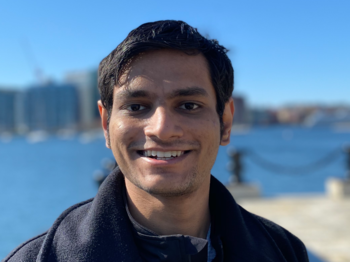
 Ankit Shah
· 5 previous affiliations
- Accenture (United States)Since 2023
- Core Tech Lead and Full Stack LLM Development Associate Director · Since 2025
- Principal Researcher · Since 2023
- Carnegie Mellon University2017–2024
- Doctor of Philosophy - PhD, Language Technologies · 2020–2024
- Graduate Research Assistant · 2020–2023
- Master of Science - MS, Computer Science [Language Technologies] · 2017–2019
- Machine learning research intern · 2023
- Research Intern · 2022
- Research Intern · 2021
2 other authors named Ankit Shah: Ankit Shah (The AI Institute · 11 papers), Ankit Shah (1 paper)
Research Overview
Ankit Shah focuses on machine learning for audio signal processing, weakly supervised learning, and the optimization of large language models. His early research established robust methods for sound event detection using noisy, web-scale data and generalized audio representations. Recently, his work has shifted toward inference-time reasoning, tool use, and knowledge unlearning in generative AI systems.
Research Trajectory
During his doctoral studies at Carnegie Mellon University, his research centered on computational audition with imprecise labels, contributing heavily to the area of Learning Fine-Grained Audio Timestamps from Coarse Tags. He investigated how to scale these systems in Framework for Evaluation of Sound Event Detection in Web Videos, demonstrating that YouTube search queries modified with the word "sound" could serve as a reliable proxy for manual human labeling. This work advanced the broader area of Representing Unstructured Environmental Acoustic Scenes.
To further address the bottleneck of manual data annotation, he introduced WeblyNet in Learning Sound Events from Webly Labeled Data. By scraping data directly from the web and utilizing two neural networks that co-teach each other to ignore noisy labels, this work advanced the research direction of Agreement Filtering for Robust Pseudo-Labeling. Over his early career, his audio research also encompassed the areas of Bridging the Semantic Acoustic Gap and Resolving Overlapping Sources in Polyphonic Sound Event Detection.
In 2022, he explored multimodal reasoning in Audio-Visual Scene-Aware Dialog and Reasoning Using Audio-Visual Transformers with Joint Student-Teacher Learning, focusing on systems that must demonstrate temporal reasoning without relying on human-generated descriptions at inference time. That same year, he argued for simpler, more interpretable models in the medical domain with On the pragmatism of using binary classifiers over data intensive neural network classifiers for detection of COVID-19 from voice, showing that standard voice features could rival complex neural networks. He continued refining audio representations in Approach to Learning Generalized Audio Representation Through Batch Embedding Covariance Regularization and Constant-Q Transforms, proposing a regularization term to better simulate the frequency information received by the human auditory system.
Expanding his focus on weak supervision to computer vision, he introduced "semi-weak labels" in Training image classifiers using Semi-Weak Label Data. This framework leveraged exact count information within an image bag to achieve performance comparable to fully supervised methods. He also addressed the mechanics of weak label learning in Importance of negative sampling in weak label learning, demonstrating that active sampling strategies like Gradient Embedding significantly boost model performance compared to simple random sampling.
In 2024, he applied modern architectures to visual speech tasks in Conformer is All You Need for Visual Speech Recognition. Returning to specialized acoustic analysis, he developed a deep learning framework in Deciphering GunType Hierarchy through Acoustic Analysis of Gunshot Recordings, which utilizes a joint Convolutional Neural Network architecture to detect gunshots and identify specific firearm categories from audio recordings.
In recent years, coinciding with his role as LLM Architecture Associate Director at Accenture's Center for Advanced AI, his research trajectory expanded significantly into the optimization and control of large language models. With collaborators, he explored the research direction of Preserving Model Utility During Machine Unlearning in LLM Unlearning via Loss Adjustment with Only Forget Data. This paper introduced the FLAT framework, which allows models to unlearn specific information using only the data meant to be forgotten, bypassing the need for massive retain datasets. He oversaw the development of an inference-time framework in ProRefine: Inference-time Prompt Refinement with Textual Feedback, which dynamically optimizes prompts using an agentic feedback loop between a teacher and a refiner model.
In 2026, he participated in evaluating agentic systems in MCP-Bench: Benchmarking Tool-Using LLM Agents with Complex Real-World Tasks via MCP Servers, a large-scale benchmark connecting agents to real-world tools to test multi-step reasoning. Finally, he collaborated on Inference Time Optimization with Confidence Dynamics, leveraging the discovery that correct LLM answers exhibit a steady increase in model certainty to improve answer selection via a novel voting method.
Current Directions
The most recent papers in the evidence address the optimization, evaluation, and control of large language models. Recent work investigates inference-time reasoning, specifically how models can dynamically refine prompts through agentic feedback loops and how internal confidence dynamics can be leveraged to improve answer selection without additional training. Additionally, current research explores the evaluation of LLM agents executing complex, multi-step tasks using external tools, as well as methods for selectively unlearning specific data from pre-trained models using only the data targeted for erasure.
Profile updated
Loading new papers…
Other researchers whose papers cluster into the same research directions — a proxy for overlapping technical interests and shared intellectual neighborhoods.
See something wrong? Report a mistake