

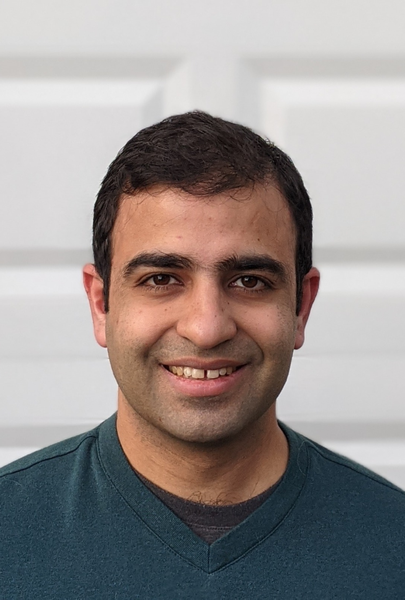
 Anjul Patney
· 4 previous affiliations
- Nvidia (United States)Since 2021
- Senior System Software Manager · Since 2023
- Principal Researcher · 2021–2023
- Senior Research Scientist · 2015–2019
- Research Scientist · 2013–2014
- Research Intern · 2010
- Meta (United States)2019–2021
- Research Scientist · 2019–2021
- University of California, Davis2007–2013
- Ph.D. Candidate · 2007–2013
- Indian Institute of Technology Delhi2003–2007
- B. Tech., Electrical Engineering · 2003–2007
Research Overview
Anjul Patney focuses on computer graphics, memory-efficient rendering architectures, and generative video processing. His trajectory spans early work on power-efficient GPU memory hierarchies and high-dimensional sampling techniques to more recent developments in neural denoising for path tracing. Currently, his research addresses real-time generative video editing, emphasizing temporal consistency and efficient diffusion models.
Research Trajectory
The evolution of Patney's research spans from early optimizations in graphics hardware architecture to modern applications of neural networks in rendering and generative video. In 2008, his collaborative work addressed the growing need for memory and power efficiency in graphics processing units (GPUs). This included participation in the development of Efficient computation of sum-products on GPUs through software-managed cache, which introduced a technique for designing memory-bound algorithms with high data reuse. By implementing a software-managed cache, the approach accelerated the marginalize a product of functions (MPF) problem, a computational bottleneck in artificial intelligence and image processing. During the same period, he contributed to Texture filter memory: a power-efficient and scalable texture memory architecture for mobile graphics processors. Recognizing that memory accesses during texture mapping consumed a significant portion of energy in embedded graphics processors, this research proposed alternatives to standard cache hierarchies to better serve the power constraints of mobile systems.
Over the following decade, Patney's focus expanded into advanced sampling and rendering techniques. In 2018, he was part of a research effort that developed Spoke-Darts for High-Dimensional Blue-Noise Sampling. This algorithm combined advancing front techniques with hyperplane sampling to generate high-quality blue noise samples in high-dimensional spaces, offering provable guarantees on sample distribution. This work advanced the broader research area of Why Spatial Indexing Collapses in High Dimensions by providing new methods to overcome the curse of dimensionality in domains like global optimization and robotics.
By 2020, his research incorporated deep learning to solve persistent challenges in interactive rendering. He co-authored Neural Temporal Adaptive Sampling and Denoising, which addressed the temporal instability and loss of high-frequency details often seen in Monte Carlo path tracing when generating image sequences with very few samples per pixel.
Most recently, Patney's work has shifted toward the intersection of generative artificial intelligence and video processing. In 2026, he contributed to SmoothDiffusion-VE: Real-time Generative Video Editing Using Adaptive Feature Cache. This research tackled the difficult trade-off between temporal consistency and processing speed in diffusion models. By introducing an adaptive feature cache that dynamically adjusts memory usage based on frame similarity, alongside a motion-guided attention mechanism, the method focuses computational resources on dynamic regions of a video. This recent publication aligns with several active research directions, specifically the areas of Constraining Spatial Attention with Temporal Motion Signals, Temporal Consistency for Generative Video Diffusion, and Efficient Training Strategies for Generative Diffusion Models.
Current Directions
Based on the most recent papers in the evidence, Patney's current research investigates the optimization of generative diffusion models for real-time video applications. A primary focus is resolving the tension between computational efficiency and temporal stability in video editing. This involves designing adaptive memory architectures—such as dynamic feature caching—that intelligently allocate resources by exploiting frame-to-frame similarities. Additionally, his recent work explores motion-guided attention mechanisms to filter out static background clutter, ensuring that neural rendering and generative editing processes concentrate their computational budget on the dynamic, changing elements of a scene.
Profile updated
Loading new papers…
Other researchers whose papers cluster into the same research directions — a proxy for overlapping technical interests and shared intellectual neighborhoods.
See something wrong? Report a mistake