

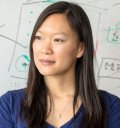
 Angela Dai
· 2 previous affiliations
- Technical University of MunichSince 2020
- Associate Professor · Since 2024
- Assistant Professor · 2020–2024
- Stanford University2013–2018
- PhD · 2013–2018
Research Overview
Angela Dai focuses on 3D scene understanding, surface reconstruction, and generative 3D deep learning. Her early work established foundational datasets and real-time reconstruction methods for indoor environments using commodity RGB-D sensors. Currently, she investigates scalable 3D scene synthesis, autoregressive mesh generation, and dynamic 4D human-object interactions to enable advanced content creation and embodied AI.
Research Trajectory
Angela Dai’s research arc begins with foundational contributions to 3D representation and reconstruction from commodity sensor data. In 2016, she participated in early deep learning efforts for 3D data, analyzing the performance gap between volumetric and multi-view architectures in Volumetric and Multi-view CNNs for Object Classification on 3D Data. This focus on robust 3D representations naturally progressed into real-time systems, leading to the development of BundleFusion: Real-Time Globally Consistent 3D Reconstruction Using On-the-Fly Surface Reintegration (2017), which provided a robust framework for capturing environments on the fly.
Recognizing that supervised 3D deep learning was constrained by a lack of large-scale annotated data, she introduced ScanNet: Richly-Annotated 3D Reconstructions of Indoor Scenes (2017). By providing millions of views across thousands of scenes with semantic segmentations and camera poses, this work became a critical resource for the community. Building on this dataset, her research expanded into the area of Semantic Priors for Geometric Shape Completion. This is exemplified by ScanComplete: Large-Scale Scene Completion and Semantic Segmentation for 3D Scans (2018), which utilized a fully-convolutional generative 3D CNN to predict complete models and semantic labels from incomplete scans, managing spatial scaling through a coarse-to-fine inference strategy. Further addressing the noise and incompleteness of commodity scans, she collaborated on Scan2CAD: Learning CAD Model Alignment in RGB-D Scans (2019), a data-driven method for aligning clean 3D CAD models to underlying scan geometry.
In recent years, Dai’s focus has shifted toward advanced generative modeling for 3D assets and scenes, heavily leveraging transformer architectures and diffusion models. A key development in this phase was MeshGPT: Generating Triangle Meshes with Decoder-Only Transformers (2024). By treating triangle meshes as sequences of geometric tokens, this work advanced the research direction of Autoregressive Transformers for 3D Mesh Generation and contributed to the broader field of Compact Surface Reconstruction from Over-Tessellated Geometry, producing clean, artist-like shapes. She continued to refine mesh generation paradigms through interactive tools like MeshPad: Interactive Sketch-Conditioned Artist-Designed Mesh Generation and Editing (2025), which uses speculative decoding to accelerate sketch-based modeling. To handle more complex, functional assets, her group presented MeshArt: Generating Articulated Meshes with Structure-guided Transformers (2025), a hierarchical approach that synthesizes articulation-aware object structures part-by-part. Moving beyond raw geometry, she also explored procedural generation in ProcGen3D: Learning Neural Procedural Graph Representations for Image-to-3D Reconstruction (2025), utilizing Monte Carlo Tree Search to predict editable procedural graph abstractions.
Concurrently, her work has scaled from individual objects to expansive environments and dynamic scenes. Contributing to the area of Compositional and Scalable 3D Scene Synthesis, she developed LT3SD: Latent Trees for 3D Scene Diffusion (2025), which employs a hierarchical latent tree representation to generate large-scale, high-fidelity environments patch-by-patch. To accelerate scene reconstruction, she introduced QuickSplat: Fast 3D Surface Reconstruction via Learned Gaussian Initialization (2025), replacing slow per-scene optimization with learned neural priors for Gaussian Splatting.
Her trajectory also encompasses the temporal dimension, tackling 4D generation and animation. In Animating the Uncaptured: Humanoid Mesh Animation with Video Diffusion Models (2025), she demonstrated how to lift motion priors from 2D video diffusion models onto static 3D humanoid meshes, bypassing the need for expensive motion capture data. Similarly, DNF: Unconditional 4D Generation with Dictionary-based Neural Fields (2025) proposed a dictionary learning approach to disentangle shape and motion in deformable objects.
Most recently, Dai has focused on high-fidelity capture and embodied semantic understanding. She led the development of ScanNet++: A High-Fidelity Dataset of 3D Indoor Scenes (2026), which couples sub-millimeter laser scans with commodity RGB-D streams to benchmark novel view synthesis and semantic comprehension. Building on this semantic foundation, her research addresses expressive scene interpretation through ExCap3D: Expressive 3D Scene Understanding via Object Captioning with Varying Detail (2026), a model designed to generate multi-level text descriptions of 3D objects and their parts. Finally, she explored zero-shot synthesis of complex behaviors in HOI-PAGE: Zero-Shot Human-Object Interaction Generation with Part Affordance Guidance (2026), utilizing large language models to reason about part-level mechanics for generating 4D human-object interactions.
Her lab also advanced differentiable radiance representations, articulated reconstruction, and embodied benchmarks in 2026. In Diff3R: Feed-forward 3D Gaussian Splatting with Uncertainty Aware Differentiable Optimization (2026), Dai contributed to Overcoming the Static Scene Assumption by bridging feed-forward 3D Gaussian Splatting with test-time optimization using implicit differentiation and uncertainty-guided updates. To address articulated structures and hidden geometry from sparse views, Dai introduced UnfoldArt: Zero-Shot Recovery of Full Articulated 3D Objects from Text or Image (2026), which couples hierarchical multi-agent debate with generative video priors. In multi-view perception, Dai co-authored Lookalike3D: Seeing Double in 3D (2026), exploiting visual redundancies across identical and similar object pairs to improve reconstruction and part co-segmentation. Further supporting embodied AI and physical interaction, Dai led Physicl Scenes: An Artist-created 3D Dataset for Learning Perception and Action (2026), delivering thousands of artist-curated scenes with physically based materials and part-level annotations to evaluate inverse rendering and mobile manipulation.
Current Directions
The most recent papers in the evidence indicate a strong focus on bridging high-fidelity 3D and 4D generation with semantic and interactive reasoning. A primary theme is the synthesis of dynamic, articulated, and interactive 3D content. This includes generating 4D human-object interactions guided by part-level affordances and animating humanoid meshes using priors distilled from large-scale video diffusion models. Another major direction involves scaling generative models to produce complex, production-ready assets and environments. This is evident in her work on hierarchical latent trees for unbounded scene diffusion, procedural graph abstractions for editable 3D reconstruction, and autoregressive transformers that generate clean, artist-like mesh topologies. Finally, she continues to advance foundational 3D scene understanding, developing expressive captioning systems, lookalike object reasoning, and artist-curated physical scene datasets that benchmark novel view synthesis, mobile manipulation, and semantic comprehension.
Profile updated
Loading new papers…
Other researchers whose papers cluster into the same research directions — a proxy for overlapping technical interests and shared intellectual neighborhoods.
See something wrong? Report a mistake