

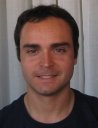
 Ángel F. García-Fernández
· 5 previous affiliations
- Universidad Politécnica de MadridSince 2025
- Associate Professor · Since 2025
- PhD student · 2007–2011
- Undergrad student · 2002–2007
- University of Liverpool2017–2025
- Associate Professor · 2023–2025
- Lecturer · 2017–2023
- Aalto University2016–2017
- Postdoc · 2016–2017
- Curtin University2013–2016
- Postdoc · 2013–2016
- Chalmers University of Technology2012–2013
- Postdoc · 2012–2013
Research Overview
Ángel F. García-Fernández focuses on nonlinear state estimation, Bayesian filtering, and the temporal parallelization of dynamical systems. His trajectory spans foundational improvements to posterior linearization and target tracking using directional statistics, advancing into multi-object tracking for aerial platforms. Recently, his focus has expanded to parallelizing optimal control and dynamic programming to overcome sequential bottlenecks in time-series modeling.
Research Trajectory
Early in his observed trajectory, García-Fernández made significant contributions to the research direction of Iterative Posterior Linearization for Non-Linear State Estimation. A central challenge in classical state estimation is handling non-linear measurements, where standard approaches often linearize the system with respect to a prior distribution. In the first-author work Posterior Linearization Filter: Principles and Implementation Using Sigma Points (2015), García-Fernández established a framework for linearizing the measurement function using statistical linear regression with respect to the posterior rather than the prior. This approach, implemented via sigma points, provided a more accurate incorporation of measurement information into Gaussian approximations of the posterior probability density function.
Building on these principles, his research expanded into complex spatial and navigational domains. By 2019, he applied posterior linearization to simultaneous localization and mapping (SLAM) in the first-author paper Rao-Blackwellized Posterior Linearization Backward SLAM. This work improved upon existing FastSLAM solutions by integrating backward trajectory simulation for smoothing and iterated posterior linearization to refine the Gaussian approximations of landmark distributions. Concurrently, García-Fernández addressed the specific challenges of angular measurements in target tracking. In Gaussian Target Tracking With Direction-of-Arrival von Mises-Fisher Measurements (2019), he proposed a novel Bayesian model that utilized von Mises-Fisher distributions to accurately capture the characteristics of direction-of-arrival data, implementing the algorithm through both Taylor series expansions and sigma points.
A major evolution in his work emerged around 2021, shifting toward the broader area of Temporal Parallelization for Dynamical Systems and themes such as Parallel Associative Scans for Temporal State Space Models. Historically, time-dependent problems in state estimation have been constrained by a sequential bottleneck, where the state at a given time step depends strictly on the preceding one. In Temporal Parallelization of Bayesian Smoothers (2021), García-Fernández and his co-author reformulated Bayesian smoothing equations as all-prefix-sums operations. This mathematical restructuring allowed the use of parallel scan algorithms, effectively reducing the computational complexity of standard smoothing algorithms from linear to logarithmic time.
This parallelization methodology was subsequently extended beyond estimation and into optimal control. In Temporal Parallelization of Dynamic Programming and Linear Quadratic Control (2023), the researchers derived the necessary elements and associative operators to apply parallel scans to dynamic programming. This enabled logarithmic time complexity for linear quadratic tracking and certain classes of nonlinear control problems, demonstrating significant computational benefits when executed on graphics processing units.
Parallel to his theoretical work in computation, García-Fernández has continued to advance applied tracking systems, particularly intersecting with the area of Robust Vision for Unstable Aerial Platforms. In the first-author paper Trajectory Poisson multi-Bernoulli mixture filter for traffic monitoring using a drone (2023), he developed a multi-object tracking algorithm that fuses optical and thermal camera data from drones. By modeling the cameras as direction-of-arrival sensors with von Mises-Fisher distributions, the work successfully applied a Bayesian multi-object tracking framework to optimally estimate vehicle trajectories from the air.
Current Directions
The most recent papers in the evidence indicate a dual focus on high-performance computational methods for control systems and advanced multi-object tracking in dynamic environments. García-Fernández continues to investigate the temporal parallelization of dynamic programming, seeking to resolve sequential bottlenecks in complex, continuous-time optimal control scenarios.
Simultaneously, his work addresses the challenges of tracking and state estimation in real-world, non-linear domains. This includes ongoing research into drone-based traffic monitoring and multi-sensor fusion, aligning with the broader area of The Unimodal Bottleneck in Probabilistic Inference. Additionally, recent collaborative work from 2024 shows his participation as a co-author in computer vision research, specifically exploring cross-frame feature consistency for weakly supervised video salient object detection, indicating an ongoing interest in integrating robust visual feature extraction with sequential data processing.
Profile updated
| Title | Venue | Year |
|---|---|---|
| Proximal Approximate Inference in State-Space Models | arXiv | 2025 |
| Temporal parallelisation of continuous-time maximum-a-posteriori trajectory estimation | arXiv | 2025 |
| On The Performance of Prefix-Sum Parallel Kalman Filters and Smoothers on GPUs | arXiv | 2025 |
| Trajectory Poisson Multi-Bernoulli Mixture Filter for Traffic Monitoring Using a Drone | IEEE Trans. Vehicular Technology | 2024 |
| Cross-frame feature-saliency mutual reinforcing for weakly supervised video salient object detection | Pattern Recognition | 2024 |
| On The Temporal Parallelisation of The Viterbi Algorithm | EUSIPCO | 2023 |
| Temporal Parallelization of Dynamic Programming and Linear Quadratic Control | IEEE Trans. Automatic Control | 2022 |
| Temporal Parallelisation of the HJB Equation and Continuous-Time Linear Quadratic Control | arXiv | 2022 |
| Temporal Parallelization of Bayesian Smoothers | IEEE Trans. Automatic Control | 2021 |
| Temporal Parallelization of Inference in Hidden Markov Models | arXiv | 2021 |
Loading new papers…
Other researchers whose papers cluster into the same research directions — a proxy for overlapping technical interests and shared intellectual neighborhoods.
See something wrong? Report a mistake