

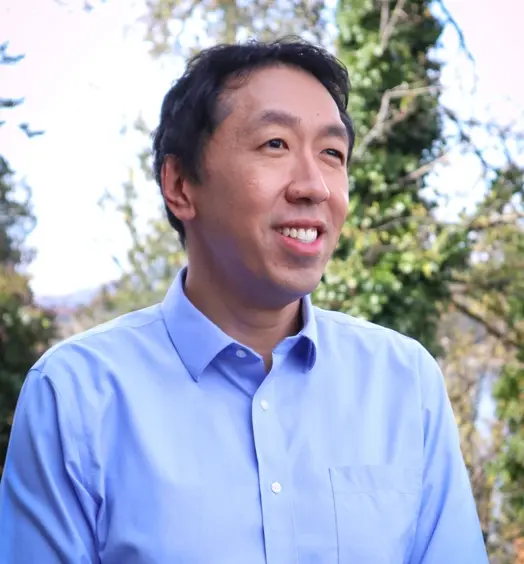
 Andrew Y. Ng
· 1 previous affiliation
- Stanford UniversitySince 2002
- Researcher · Since 2002
Research Overview
Andrew Y. Ng focuses on machine learning, scalable deep learning architectures, and sequential decision making. His trajectory spans foundational work in reinforcement learning and probabilistic modeling to the development of large-scale distributed neural networks and end-to-end speech processing systems. Recently, his research investigates multimodal foundation models, advanced medical imaging diagnostics, and rigorous evaluation paradigms for large language models.
Research Trajectory
His early research addressed foundational challenges in reinforcement learning, planning, and probabilistic modeling. He developed A Sparse Sampling Algorithm for Near-Optimal Planning in Large Markov Decision Processes, introducing an online planning method that scales independently of state space size by utilizing generative models. This work contributed to the research direction of Scaling Sequential Decision Making Beyond the Curse of Dimensionality and the broader area of Multi-Step Lookahead for Robust Planning and Convergence. He also contributed to the introduction of Latent Dirichlet Allocation, a generative model for discovering latent topics in discrete data collections. In the domain of unsupervised learning, he analyzed matrix perturbation theory to provide theoretical grounding and a simplified algorithm in On Spectral Clustering: Analysis and an algorithm, and collaborated on Distance Metric Learning with Application to Clustering with Side-Information to allow users to guide clustering via similarity examples. Applying reinforcement learning to complex physical systems, he led the development of Autonomous Helicopter Flight via Reinforcement Learning, which utilized predictive dynamics models and the PEGASUS algorithm to achieve robust hover and maneuver control.
As deep learning began to demonstrate significant potential, his focus shifted toward scaling neural network architectures and training paradigms. He directed the development of the DistBelief framework in Large Scale Distributed Deep Networks, which introduced distributed training algorithms like Downpour SGD to train models with billions of parameters across thousands of CPU cores. Concurrently, he explored unsupervised feature extraction at scale, demonstrating in Building high-level features using large scale unsupervised learning that a deep sparse autoencoder trained on millions of unlabeled images could autonomously learn class-specific detectors, such as for human faces. To further democratize large-scale training, his group investigated commodity hardware solutions, detailing a high-performance computing approach using GPU clusters and MPI in Deep learning with COTS HPC systems.
During this period, he also advanced representation learning across multiple modalities. For computer vision, he guided work on Convolutional-Recursive Deep Learning for 3D Object Classification, combining convolutional and recursive neural networks to process RGB-D imagery. In natural language processing, he oversaw research into compositional semantics, including Semantic Compositionality through Recursive Matrix-Vector Spaces and Parsing with Compositional Vector Grammars, which integrated syntactically untied recursive neural networks with probabilistic context-free grammars. He also extended neural methods to knowledge graphs in Reasoning With Neural Tensor Networks for Knowledge Base Completion, allowing entities and relations to interact multiplicatively. This multi-domain expertise culminated in significant contributions to speech recognition. He oversaw the creation of Lexicon-Free Conversational Speech Recognition with Neural Networks, which replaced complex traditional pipelines with an end-to-end neural network mapping acoustics directly to characters. He subsequently participated in the large-scale collaborative effort Deep Speech 2 : End-to-End Speech Recognition in English and Mandarin, advancing the research direction of Consolidating Multi-Stage Speech Pipelines into End-to-End Networks by demonstrating that a single architecture could handle vastly different languages.
More recently, his trajectory has encompassed medical artificial intelligence and the evaluation of multimodal foundation models. He directed the creation of CheXpert: A Large Chest Radiograph Dataset with Uncertainty Labels and Expert Comparison, providing a massive dataset with automated uncertainty extraction from radiology reports to train models that rival expert performance. Continuing to probe the capabilities of large-scale models, he investigated context window scaling in Many-Shot In-Context Learning in Multimodal Foundation Models, benchmarking systems across diverse imagery domains. He also contributed to UQ: Assessing Language Models on Unsolved Questions, exploring dynamic, asynchronous evaluation paradigms to better measure frontier model capabilities. Returning to clinical applications, he collaborated on STARC-9: A Large-scale Dataset for Multi-Class Tissue Classification for CRC Histopathology, supporting the development of semi-automated curation frameworks for cancer diagnosis.
Current Directions
The most recent papers in the evidence indicate a dual focus on the capabilities of frontier foundation models and the application of deep learning to specialized medical domains. Recent work investigates the scaling behavior of multimodal foundation models, particularly how extended context windows enable many-shot in-context learning across diverse visual domains, from natural images to remote sensing. Concurrently, there is an emphasis on developing more rigorous, realistic evaluation paradigms for large language models by assessing them on unsolved questions rather than static, exam-style benchmarks. In the clinical sphere, recent collaborative efforts continue to address data bottlenecks in medical imaging, focusing on large-scale, high-quality dataset curation for tasks such as histopathology tissue classification to improve the generalizability and reliability of diagnostic models.
Profile updated
Loading new papers…
Other researchers whose papers cluster into the same research directions — a proxy for overlapping technical interests and shared intellectual neighborhoods.
See something wrong? Report a mistake