

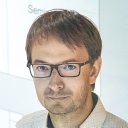
 Andreas Geiger
· 4 previous affiliations
- University of TübingenSince 2018
- Professor · Since 2018
- ETH Zurich2016–2018
- Assistant Professor · 2016–2018
- Max Planck Society2013–2016
- Research Scientist · 2013–2016
- Karlsruhe Institute of Technology2008–2013
- PhD Student · 2008–2013
Research Overview
Andreas Geiger focuses on computer vision, machine learning, and autonomous driving, developing models for 3D reconstruction, generative scene synthesis, and vehicle motion planning. His trajectory spans early foundational benchmarks for mobile robotics to recent advances in neural implicit representations and generative simulation. Currently, his work addresses scalable reinforcement learning for autonomous agents and pixel-space diffusion for monocular geometry estimation.
Research Trajectory
In the early 2010s, his research centered on foundational computer vision for robotics. He developed methods for fast matching of high-resolution images in Efficient Large-Scale Stereo Matching, utilizing a triangulation prior to reduce ambiguities. This practical focus on real-world perception culminated in the introduction of Vision meets robotics: The KITTI dataset, a comprehensive suite of traffic scenarios captured with diverse sensor modalities that became a cornerstone for autonomous driving research. Building on this, he addressed 3D motion modeling in Object scene flow for autonomous vehicles, jointly optimizing superpixel geometry and object-level motion by assuming scenes consist of rigidly moving objects.
Moving into the mid-to-late 2010s, his focus expanded toward deep learning, generative models, and complex 3D representations. He investigated the theoretical underpinnings of adversarial networks, analyzing the necessity of absolute continuity for convergence in Which Training Methods for GANs do actually Converge?. During this era, his research also encompassed the broader area of Optimizing the Mixing Ratio of Synthetic and Real Data and work in Mitigating Dynamic Object Interference in Visual SLAM.
A significant advancement in 3D reconstruction arrived with Occupancy Networks: Learning 3D Reconstruction in Function Space. This work introduced a novel continuous representation for high-resolution geometry, modeling 3D surfaces as the decision boundary of a neural network and catalyzing extensive work in the research direction of Neural Implicit Surface Representations. With collaborators, he subsequently advanced this paradigm by enabling training without 3D ground truth in Differentiable Volumetric Rendering: Learning Implicit 3D Representations Without 3D Supervision, deriving analytic gradients to learn continuous implicit representations directly from 2D images.
By 2021, his work increasingly integrated multi-modal perception and 3D-aware generative modeling. In autonomous driving, he explored bridging the semantic-geometric gap with Multi-Modal Fusion Transformer for End-to-End Autonomous Driving, utilizing global self-attention to integrate camera and LiDAR data. Concurrently, he advanced the area of Compositional Generative Models for Multi Object 3D Scenes with GIRAFFE: Representing Scenes As Compositional Generative Neural Feature Fields. This model disentangles objects and backgrounds, allowing explicit control over 3D scenes trained solely on unlabelled image collections. This period also saw contributions to the broader direction of Generative Simulation for Scaling Embodied AI.
In 2024, his trajectory scaled up self-supervision, open-vocabulary understanding, and generative simulation. He developed methods for unsupervised part discovery from coherent motion in LISO: Lidar-only Self-Supervised 3D Object Detection, leveraging lidar scene flow to train detectors without manual annotations. He also addressed limitations in vision-language models by refining dataset taxonomies in Renovating Names in Open-Vocabulary Segmentation Benchmarks. In multi-view perception, his group contributed to GTA: A Geometry-Aware Attention Mechanism for Multi-View Transformers. Returning to autonomous driving simulation, he introduced a generative simulator for vehicle motion planning in SLEDGE: Synthesizing Simulation Environments for Driving Agents with Generative Models, which models road network topology and generates agent bounding boxes and lane graphs from real-world driving logs.
In 2026, Geiger's research expanded across interpretability in multi-view architectures, articulation inference, controllable generation, and model efficiency. Geiger contributed to Understanding Multi-View Transformers, analyzing the internal representations of feed-forward 3D networks through layer-wise probes to uncover how single-view and cross-view attention progressively solve multi-view alignment and intra-view geometry. Expanding structural perception, Geiger guided ViewStruct: View-Grounded Articulation and Connectivity Inference, which adapts vision-language models to infer rigid part groupings and joint parameters in view-relative frames without per-instance optimization. In generative modeling, Geiger co-developed Trajectory Forcing: Structure-First Generation with Controllable Semantic Trajectories, and explored memory dynamics in Echoes of the Prior: A Computational Phenomenology of Forgetting (also detailed on arXiv). Additionally, Geiger co-authored UniComp: A Unified Evaluation of Large Language Model Compression via Pruning, Quantization and Distillation to systematically benchmark language model compression techniques.
Current Directions
The most recent papers in the evidence address scalable autonomous driving policies and highly efficient paradigms for 3D reconstruction. In the domain of vehicle motion planning, recent work investigates reinforcement learning formulations that replace complex, engineered reward functions with simple, scalable objectives, as seen in CaRL: Learning Scalable Planning Policies with Simple Rewards. This is complemented by efforts to systematically expose structural flaws and reliance on brittle shortcuts in closed-loop driving models, demonstrated in PlanT 2.0: Exposing Biases and Structural Flaws in Closed-Loop Driving.
Simultaneously, his recent research advances monocular geometry estimation and rendering efficiency. This includes collaborative research applying diffusion models directly to raw 3D point maps in pixel space with PointDiT: Pixel-Space Diffusion for Monocular Geometry Estimation, and joint work reimagining 3D reconstruction as an online learning problem via test-time training in TTT3R: 3D Reconstruction as Test-Time Training. Furthermore, he is optimizing 3D Gaussian Splatting through error-guided densification strategies, as detailed in ConeGS: Error-Guided Densification Using Pixel Cones for Improved Reconstruction with Fewer Primitives. These efforts align with his broader interest in the research direction of Eliminating Per-Scene Optimization with Feed-Forward 3D Reconstruction.
Profile updated
Loading new papers…
Other researchers whose papers cluster into the same research directions — a proxy for overlapping technical interests and shared intellectual neighborhoods.
See something wrong? Report a mistake