

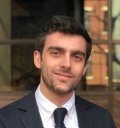
 Andrea Agazzi
· 7 previous affiliations
- University of BernSince 2024
- Professor of Applied Stochastics · Since 2024
- University of Pisa2022–2024
- Assistant Professor · 2022–2024
- Duke University2018–2022
- Postdoc · 2018–2022
- University of Geneva2013–2017
- PhD Candidate · 2013–2017
- Statistical Consultant · 2015
- Graduate Teaching Assistant · 2013–2014
- Stanford University2013–2017
- PhD Candidate · 2013–2017
- Statistical Consultant · 2015
- Imperial College London2012–2013
- Master of Science (MS), Theoretical and Mathematical Physics · 2012–2013
- ETH Zurich2009–2012
- Bachelor of Science (BS), Physics · 2009–2012
Research Overview
Andrea Agazzi focuses on the mathematical foundations of machine learning, analyzing the training dynamics of neural networks and reinforcement learning algorithms through the lens of mean-field theory and continuous dynamical systems. His trajectory spans from proving global optimality in policy optimization and recurrent architectures to designing incentive mechanisms for resource allocation. Most recently, his work investigates the geometric evolution of token representations in transformer models.
Research Trajectory
Agazzi's early work established rigorous convergence guarantees for reinforcement learning with nonlinear function approximation. In Global optimality of softmax policy gradient with single hidden layer neural networks in the mean-field regime (2021), he modeled the training dynamics of wide neural networks as a Wasserstein gradient flow, proving the global optimality of fixed points under entropy regularization. This contributed to the broader areas of Global Convergence of Entropy Regularized Policy Optimization and Neural Network Training as Wasserstein Gradient Flow. He extended this analytical framework to value-based methods in Temporal-difference learning with nonlinear function approximation: lazy training and mean field regimes, demonstrating a theoretical trade-off between the convergence guarantees of the "lazy training" regime and the expressivity of the mean-field regime. This work advanced the research direction of The Non-Linear Function Approximation Gap in Reinforcement Learning.
Concurrently, Agazzi participated in research on multi-agent systems and resource allocation. In Urgency-aware optimal routing in repeated games through artificial currencies (2021), he collaborated on an incentive mechanism using an artificial currency to align selfish routing choices with system-optimal traffic flow. He later expanded on these concepts in Fair Artificial Currency Incentives in Repeated Weighted Congestion Games: Equity vs. Equality (2024), proposing pricing policies that balance system efficiency with distinct notions of fairness for users with varying congestion contributions.
Returning to policy optimization and continuous dynamics, Agazzi and collaborators addressed local optima in the Linear Quadratic Regulator (LQR) problem with non-linear controls. In A Homotopic Approach to Policy Gradients for Linear Quadratic Regulators with Nonlinear Controls (2022), they introduced a homotopy method that gradually increases the discount factor to guide policies toward global optima. Expanding his mean-field analysis to sequence modeling, he established a rigorous foundation for recurrent architectures in Global optimality of Elman-type RNNs in the mean-field regime (2023). This paper proved that wide Elman-type RNNs trained with gradient descent converge to globally optimal solutions while actively learning features, distinguishing the mean-field regime from fixed-kernel approaches.
In his most recent work, Agazzi has focused on the quantitative dynamics of wide neural networks and the internal mechanisms of transformers. In Quantitative convergence of trained neural networks to Gaussian processes (2025), he provided rigorous bounds on the convergence rate of trained shallow networks to Gaussian Processes as width increases, utilizing the quadratic Wasserstein distance. This work addresses challenges in the areas of The Temporal Fragility of Infinite Width Limits and Unified Error Decomposition for Neural Differential Equation Solvers. Simultaneously, his research group has developed mathematical frameworks to explain token representation dynamics in attention mechanisms. In Emergence of meta-stable clustering in mean-field transformer models (2025), they modeled tokens as interacting particles on a sphere, proving that tokens form meta-stable clusters before reaching total consensus. This contributed to the research direction of Dynamic Metastability in Transformer Self Attention. They further unified these token dynamics in A multiscale analysis of mean-field transformers in the moderate interaction regime (2025), identifying distinct phases of behavior—Alignment, Heat, and Pairing—that explain how transformers compress information and build abstract representations.
Current Directions
The most recent papers in the evidence indicate a strong focus on the mathematical dynamics of modern deep learning architectures, particularly transformers and wide neural networks. Agazzi's current work investigates the geometric evolution of token representations, treating self-attention mechanisms as interacting particle systems to rigorously explain phenomena like meta-stable clustering and information compression across network layers. Additionally, he continues to refine the theoretical understanding of infinite-width limits, developing quantitative bounds for the convergence of trained networks to Gaussian processes to better characterize the neural tangent kernel regime during the actual training process.
Profile updated
Loading new papers…
Other researchers whose papers cluster into the same research directions — a proxy for overlapping technical interests and shared intellectual neighborhoods.
See something wrong? Report a mistake