

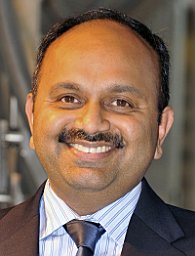
 Amitabh Varshney
· 5 previous affiliations
- University of Maryland, College ParkSince 2000
- Director, University of Maryland Institute for Advanced Computer Studies · Since 2010
- Full Professor · Since 2006
- Associate Professor · 2000–2006
- Dean · Since 2018
- Stony Brook University1994–2000
- Assistant Professor of Computer Science · 1994–2000
- PhD, Computer Science · 1989–1994
- Indian Institute of Technology Delhi1985–1989
- Undergrad student · 1985–1989
Research Overview
Amitabh Varshney focuses on immersive computer graphics, virtual reality, and neural scene representations. His research trajectory spans foveated rendering techniques for high-resolution displays to the development of continuous implicit neural representations for light fields and 3D environments. His most recent work addresses volumetric capture for cinematic-quality virtual reality and the evaluation of fairness and reliability in clinical artificial intelligence systems.
Research Trajectory
Varshney’s early work heavily emphasized the optimization of immersive visual experiences, particularly through foveated rendering and 360-degree environments. He developed Kernel Foveated Rendering, a GPU-driven pipeline that accelerates interactive 3D graphics by parameterizing foveation to mimic the human retina's photoreceptor distribution. Expanding into mixed reality, his lab created Geollery: A Mixed Reality Social Media Platform, a system that progressively renders interactive mirrored worlds integrating user-generated and geotagged content. To support panoramic content, he introduced Deep Depth Estimation on 360° Images with a Double Quaternion Loss, utilizing an adaptive depth refinement procedure and double quaternion approximation to measure stereo consistency. This focus on 360-degree environments continued with A Log-Rectilinear Transformation for Foveated 360-degree Video Streaming, which addressed the bandwidth challenges of high-resolution VR headsets by mitigating aliasing and flickering artifacts. He further extended these optimization strategies to complex light fields in 3D-Kernel Foveated Rendering for Light Fields.
Alongside his core graphics work, Varshney has participated in distributed machine learning research, contributing to the area of Bidirectional Compression for Communication Efficient Distributed Learning and the broader direction of Communication Efficient Federated Fine-tuning of Foundation Models. This is exemplified by his collaborative work on Comfetch: Federated Learning of Large Networks on Memory-Constrained Clients via Sketching, an algorithm utilizing Count Sketch to compress model parameters for mobile devices.
Returning to visual computing, his research shifted toward the emerging field of Continuous Image Representation via Implicit Neural Fields. He introduced VIINTER: View Interpolation with Implicit Neural Representations of Images, a method for synthesizing novel views without requiring explicit 3D scene structure or camera poses. Building on implicit representations, he developed PRIF: Primary Ray-Based Implicit Function, a novel shape representation that operates directly on oriented rays to produce surface hit points, bypassing expensive sphere-tracing operations for efficient shape extraction.
In recent years, Varshney's graphics research has concentrated heavily on optimizing light fields and volumetric capture. Contributing to the research direction of Continuous Level of Detail for Neural Scene Representations, he presented Continuous Levels of Detail for Light Field Networks, which enables smooth transitions between detail levels to reduce flickering and bandwidth spikes during real-time streaming. He further refined light field compression with Neural Subspaces for Light Fields, proposing a framework that utilizes several small, specialized neural networks rather than a single unified model to facilitate rapid transmission and decoding. To acquire the high-fidelity data necessary for these environments, he led the development of HoloCamera: Advanced Volumetric Capture for Cinematic-Quality VR Applications. This room-sized instrument features 300 high-resolution cameras and a distributed GPU array to rapidly process and stream 4K light fields for virtual avatars and scenarios.
Most recently, Varshney has expanded his collaborative efforts into clinical artificial intelligence and algorithmic fairness. He contributed to Detecting and Monitoring Bias for Subgroups in Breast Cancer Detection AI, a study analyzing performance degradation across demographic subgroups. This work aligns with the research direction of Subgroup Performance Masking in Machine Learning Evaluation, proposing a CUSUM-based monitoring system to detect performance drifts and ensure equitable AI deployment in healthcare settings.
Current Directions
Varshney's most recent work investigates two distinct but highly impactful domains: high-fidelity volumetric capture for virtual reality and the reliability of clinical artificial intelligence. In visual computing, he is advancing the hardware and software architectures required for cinematic-quality VR, focusing on distributed GPU processing and specialized neural network structures to rapidly acquire, compress, and stream complex light fields. Concurrently, his collaborative research in medical AI addresses the critical need for equitable clinical models. This work involves developing statistical monitoring systems to detect performance drift and mitigate bias across specific demographic subgroups, ensuring that high-performing diagnostic tools remain reliable for all patient populations.
Profile updated
Loading new papers…
Other researchers whose papers cluster into the same research directions — a proxy for overlapping technical interests and shared intellectual neighborhoods.
See something wrong? Report a mistake