

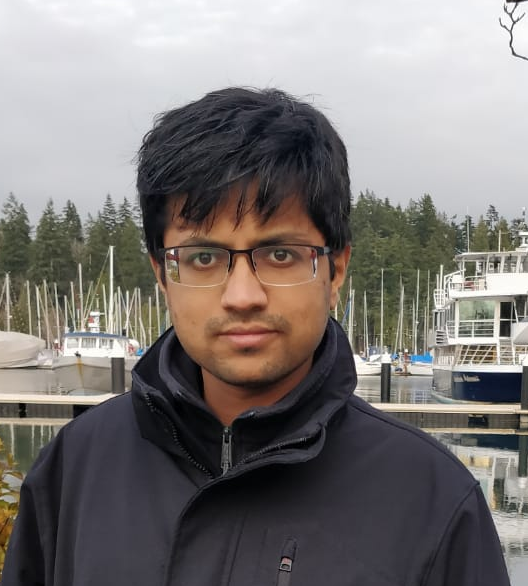
 Ameya Joshi
· 5 previous affiliations
- Playground Inc.Since 2025
- Researcher · Since 2025
- InstaDeep2023–2025
- Researcher · 2023–2025
- New York University2020–2023
- PhD Student · 2020–2023
- Iowa State University2018–2019
- PhD student · 2018–2019
- Undergrad student · 2010–2014
Research Overview
Ameya Joshi focuses on adversarial robustness, efficient neural network compression, and privacy-preserving inference. His trajectory spans from generative data augmentation and robust learning algorithms to certified defenses for vision transformers and large multimodal models. Recent work investigates scalable methods for secure multi-party computation and the formal certification of zero-shot vision-language architectures.
Research Trajectory
Joshi's early collaborative work involved medical image analysis, specifically participating in the Selective visualization of anomalies in fundus images via sparse and low rank decomposition (2014). He subsequently explored the intersection of generative modeling and computer vision. He introduced Semantic Adversarial Attacks: Parametric Transformations That Fool Deep Classifiers (2019), demonstrating that deep classifiers are vulnerable to natural-looking, attribute-level modifications—such as changing hair color or adding accessories—generated by conditional models, moving beyond traditional imperceptible pixel-level noise. In a related application of generative models, he contributed to Attribute-Controlled Traffic Data Augmentation Using Conditional Generative Models (2019), which synthesized diverse, semantically valid traffic scenes to improve the robustness of autonomous vehicle perception systems under varying lighting and weather conditions.
Expanding into scientific machine learning and model efficiency in 2020, Joshi participated in developing distributed computing frameworks for training large, data-free neural network solvers for complex partial differential equations in Deep Generative Models that Solve PDEs: Distributed Computing for Training Large Data-Free Models. Concurrently, he addressed the research areas of Hardware Friendly Sparsity for Practical Neural Network Compression and Generalizing Model Pruning Across Diverse Neural Architectures by co-developing ESPN: Extremely Sparse Pruned Networks. This algorithm combined single-shot pruning with iterative mask discovery to achieve massive compression ratios, enabling the deployment of deep learning models in resource-constrained environments.
His focus on robustness deepened in 2021. With collaborators, he proposed a novel loss function in Adversarially Robust Learning via Entropic Regularization, which sampled adversarial examples from a specialized distribution to improve classification accuracy under attack. He also contributed to foundational optimization techniques in Differentiable Spline Approximations, extending gradient-based optimization to piecewise polynomial models via block-sparse Jacobian structures. Returning to adversarial vulnerabilities, he identified critical weaknesses in emerging architectures with Adversarial Token Attacks on Vision Transformers, showing that Vision Transformers (ViTs) are highly sensitive to perturbations in a small number of input tokens compared to traditional convolutional networks.
To defend against such vulnerabilities, Joshi advanced the research direction of Provable L2 Radius Guarantees through Noise Sampling by developing Smooth-Reduce: Leveraging Patches for Improved Certified Robustness (2022). This training-free method aggregated randomized smoothing predictions over overlapping patches to achieve larger certified radii without requiring expensive model retraining. In parallel, he addressed the broader area of Mitigating the Computational Overhead of Encrypted Machine Learning with Selective Network Linearization for Efficient Private Inference, a gradient-based algorithm that strategically replaced expensive ReLU activations with linear functions to optimize latency in secure multi-party computation.
Investigating natural distribution shifts in 2023, Joshi co-authored Distributionally Robust Classification on a Data Budget, which introduced the JANuS dataset collection to study robust learning when training data is limited. This was complemented by Caption supervision enables robust learners: a controlled study of distributionally robust model training, demonstrating that standard convolutional networks can achieve robustness comparable to vision-language models when trained with image-linked text as ground-truth labels.
Joshi's recent trajectory synthesizes his expertise in robustness, scientific computing, and privacy. In 2024, he co-developed Fast Certification of Vision-Language Models Using Incremental Randomized Smoothing, introducing a method to rapidly certify zero-shot models like CLIP by caching and reusing prompt information. In scientific machine learning, he contributed to NeuFENet: neural finite element solutions with theoretical bounds for parametric PDEs, a mesh-based approach providing theoretical convergence guarantees for neural PDE solvers. Finally, he participated in adapting transformer architectures for secure environments in PriViT: Vision Transformers for Private Inference, which selectively Taylorizes nonlinearities to make ViTs compatible with multi-party computation protocols.
Current Directions
The most recent papers in the evidence indicate a dual focus on scaling formal guarantees for foundation models and adapting modern architectures for secure deployment. Recent work investigates the rapid certification of zero-shot vision-language models, utilizing incremental randomized smoothing and caching techniques to make the verification of large-scale multimodal systems computationally tractable. Concurrently, ongoing research addresses the intersection of cryptography and deep learning, specifically modifying Vision Transformer architectures to support efficient, privacy-preserving inference under secure multi-party computation protocols. Additionally, there is a continued interest in scientific machine learning, emphasizing neural PDE solvers that incorporate finite element methods to provide strict theoretical convergence bounds and exact boundary constraints.
Profile updated
Loading new papers…
Other researchers whose papers cluster into the same research directions — a proxy for overlapping technical interests and shared intellectual neighborhoods.
See something wrong? Report a mistake