

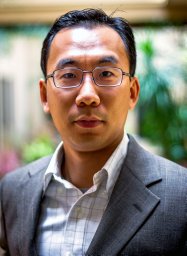
 Allen Yang
· 6 previous affiliations
- University of California, BerkeleySince 2006
- Executive Director · Since 2016
- Principal Investigator · Since 2006
- NSF/Haas Business School Innovation Corps, Summer 2015, Entrepreneurship/Entrepreneurial Studies · 2015
- Grafty Inc.Since 2015
- Co-Founder & CTO · Since 2015
- SkyDeck BerkeleySince 2017
- Faculty in Residence · Since 2017
- FHL Vive Center for Enhanced RealitySince 2018
- Executive Director · Since 2018
- Principal Investigator · 2006–2022
- PhD, ECE · 2001–2006
Research Overview
Allen Yang focuses on computer vision, sparse signal representation, and compressive sensing. His early research established foundational methods for face recognition using L1-minimization and distributed object recognition in constrained networks. The most recent work in his active publication period addresses nonlinear extensions of compressive sensing and human-in-the-loop decision making for autonomous systems.
Research Trajectory
Allen Yang’s early research focused on core problems in computer vision and image processing, with an emphasis on clustering and distributed recognition. In 2008, as first author, he investigated the use of lossy data compression for mid-level image segmentation. In Unsupervised segmentation of natural images via lossy data compression, Yang and his collaborators modeled texture features as multivariate mixed data using Gaussian mixtures. By allowing the mixture components to be degenerate—a common occurrence when using shared feature representations for different textures—the work demonstrated that agglomerative clustering derived from data compression principles could effectively segment natural images. The following year, he led research into visual surveillance under hardware constraints. The first-author paper Multiple-view object recognition in band-limited distributed camera networks (2009) proposed a framework for networks of smart cameras, utilizing local computational power on the sensors to extract and compress features, thereby compensating for low bandwidth and visual nuisances like occlusion.
Beginning in 2009, Yang’s trajectory shifted significantly toward the application of sparse signal representation in computer vision. He was the second author on Robust Face Recognition via Sparse Representation (2009), which cast face recognition as a problem of classifying among multiple linear regression models. By leveraging L1-minimization, the proposed Sparse Representation-based Classification (SRC) framework provided a robust method for identifying human faces despite severe real-world nuisances such as varying illumination, occlusion, and disguise. This direction became a major theme of his work over the next several years, leading to further investigations into the theoretical validity and computational efficiency of sparse error correction. Recognizing that the computational cost of L1-minimization was a bottleneck for practical applications, Yang led the development of optimized solvers in the first-author paper Fast L1-Minimization Algorithms for Robust Face Recognition (2013), which sought to make the SRC framework viable for broader deployment.
Around 2013, Yang’s work in compressive sensing expanded beyond linear models to address nonlinear relationships between measurements and unknowns. As second author on Quadratic Compressive Sensing - A Nonlinear Extension of Compressive Sensing (2013), he helped extend the classical compressive sensing framework using a second-order Taylor expansion. By employing a lifting technique, the research provided a method to more accurately characterize nonlinear dynamics that traditional linear approximations would otherwise treat as noise, opening up applications in areas like phase retrieval.
In the latter part of his active publication record, Yang applied his expertise in modeling and optimization to cyber-physical systems and control. In Improving human-in-the-loop decision making in multi-mode driver assistance systems using hidden mode stochastic hybrid systems (2015), he and his co-authors addressed the limitations of commercial automatic braking and lane-keeping systems that typically ignore the state of the human driver. As second author, Yang contributed to a framework that monitored both human behavior and vehicle state, using hidden mode stochastic hybrid systems to infer the driver's state and compute optimal control policies for system intervention.
Current Directions
The most recent papers in the evidence, dating from 2015 and 2016, indicate a diversification of Yang’s research into human-in-the-loop systems and advanced manifold learning. Building on his prior work in sparse representation, his recent collaborative efforts investigate single-sample face recognition, utilizing sparse illumination learning and transfer techniques to handle image corruption and misalignment when only one gallery image is available per class.
Additionally, recent work explores the geometric structure of data for computer vision and machine learning tasks. This includes participation in developing locality-preserving low-rank representations for graph construction, which extends traditional low-rank representation models from linear subspaces to nonlinear manifolds. Concurrently, his research addresses applied decision-making in autonomous and semi-autonomous systems, specifically focusing on how stochastic hybrid systems can be used to model human-vehicle interaction and improve the safety and efficacy of multi-mode driver assistance technologies.
Profile updated
Loading new papers…
Other researchers whose papers cluster into the same research directions — a proxy for overlapping technical interests and shared intellectual neighborhoods.
See something wrong? Report a mistake