

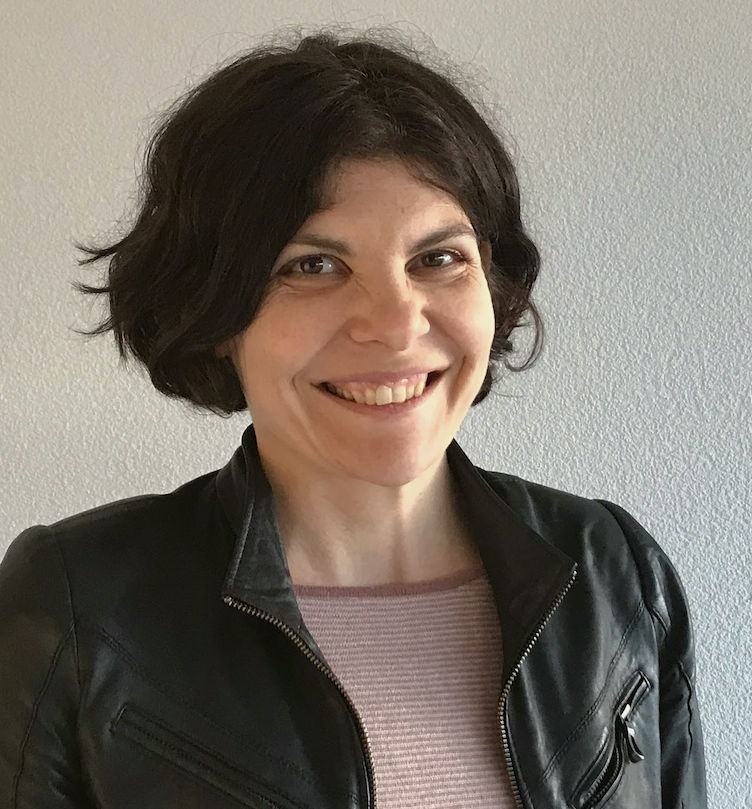
 Alisa Rupenyan
· 7 previous affiliations
- Innosuisse – Swiss Innovation AgencySince 2021
- Expert · Since 2021
- Stiftung Rieter endowed professor and group leader for Industrial AI · Since 2023
- obvioTec AG2022–2023
- Advisory Board Member · 2022–2023
- Inspire2018–2023
- Group leader Advanced Controls at inspire / ETH Zurich · 2018–2023
- ETH Zurich2018–2023
- Senior Scientist Group Lead · 2020–2023
- Group leader · 2018–2023
- Vrije Universiteit Amsterdam2005–2009
- Doctor of Philosophy (Ph.D.), Physical Sciences, Time-resolved laser spectroscopy for studying photoreactions · 2005–2009
- Master's degree, Laser Physics and Optics · 2003–2004
Research Overview
Alisa Rupenyan focuses on intelligent manufacturing systems, integrating optimization and artificial intelligence to enhance autonomous control. Her trajectory spans real-time predictive control for precision machining, safe exploration using Gaussian processes, and data-driven controller tuning. Currently, she investigates the manipulation of deformable objects and multi-fidelity Bayesian optimization leveraging digital twins to bridge simulation and physical deployment.
Research Trajectory
Early work in Rupenyan's trajectory addressed high-performance control architectures for industrial applications. In Real-Time Predictive Control for Precision Machining (2019), she and her collaborators developed a Model Predictive Contouring Control (MPCC) framework that shifted from global to local curvilinear coordinates. This approach reduced computational complexity, enabling sub-millisecond real-time control while maintaining micrometer-level tracking tolerances. Exploring reinforcement learning for physical systems, she subsequently participated in research on sim-to-real transfer for autonomous vehicles. The study Learning from Simulation, Racing in Reality (2021) demonstrated that a policy trained purely in simulation with model randomization could successfully transfer to a miniature race car platform, utilizing a regularized policy output to enable aggressive yet smooth driving.
A major theme in her research is the application of Bayesian Optimization (BO) to complex manufacturing processes and controller tuning. In Performance-based Trajectory Optimization for Path Following Control Using Bayesian Optimization (2021), she introduced a sample-efficient joint tuning algorithm that models performance metrics as Gaussian processes to optimize cascade controller parameters. Expanding this methodology to materials processing, Plasma Spray Process Parameters Configuration using Sample-efficient Batch Bayesian Optimization applied a batch BO framework to Atmospheric Plasma Spraying. By integrating physical domain knowledge with a parallelized acquisition strategy, this work reduced the need for expensive physical experiments, contributing to the broader research direction of Feasibility-First Search for Constrained Optimization.
As manufacturing environments become increasingly interconnected, her research expanded to cyber-physical systems. She led work on Controller-Aware Dynamic Network Management for Industry 4.0 (2022), proposing a dynamic network management framework that allocates resources based on controller-dependent run-time specifications, ensuring the performance of physical processes in constrained digital environments.
Returning to controller tuning, she focused on formalizing safety and stability guarantees. Safety-Aware Cascade Controller Tuning Using Constrained Bayesian Optimization (2023) presented a data-driven method for automatically tuning industrial cascade controllers while ensuring system stability. Addressing real-world noise, Safe Risk-Averse Bayesian Optimization for Controller Tuning introduced RAGoOSe, a BO framework that combines risk-averse optimization with safety constraints to handle heteroscedastic (input-dependent) noise in high-precision motion systems. This body of work significantly advanced the area of Bayesian Optimization for Physical Controller Tuning.
In 2024, her focus shifted toward real-time adaptation and dynamic environments. Adaptive Bayesian Optimization for High-Precision Motion Systems proposed a purely data-driven, model-free approach for the online tuning of low-level controller parameters, adapting safe BO algorithms for real-time critical scenarios. Concurrently, she contributed to Safe Time-Varying Optimization based on Gaussian Processes with Spatio-Temporal Kernel, which developed the TVSAFEOPT algorithm. By leveraging spatio-temporal Gaussian Processes, this method proactively adjusts safe sets in dynamic environments, advancing the research direction of The Sensitivity of Lipschitz Bounds in Safe Learning.
Her most recent work demonstrates a broadening scope into multi-fidelity methods, soft robotics, and iterative learning. Efficient safe learning for controller tuning with experimental validation (2025) reformulated safe learning to avoid exhaustive searches, achieving faster tuning through smart initialization. In the domain of soft robotics, Differentiable Material Point Method for the Control of Deformable Objects introduced a differentiable simulator using higher-order integration and automatic differentiation to actively damp hyperelastic materials. To bridge simulation and reality more efficiently, Guided Multi-Fidelity Bayesian Optimization for Data-driven Controller Tuning with Digital Twins developed a framework that dynamically weights simulation data from digital twins against physical trials. Finally, Iterative Learning Predictive Control for Constrained Uncertain Systems combined Model Predictive Control with set-membership identification, contributing to the area of Precision Through Repetition in Iterative Learning Control by safely optimizing repetitive systems while reducing control conservatism.
Current Directions
The most recent work in the evidence points toward increasingly dynamic and complex applications of industrial AI. Current research investigates the integration of digital twins with multi-fidelity Bayesian optimization to accelerate sim-to-real transfer, reducing the reliance on expensive physical trials by intelligently correcting simulation data. Additionally, there is a distinct focus on the control of highly deformable objects using differentiable physics simulators, moving beyond rigid body dynamics to handle soft materials in manufacturing contexts. Another active area involves refining safe exploration in time-varying environments and combining iterative learning with predictive control to guarantee robust constraint satisfaction in repetitive manufacturing tasks.
Profile updated
Loading new papers…
Other researchers whose papers cluster into the same research directions — a proxy for overlapping technical interests and shared intellectual neighborhoods.
See something wrong? Report a mistake