

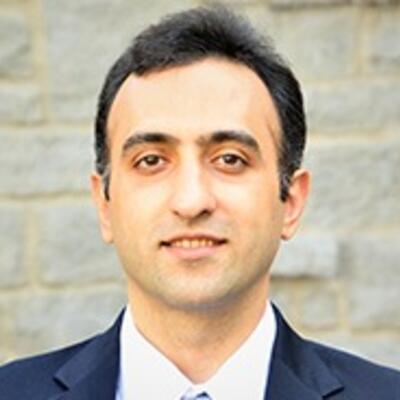
 Alireza Aghasi
· 2 previous affiliations
- Oregon State UniversitySince 2022
- Associate Professor · Since 2022
- Georgia State University2017–2022
- Assistant Professor · 2017–2022
Research Overview
Alireza Aghasi focuses on the intersection of optimization theory, high-dimensional signal processing, and machine learning. His work emphasizes the development of algorithms with rigorous mathematical guarantees for complex, large-scale systems, ranging from deep neural network compression to distributed resource allocation in infrastructure and autonomous networks. By leveraging tools from convex optimization and high-dimensional probability, he addresses fundamental challenges in data science, including missing data robustness, model interpretability, and the stability of multi-agent systems.
Research Trajectory
The evolution of Aghasi’s research reflects a consistent application of convex optimization to increasingly complex and decentralized problems. His early work was rooted in signal and information processing, specifically addressing inverse problems and shape analysis. In 2016, he introduced a framework for Object Learning and Convex Cardinal Shape Composition, which utilized convex proxies to solve combinatorial problems in 2D and 3D object decomposition. This period marked a focus on replacing computationally expensive non-convex formulations with scalable convex alternatives that maintain recovery guarantees.
As deep learning became a dominant paradigm, Aghasi transitioned toward Identifying and Eliminating Parameter Redundancy in Deep Networks. His research in this area sought to move beyond heuristic pruning methods by providing theoretical foundations for model compression. This work contributed to the broader effort of Certifying Neural Networks via Linear Bound Propagation, ensuring that compressed models remain robust and performant. During this time, he also addressed bilinear inverse problems, developing methods to recover sparse vectors from entrywise products without the need for high-dimensional lifting.
Starting around 2020, his focus shifted significantly toward distributed optimization and multi-agent systems. This transition addressed the need for scalable algorithms in decentralized environments, such as smart grids and autonomous vehicle networks. A central theme in this phase is Anytime Feasible Optimization for Safety-Critical Systems, where algorithms must satisfy physical constraints at every iteration, not just at convergence. This research has direct implications for managing Ramp Rate Constraints in Power Grid Optimization, where instantaneous balance between supply and demand is critical.
Current Directions
Aghasi’s current research program is characterized by three primary pillars: distributed resource allocation (DRA), robustness to data uncertainty, and the optimization of autonomous systems. In the domain of DRA, he investigates how multi-agent systems can solve global optimization problems locally while remaining resilient to communication noise and network topology changes. This includes surveying the landscape of primal, dual, and ADMM-based frameworks to identify scalable solutions for critical infrastructure.
His work on data uncertainty focuses on statistical learning in the presence of missing or corrupted information. Rather than relying on traditional imputation techniques, he develops "certain models" and robust regression frameworks that treat missing values as sources of statistical uncertainty to be managed within the optimization process. This approach aims to reduce the preprocessing burden in machine learning pipelines while improving the reliability of the resulting models.
Most recently, he has applied these distributed optimization techniques to autonomous vehicle platooning. This work addresses the challenges of limited communication bandwidth and the need for exact convergence in high-speed, safety-critical environments. By integrating Model Predictive Control (MPC) with quantized communication strategies, he seeks to enable coordinated movement in autonomous networks with minimal data overhead.
Representative Work
Convex Shape Composition and Inverse Problems
In Object Learning and Convex Cardinal Shape Composition, Aghasi proposed a framework for decomposing complex objects into a set of overlapping prototype shapes. By formulating the problem as a convex program, the work achieved significant computational speedups over traditional combinatorial approaches. This methodology provided a foundation for shape recovery in high-noise environments with rigorous mathematical guarantees. He extended these optimization principles to bilinear inversion in A convex program for bilinear inversion of sparse vectors, where he introduced the $\ell_1$-BranchHull framework. This approach allows for the recovery of sparse vectors from their products without the computational cost of lifting the problem into higher dimensions, scaling nearly linearly with the total sparsity of the vectors.
Neural Network Pruning
Aghasi addressed the over-parameterization of deep learning models through the development of Net-Trim. In Net-Trim: Convex Pruning of Deep Neural Networks with Performance Guarantee, he introduced a post-training sparsification technique that uses layer-wise convex optimization. By relaxing non-convex ReLU constraints into convex programs, the method provides mathematical guarantees that the pruned network's performance remains consistent with the original model. This work moved the field of model compression away from simple weight-based heuristics toward a more principled optimization-based approach.
Anytime Feasible Distributed Optimization
In the context of safety-critical systems, Aghasi developed algorithms that prioritize feasibility throughout the optimization process. In 1st-Order Dynamics on Nonlinear Agents for Resource Allocation over Uniformly-Connected Networks, he introduced a distributed algorithm for resource allocation that accounts for physical nonlinearities such as actuator saturation. A key contribution of this work is the "anytime feasibility" property, ensuring that strict resource constraints are satisfied at every step. This is particularly relevant for real-world systems like power grids, where violating constraints during the convergence process can lead to system instability.
Robustness to Missing Data
Addressing the practical challenges of data quality, Aghasi developed RIGID: Robust Linear Regression with Missing Data. This framework reformulates the problem of missing feature values into a convex min-max robustness problem. Unlike traditional imputation methods that attempt to fill in missing values before training, RIGID manages the uncertainty within the solver itself. This results in a more scalable and accurate approach to linear regression when data is incomplete or corrupted. He has also participated in research regarding "Certain Models," which identifies optimal models regardless of how missing data is repaired, further reducing the reliance on data cleaning.
Autonomous Vehicle Coordination
His recent work applies distributed optimization to the coordination of autonomous systems. In Fully Distributed and Quantized Algorithm for MPC-based Autonomous Vehicle Platooning Optimization, he proposed an algorithm for vehicle platooning that operates under strict communication bandwidth constraints. By combining Model Predictive Control with logarithmic data quantization and gradient-tracking, the algorithm achieves exact convergence to the optimal control state. This work demonstrates the application of high-dimensional optimization theory to the practical constraints of modern autonomous transport networks.
Profile updated
Loading new papers…
Other researchers whose papers cluster into the same research directions — a proxy for overlapping technical interests and shared intellectual neighborhoods.
See something wrong? Report a mistake