

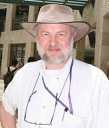
 Alfred M. Bruckstein
1 previous affiliation
- Full Professor · 1984–2025
- PhD student · 1980–1984
Research Overview
Alfred M. Bruckstein focuses on computer vision, geometric image analysis, and shape reconstruction. His trajectory spans early foundational work in level set methods and curve evolution for image processing to later advancements in non-rigid shape analysis and variational optical flow. More recently, his research addresses high-precision depth recovery and geometric refinement using multimodal sensor fusion.
Research Trajectory
The early phase of Bruckstein's research heavily emphasized the application of differential geometry and partial differential equations to computer vision problems. In 1995, his group introduced new numerical implementations for geometric problems, including Finding Shortest Paths on Surfaces Using Level Sets Propagation. This work calculated minimal length paths by tracking equal geodesic distance contours as zero sets of an evolving bivariate function on a rectangular grid. Concurrently, he developed techniques for 3D shape recovery in Shape from shading: Level set propagation and viscosity solutions. By propagating an initialized 3D function so that its level sets tracked height contours, the method imported techniques from fluid dynamics to handle non-smooth surfaces and topological changes. This foundational interest in curve evolution was further formalized in Analyzing and Synthesizing Images by Evolving Curves with the Osher-Sethian Method (1997), which bridged Hamilton-Jacobi equations and differential conservation laws to construct accurate numerical schemes for image analysis.
Moving into the early 2000s, his focus expanded to image segmentation and edge detection. With collaborators, he explored multiresolution approximations to handle nonuniform illumination in Efficient Computation of Adaptive Threshold Surfaces for Image Binarization (2001), offering an alternative to traditional Laplace equation solutions. This was followed by a geometric variational framework for object segmentation in Regularized Laplacian Zero Crossings as Optimal Edge Integrators (2003). This research demonstrated that classical zero-crossings of the image Laplacian inherently provide optimal edge integration by accumulating the inner product between the edge normal and the image gradient.
By the late 2000s, Bruckstein's work addressed increasingly complex motion and deformation modeling. He contributed to novel spatio-temporal models in Over-Parameterized Variational Optical Flow (2008), which utilized varying coefficients and basis functions at each pixel to improve flow estimation beyond traditional neighborhood-based constraints. During this period, he also participated in significant research on deformable object comparison. This included Analysis of Two-Dimensional Non-Rigid Shapes (2008), which established similarity criteria based on intrinsic geometric properties and the Gromov-Hausdorff distance, and Partial Similarity of Objects, or How to Compare a Centaur to a Horse (2009), which quantified partial similarity using Pareto optimality for recognizing non-rigid geometric objects and images.
In the subsequent years, his research tackled advanced regularization techniques and structural analysis. He led work on Orientation-Matching Minimization for Image Denoising and Inpainting (2011), proposing a two-step TV-Stokes algorithm to reconstruct images via regularized tangential vector fields. He also developed computationally efficient, parallelizable methods for smoothing complex data structures in Fast Regularization of Matrix-Valued Images (2012), utilizing an augmented Lagrangian framework to enable real-time processing on graphics hardware. Expanding into combinatorial problems, his group introduced an efficient spectral method for matching vertices in Graph Isomorphisms and Automorphisms via Spectral Signatures (2013), utilizing heat kernels associated with the graph Laplacian to achieve practical polynomial runtimes.
In the mid-2010s, Bruckstein's trajectory shifted toward the enhancement of 3D sensor data, specifically focusing on consumer RGB-D scanners. He directed research in RGBD-fusion: Real-time high precision depth recovery (2015), which fused intensity and depth information to calculate detailed geometry directly without explicitly integrating surface normals. This work advanced the research area of Resolving Texture Geometry Ambiguity in Depth Estimation. He further contributed to Real-Time Depth Refinement for Specular Objects (2016), which utilized built-in monochromatic IR projectors to correct depth profiles for non-Lambertian surfaces. This publication intersects with several broader research directions, including the areas of Near Infrared Shading for Surface Geometry Estimation, Inverse Rendering for Translucent Materials, and Depth Estimation from Inverse Square Light Attenuation. Additionally, this work supports ongoing developments in the fields of Temporal Consistency in Video Depth Estimation and Depth Map Super Resolution and Geometric Refinement.
Current Directions
The most recent papers in the evidence, dating to 2015 and 2016, indicate a focus on high-fidelity 3D reconstruction and sensor fusion. This recent work investigates methods for overcoming the hardware limitations of consumer RGB-D scanners by integrating photometric cues with coarse depth maps. Specifically, these efforts address the challenges of recovering fine geometric details under natural scene illumination and correcting depth artifacts caused by specular reflections. By leveraging shape-from-shading techniques and infrared sensor data, this research aims to produce highly accurate, real-time depth profiles for complex, non-Lambertian objects.
Profile updated
Loading new papers…
Other researchers whose papers cluster into the same research directions — a proxy for overlapping technical interests and shared intellectual neighborhoods.
See something wrong? Report a mistake