

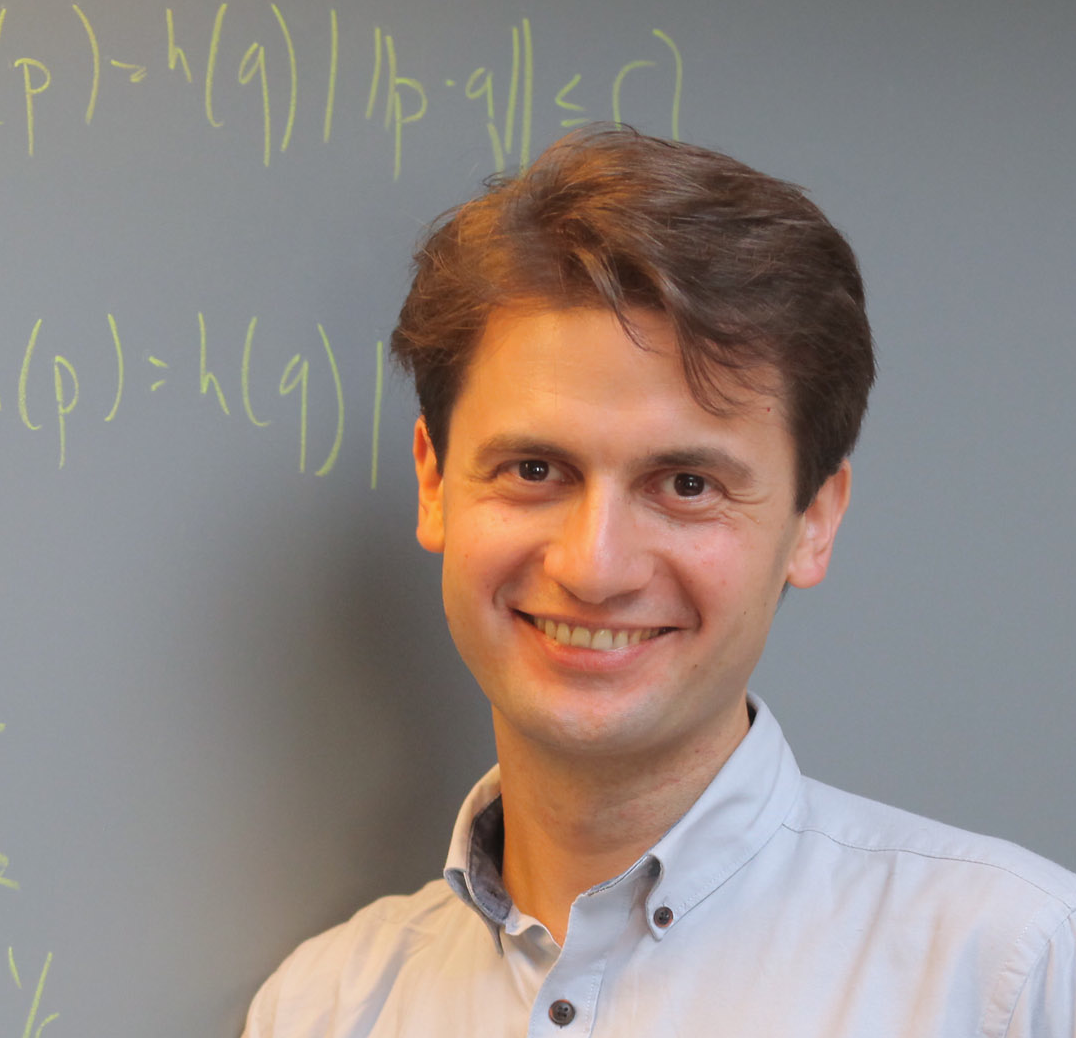
 Alexandr Andoni
· 3 previous affiliations
- Columbia UniversitySince 2015
- Associate Professor · Since 2015
- researcher · 2014–2015
- Microsoft (United States)2010–2014
- researcher · 2010–2014
Research Overview
Alexandr Andoni focuses on algorithmic foundations for massive datasets, high-dimensional similarity search, and sublinear algorithms. His trajectory spans foundational lower bounds in metric embeddings to the development of optimal locality-sensitive hashing schemes for approximate nearest neighbor search. His most recent work investigates adversarially robust search frameworks and sub-quadratic attention mechanisms for machine learning architectures.
Research Trajectory
His early research established foundational results in metric embeddings and similarity search. He proved fundamental limits in Lower bounds for embedding edit distance into normed spaces. Building on this geometric foundation, he introduced a Locality-sensitive hashing scheme based on p-stable distributions and subsequently developed Near-Optimal Hashing Algorithms for Approximate Nearest Neighbor in High Dimensions, which achieved near-optimal query time and space bounds for Euclidean spaces.
Returning to these core problems a decade later, he contributed to the area of Approximate Nearest Neighbor Search in High Dimensions. He introduced Practical and Optimal LSH for Angular Distance, which provided an asymptotically optimal and practically efficient algorithm for angular distance, alongside fine-grained lower bounds. In the same year, he contributed to Optimal Data-Dependent Hashing for Approximate Near Neighbors, further refining the theoretical limits of hashing structures.
Around 2020, his research broadened to encompass parallel graph algorithms, string matching, and streaming models. He developed a near-linear time constant-factor approximation for string comparison in Edit Distance in Near-Linear Time: it's a Constant Factor. In graph theory, he introduced low hop emulators to achieve poly-logarithmic depth for Parallel approximate undirected shortest paths via low hop emulators. He also analyzed the space complexity of bias-regularized support vector machines in Streaming Complexity of SVMs. Continuing his focus on high-dimensional metrics, he proposed Approximate Nearest Neighbors Beyond Space Partitions, which bypassed traditional embedding steps to handle $\ell_p$ and generalized Hamming distances directly.
More recently, the trajectory has integrated modern machine learning constraints, such as adversarial robustness and differential privacy, into classical search problems. This includes advancing the research direction of Data-Dependent Hashing for High-Dimensional Similarity Search and work in the broader area of Generalizing Geometric Algorithms to Arbitrary Metric Spaces. He framed hash function selection as a zero-sum game in Learning to Hash Robustly, Guaranteed to create data-adaptive, robust LSH methods. He then addressed spatial queries with strict privacy guarantees in Differentially Private Approximate Near Neighbor Counting in High Dimensions, breaking the curse of dimensionality for private range counting. With collaborators, he explored fundamental limits in Statistical-Computational Trade-offs for Density Estimation, proving that statistical and computational complexities form an interconnected trade-off. In 2025, he introduced From Search to Decision: A Framework for Adversarially Robust Approximate Nearest Neighbor Search, which reduces search problems to robust decision problems using differential privacy frameworks. Additionally, he participated in the development of Approximate Nearest Neighbor Attention (ANNA) in Fast attention mechanisms: a tale of parallelism, a sub-quadratic mechanism utilizing locality-sensitive hashing to scale standard Transformers to massive contexts.
Current Directions
The most recent papers in the evidence address the intersection of classical similarity search with the demands of modern, large-scale machine learning. Current work investigates adversarially robust frameworks for approximate nearest neighbor search, leveraging differential privacy techniques to protect against adaptive queries. Additionally, recent research explores the fundamental statistical-computational trade-offs inherent in density estimation and applies locality-sensitive hashing to design sub-quadratic attention mechanisms, enabling standard Transformer architectures to process massive contexts more efficiently.
Profile updated
Loading new papers…
Other researchers whose papers cluster into the same research directions — a proxy for overlapping technical interests and shared intellectual neighborhoods.
See something wrong? Report a mistake