

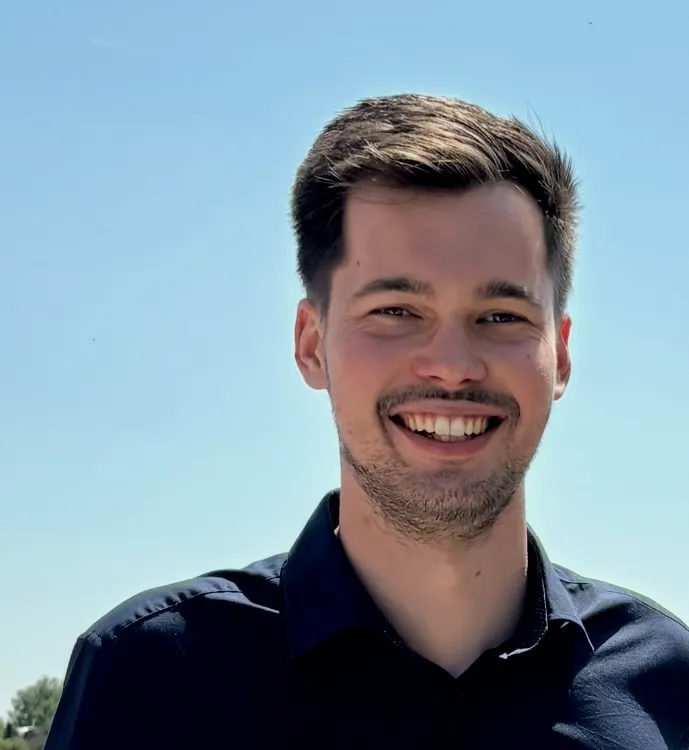
 Alexander Weers
· 1 previous affiliation
- Technical University of MunichSince 2022
- PhD student · Since 2025
- MS student · 2022–2025
Research Overview
Alexander Weers focuses on medical image analysis, topology-aware deep learning, and interpretable machine learning for clinical diagnostics. His work addresses the structural integrity of segmentation models by developing efficient graph-based frameworks and rigorously evaluating topological benchmarking practices. Recently, his research has expanded into whole-slide image analysis, emphasizing tissue-aligned representations that improve the interpretability of computational histopathology.
Research Trajectory
Weers's published work centers on the intersection of deep learning and structural correctness in medical imaging, particularly within the research direction of Topology Aware Deep Learning for Structural Image Segmentation. Ensuring that segmentation models preserve critical anatomical structures—such as the connectivity of vessels or neurons—is a persistent challenge in the field. In 2025, he collaborated on Pitfalls of Topology-Aware Image Segmentation, an empirical study identifying critical flaws in how topology-aware models are evaluated. This work highlighted issues with inadequate connectivity choices, overlooked topological artifacts in ground truth annotations, and the misapplication of evaluation metrics, demonstrating how these factors can skew model rankings and hinder real-world applicability.
Continuing in this domain, he contributed to the development of Topograph: An Efficient Graph-Based Framework for Strictly Topology Preserving Image Segmentation. This research introduced a highly efficient loss framework designed to maintain structural features, like connectivity and holes, without compromising pixel-wise accuracy. By utilizing a component graph to isolate topologically critical errors, the method achieved significant computational speedups over existing techniques in the broader area of Scaling Topological Data Analysis for Deep Learning and advanced work in the field of Structural Continuity and Topological Integrity in Image Segmentation.
Building on his expertise in graph-based representations, Weers subsequently shifted his focus toward computational pathology. He introduced From Pixels to Histopathology: A Graph-Based Framework for Interpretable Whole Slide Image Analysis, addressing the limitations of standard patch-based methods that artificially fragment tissue and produce opaque predictions. In this work, he developed a novel framework that transforms gigapixel whole-slide images into graph representations aligned with natural biological boundaries rather than arbitrary grids. By incorporating an adaptive graph coarsening technique guided by learned embeddings, this approach provides a structurally grounded method for cancer diagnosis. This contribution aligns with the research direction of Visual Interpretability for Medical Image Analysis and the area of Aligning Neural Representations with High Level Clinical Concepts.
Current Directions
The most recent papers in the evidence indicate a strong focus on bridging the gap between pixel-level predictions and clinically interpretable structures. Weers's current work investigates how graph-based frameworks can replace rigid, grid-based processing in computational histopathology. By aligning neural representations with natural tissue boundaries, he aims to create diagnostic tools that are interpretable by design. A unifying theme across his recent research is the use of structural and topological constraints—whether through specialized loss functions or adaptive graph coarsening—to ensure that deep learning models respect the underlying biological reality of medical images.
Profile updated
Loading new papers…
Other researchers whose papers cluster into the same research directions — a proxy for overlapping technical interests and shared intellectual neighborhoods.
See something wrong? Report a mistake