

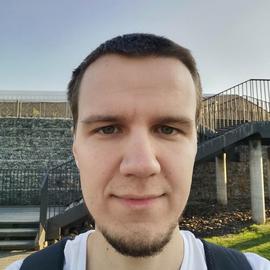
 Alexander Korotin
· 2 previous affiliations
- Applied AI InstituteSince 2025
- Senior Researcher · Since 2025
- Assistant Professor · 2023–2024
- Head of Research Group · 2022–2024
- PhD student · 2018–2022
Research Overview
Alexander Korotin focuses on computational optimal transport, generative modeling, and the theoretical foundations of neural network-based solvers. His early work established rigorous benchmarks and non-minimax algorithms for continuous Wasserstein distances. More recently, his research investigates robust distribution alignment, diffusion models, and statistical learning guarantees for adversarial optimal transport.
Research Trajectory
Alexander Korotin’s research trajectory begins with early work in online learning and decision-making, as seen in Adaptive hedging under delayed feedback (2020). Shortly thereafter, his focus shifted decisively toward establishing rigorous mathematical and empirical foundations for neural optimal transport (OT).
A major challenge in early neural OT was the lack of standard quantitative evaluation methods. In Do Neural Optimal Transport Solvers Work? A Continuous Wasserstein-2 Benchmark (2021), he addressed this by introducing input-convex neural networks (ICNNs) to construct continuous benchmark measures with analytically known ground truth transport maps. Building on this foundation, he developed scalable methods that avoid the pitfalls of adversarial training, contributing to the research direction of The Dynamics of Minimax Optimization Instability. This approach is exemplified by Continuous Wasserstein-2 Barycenter Estimation without Minimax Optimization (2021) and Wasserstein-2 Generative Networks (2021), both of which utilize cycle-consistency regularization to approximate the Wasserstein-2 distance without introducing entropic bias.
In 2022, he critically examined the relationship between generative models and optimal transport theory. In Kantorovich Strikes Back! Wasserstein GANs are not Optimal Transport?, he evaluated how well Wasserstein GAN dual solvers actually approximate true optimal transport costs and gradients in high-dimensional spaces. The following year, he formalized the use of neural networks in this domain with Neural Optimal Transport (2023), proving that neural networks are universal approximators of transport plans. This work significantly advanced the area of Minimax Optimization for Neural Optimal Transport.
As his research program expanded, his laboratory began addressing robustness and complex data distributions. In Robust Barycenter Estimation using Semi-Unbalanced Neural Optimal Transport (2025), his group introduced the U-NOTB framework to filter outliers and handle class imbalances, contributing to the broader area of Robust Distribution Alignment via Unbalanced Optimal Transport.
By 2026, his team produced a suite of theoretical and methodological advancements bridging optimal transport, statistical learning, and modern generative paradigms. They provided the first formal statistical learning bounds for adversarial solvers in A Statistical Learning Perspective on Semi-dual Adversarial Neural Optimal Transport Solvers, proving that learned transport maps reliably converge to the true mathematically optimal map given sufficient data and network expressivity. They also applied optimal transport principles to dynamic systems; Learning of Population Dynamics: Inverse Optimization Meets JKO Scheme framed the recovery of energy rules driving population dynamics as an inverse optimization problem, enabling end-to-end training from time-lapse snapshots.
His recent work heavily explores diffusion models and flow matching. InfoBridge: Mutual Information estimation via Bridge Matching leverages diffusion bridge matching to create an unbiased estimator for mutual information, reframing the estimation as a domain transfer problem. Meanwhile, Unlocking the Duality between Flow and Field Matching unifies Conditional Flow Matching and Interaction Field Matching by demonstrating they describe the same underlying generative dynamics. Extending diffusion models to discrete domains, his team developed Inverse-distilled Diffusion Language Models, which adapts continuous diffusion techniques to significantly accelerate text generation while maintaining quality.
Finally, Inverse Entropic Optimal Transport Solves Semi-supervised Learning via Data Likelihood Maximization introduced the EBiEOT framework, unifying paired and unpaired data into a single loss function. This work touches on several complex research areas, including Overcoming Local Mode Entrapment in Multimodal Sampling and Gaussian Mixture Parameterization for Tractable Inference.
Current Directions
Based on his most recent papers, current work focuses on the intersection of optimal transport, inverse optimization, and advanced generative modeling. A major theme is establishing rigorous statistical guarantees for neural solvers, ensuring that empirical successes in generative AI are backed by formal convergence proofs. Additionally, recent research investigates the unification of disparate generative frameworks—such as flow matching, field matching, and diffusion models—and adapts continuous generative techniques to discrete domains like language modeling. Another active direction involves leveraging inverse entropic optimal transport to solve semi-supervised learning and domain transfer problems, maximizing data likelihood across both paired and unpaired datasets.
Profile updated
Loading new papers…
Other researchers whose papers cluster into the same research directions — a proxy for overlapping technical interests and shared intellectual neighborhoods.
See something wrong? Report a mistake