

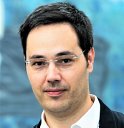
 Alessio Micheli
· 1 previous affiliation
- University of PisaCurrent
- Full Professor · Current
Research Overview
Alessio Micheli focuses on machine learning for structured data, specifically advancing graph neural networks, reservoir computing, and deep probabilistic models. His trajectory spans early recursive neural networks for chemical structures to the development of highly efficient graph echo state networks and contextual Markov models. Recently, his work investigates explainable AI for graph networks and scalable network quantification.
Research Trajectory
Micheli’s early research explored how neural networks process structured domains, particularly through recursive architectures. He investigated recursive cascade correlation networks for quantitative structure-activity relationship (QSAR) studies, analyzing how these models handle chemical compounds as labeled directed graphs in Analysis of the Internal Representations Developed by Neural Networks for Structures Applied to Quantitative Structure-Activity Relationship Studies of Benzodiazepines. Building on this foundation, he introduced contextual recursive cascade correlation (CRCC) to relax causality assumptions and exploit contextual information stored in frozen units, as detailed in Contextual processing of structured data by recursive cascade correlation.
A major arc of his subsequent work involves reservoir computing, specifically extending these efficient, fixed-weight recurrent systems to graph-structured data. This led to the formulation of Graph Echo State Networks in 2010. Over the following decade, he heavily contributed to the research direction of Reservoir Computing with Fixed Recurrent Dynamics. He expanded these concepts into deep architectures, providing a comprehensive evaluation of multi-layered reservoir systems in Deep reservoir computing: A critical experimental analysis and formalizing their construction in Design of deep echo state networks. This body of work significantly advanced the broader area of Hierarchical Temporal Integration in Deep Recurrent Networks.
Concurrently, Micheli developed deep probabilistic approaches for graphs. He led the development of the Contextual Graph Markov Model (CGMM), combining generative models with neural network principles to build deep architectures constructively, as presented in Contextual Graph Markov Model: A Deep and Generative Approach to Graph Processing. He continued to bridge dynamical systems and graph learning by representing input graphs as fixed points of recurrent neural networks, yielding highly efficient, sparse architectures in Fast and Deep Graph Neural Networks. Recognizing the rapid proliferation of graph learning models, he also addressed methodological rigor in the field, outlining best practices for experimental reproducibility and unbiased evaluation in A Fair Comparison of Graph Neural Networks for Graph Classification.
In recent years, Micheli has deepened the theoretical and practical foundations of both reservoir computing and probabilistic graph models. In the realm of echo state networks, he investigated hierarchical contractivity in Hierarchical Dynamics in Deep Echo State Networks and established rigorous necessary and sufficient conditions for graph embedding stability in Spectral Bounds for Graph Echo State Network Stability. He also explored architectural variations, such as the Pyramidal Reservoir Graph Neural Network and the integration of gating mechanisms for long-term dependencies in On the effectiveness of Gated Echo State Networks for data exhibiting long-term dependencies.
Simultaneously, his work on generative graph models evolved to incorporate Bayesian nonparametrics. He introduced an extension utilizing Hierarchical Dirichlet Processes to automatically determine optimal internal representation sizes in The Infinite Contextual Graph Markov Model, producing highly compact graph embeddings. This was followed by E-CGMM, which extended deep Bayesian graph networks to handle continuous, multi-dimensional edge features via dynamic discretization in Modeling Edge Features with Deep Bayesian Graph Networks. Both of these models contribute to the research direction of Edge Aware Message Passing for Relational Graphs. He also applied probabilistic frameworks to dynamic structures in Hidden Markov Models for Temporal Graph Representation Learning. To support the community, he formalized these tools into a reproducible software ecosystem with PyDGN: a Python Library for Flexible and Reproducible Research on Deep Learning for Graphs.
Most recently, Micheli has focused on the interpretability and robustness of graph neural networks. He investigated the inductive biases of convolutional and recursive architectures using explainable AI (XAI) techniques in Analyzing Explanations of Deep Graph Networks Through Node Centrality and Connectivity and explored related themes of fairness in XAI and Bias of Deep Graph Networks. Expanding into new problem settings, he addressed the challenge of estimating class proportions in unlabeled graph nodes under prior probability shifts, introducing a scalable method for network quantification in Learning to quantify graph nodes. Building on this, Micheli led the introduction of Graph Node Symmetric Quantification in A Framework for Graph Node Symmetric Quantification under Dataset Shift, eliminating intermediate node-level classifiers to predict class prevalence directly on node samples under prior probability and structural covariate shifts.
Current Directions
The most recent papers in the evidence indicate a strong focus on the interpretability, fairness, and robustness of deep graph networks. Recent work investigates explainable AI (XAI) for graph models, utilizing concepts like node centrality and connectivity to understand the inductive biases that distinguish different architectural classes, such as convolutional and recursive networks. Additionally, Micheli is addressing the emerging problem of network quantification—estimating class distributions in unlabeled graph subsets under prior probability shifts—developing scalable methods that remain resilient to challenges like heterophily in complex networks.
Profile updated
| Paper | Venue | Year |
|---|---|---|
| The Infinite Contextual Graph Markov ModelGitHubdiningphil/ | ICML | 2022 |
Loading new papers…
Other researchers whose papers cluster into the same research directions — a proxy for overlapping technical interests and shared intellectual neighborhoods.
See something wrong? Report a mistake