

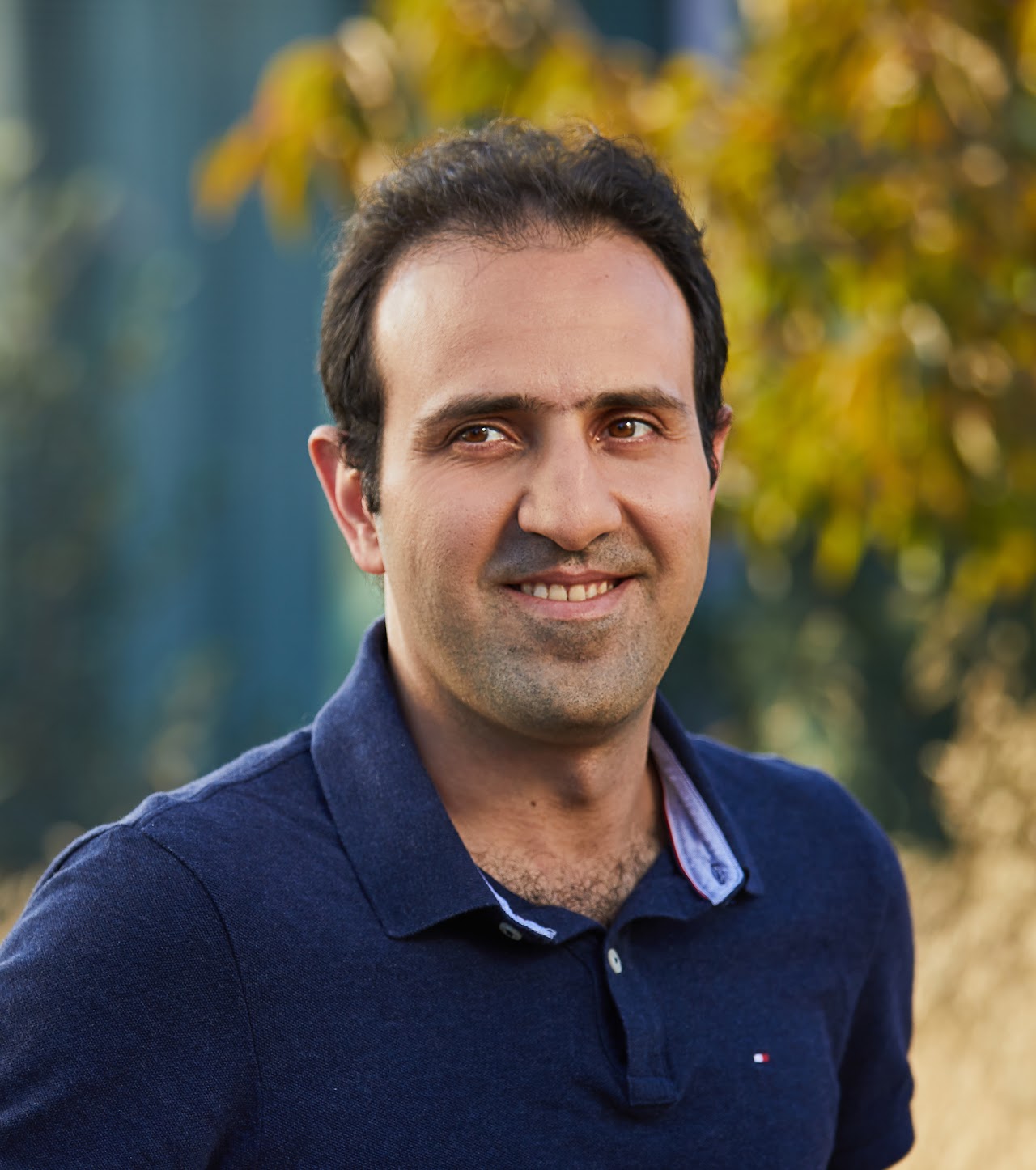
 Ahmad Beirami
· 9 previous affiliations
- FidianSince 2025
- Co-Founder / CEO · Since 2025
- Google DeepMind (United Kingdom)2024–2025
- Research Scientist · 2024–2025
- Google (United States)2022–2025
- Research Scientist · 2022–2025
- Research Affiliate · 2017–2025
- Postdoctoral Fellow · 2015–2018
- Postdoc · 2015–2017
- Meta (United States)2019–2022
- Research Scientist · 2019–2022
- Electronic Arts - SEED2017–2019
- Research Scientist · 2017–2019
- Harvard University2016–2017
- Postdoctoral Fellow · 2016–2017
- Duke University2014–2016
- Postdoc · 2014–2016
- Georgia Institute of Technology2009–2014
- PhD student · 2009–2014
Research Overview
Ahmad Beirami focuses on the alignment, efficiency, and fairness of large language models, alongside reinforcement learning applications. His trajectory spans foundational work in algorithmic fairness and robust optimization to the development of scalable inference and post-training alignment techniques. His current research investigates test-time compute scaling, reward-guided inference, and the theoretical limits of alignment policies.
Research Trajectory
During his tenure as a research leader at organizations including Google DeepMind, Meta, and Electronic Arts, Beirami's work has consistently addressed the safety, alignment, and efficiency of generative models. His early 2024 research investigated vulnerabilities and biases in large language models. He guided the development of Gradient-Based Language Model Red Teaming, which explored automated methods for identifying safety gaps. Concurrently, he contributed to the research direction of Post-Hoc Fairness Adjustment for Machine Learning. This work began with the preprint Inducing Group Fairness in LLM-Based Decisions, which measured toxicity classification biases in prompt-based classifiers, and was subsequently formalized in Inducing Group Fairness in Prompt-Based Language Model Decisions, demonstrating that regularization-based approaches effectively mitigate bias without sacrificing performance.
A major theme of Beirami's trajectory is the alignment of language models with human preferences, particularly through reward modeling and inference-time interventions. He oversaw Reuse Your Rewards: Reward Model Transfer for Zero-Shot Cross-Lingual Alignment, which demonstrated that a reward model trained on a single source language could be successfully applied to target languages in zero-shot settings for summarization and dialog generation. He also led investigations into decoding strategies, introducing Controlled Decoding from Language Models to steer model outputs.
His most extensive theoretical contributions focus on the Best-of-N alignment policy. Beirami initiated a rigorous analysis of this popular strategy in the preprints Theoretical guarantees on the best-of-n alignment policy and Theoretical guarantees on the best-of-n alignment policy. These papers debunked the standard mathematical formula for calculating the KL divergence of Best-of-N sampling, proving it to be a loose upper bound. This foundational work culminated in the peer-reviewed publication Theoretical guarantees on the best-of-n alignment policy, which provided a tighter estimator and established strict theoretical caps on win rates, offering a robust framework for understanding the preservation of base model capabilities.
Building on this theoretical foundation, Beirami's 2025 research bridges the gap between training procedures and complex inference-time decoding. He directed the development of InfAlign: Inference-aware language model alignment, which proved that inference-time procedures can be optimized during training via specific reward function transformations, yielding significant performance boosts. In parallel, he contributed to the broader area of Lossless Parallel Inference via Speculative Decoding by participating in the design of SPECS: Faster Test-Time Scaling through Speculative Drafts. This framework dynamically switches between a large target model and a smaller draft model based on real-time reward signals, reducing inference latency while maintaining the accuracy of heavy-duty beam search.
Most recently, Beirami has addressed the vulnerabilities of inference-time alignment to imperfect proxy reward models. He introduced a smoothed version of Best-of-N sampling in the preprint Best-of-N through the Smoothing Lens: KL Divergence and Regret Analysis. With collaborators, he formalized this approach in the 2026 publication Best-of-N through the Smoothing Lens: KL Divergence and Regret Analysis, demonstrating that a smoothing parameter can effectively mitigate reward hacking and maintain better alignment with true human preferences.
Current Directions
Recent work investigates the intersection of test-time compute scaling and robust alignment in large language models. A primary focus is on inference-aware alignment, developing frameworks that bridge the gap between standard reinforcement learning from human feedback and complex, real-world decoding strategies. This includes optimizing models specifically for the inference procedures they will use in deployment, thereby improving performance without additional computational overhead.
Additionally, Beirami is exploring methods to accelerate deliberative reasoning and autoregressive inference. By leveraging speculative drafting and dynamic model switching, this research aims to achieve the accuracy of computationally intensive search methods while significantly reducing latency. Alongside efficiency, his current research addresses the reliability of reward-guided search, particularly through smoothed sampling techniques designed to mitigate reward overoptimization and ensure models remain aligned with human preferences even when relying on imperfect proxy reward models.
Profile updated
Loading new papers…
Other researchers whose papers cluster into the same research directions — a proxy for overlapping technical interests and shared intellectual neighborhoods.
See something wrong? Report a mistake