

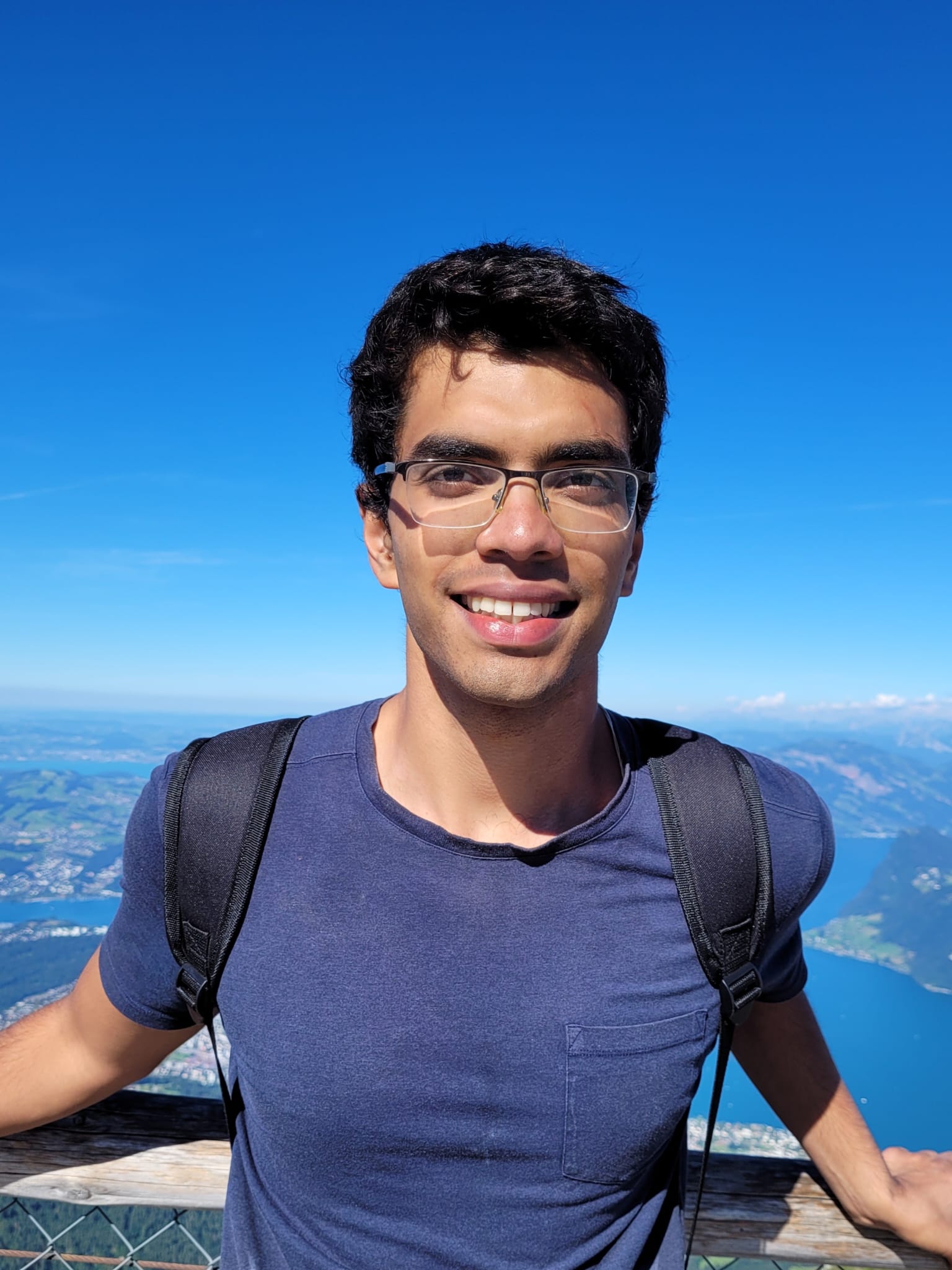
 Advait U Parulekar
· 4 previous affiliations
- The University of Texas at AustinSince 2020
- Research Assistant · Since 2020
- Doctor of Philosophy - PhD, Electrical and Computer Engineering · 2020
- PhD student · From 2020
- ML Research Intern · 2025
- Research Intern · 2023
- Texas A&M University2015–2019
- Research Assistant · 2019
- Peer Teacher · 2018–2019
- Bachelors, Computer Engineering · 2015–2019
Research Overview
Advait U Parulekar focuses on statistical learning theory, with a particular emphasis on the algorithmic foundations of generative models, in-context learning, and reinforcement learning. His work seeks to provide rigorous theoretical justifications for emergent behaviors in large-scale machine learning systems, including the generalization capabilities of Transformers and the sampling efficiency of diffusion-based models. By bridging the gap between empirical success and mathematical guarantees, his research addresses fundamental questions in Robust Adaptation, posterior sampling, and invariant representation learning.
Research Trajectory
The early stage of Parulekar’s research, beginning around 2020, was primarily concerned with sequential decision-making under uncertainty and the spectral properties of parametric matrices. During this period, he investigated the limitations of optimism in multi-armed bandit frameworks and reinforcement learning (RL). A significant contribution involved the study of "protected" subspaces in linear bandits, where he identified a fundamental performance gap between continuous and discrete action spaces. This work demonstrated that while optimistic algorithms can achieve efficient regret in continuous settings, discrete action spaces can impose much stricter lower bounds on performance.
Simultaneously, Parulekar contributed to the development of iterative schemes for locating conical degeneracies in matrix spectra. This work, which established quadratic convergence for locating double eigenvalues in real symmetric and complex Hermitian matrices, provided a computational foundation for analyzing parametric self-adjoint matrices. By 2021, his focus shifted toward scaling reinforcement learning algorithms through function approximation. He led the development of the first computationally and statistically efficient algorithms for Stochastic Shortest Path (SSP) problems using linear function approximation. This work introduced the concept of "Optimistic Approximate Fixed Points" to achieve sublinear regret, a result that addressed a long-standing gap in the RL literature regarding stationary policies in large state spaces.
In 2022 and 2023, Parulekar’s work evolved to address the theoretical underpinnings of representation learning and generative modeling. He explored the Sparse Mechanism Shift Hypothesis, providing a PAC-based theoretical foundation for Invariant Risk Minimization (IRM). This research moved beyond brittle worst-case assumptions to prove that invariant representations could reliably generalize across shifting environments. During this time, he also investigated contrastive learning, specifically proving that minimizing the InfoNCE loss leads to representations that preserve the underlying cluster structure of data.
His most recent work, spanning 2024 to 2026, focuses on the mechanics of In-Context Learning (ICL) in Transformers and the tractability of Overcoming Local Mode Entrapment in Multimodal Sampling in diffusion models. This phase of his research is characterized by a shift toward understanding how static network architectures perform complex algorithmic tasks during a single forward pass and how score-based models can be used for efficient Bayesian inference.
Current Directions
Parulekar’s current research is concentrated on two primary pillars: the geometric interpretation of Transformer-based learning and the convergence analysis of Langevin-type sampling methods.
In the domain of ICL, he is investigating how the softmax attention mechanism enables Transformers to adapt to the complexity of the functions they are prompted to learn. Rather than viewing ICL solely through the lens of gradient descent, his work proposes a geometric explanation centered on function Lipschitzness. This direction aims to clarify why Transformers excel at few-shot adaptation without explicit weight updates.
In the area of generative models, Parulekar is addressing the "intractability" of sampling from posterior distributions. His recent work on Annealed Langevin Monte Carlo (ALMC) provides formal proofs for polynomial-time sampling in score-based models. This research is critical for the deployment of diffusion models in inverse problems, such as image inpainting and medical imaging, where sampling from a conditional distribution is required. He continues to explore the trade-offs between global correctness and local sample quality in these high-dimensional probability landscapes.
Representative Work
Stochastic Linear Bandits with Protected Subspace In this work, Parulekar introduces a framework for optimizing linear objectives where rewards are constrained by an unknown "protected" subspace. The paper establishes a stark contrast in regret bounds: while continuous action spaces allow for $\tilde{O}(sd\sqrt{T})$ regret, discrete action spaces are shown to force an $\Omega(T^{3/4})$ regret. This finding highlights a fundamental limitation of naive optimism in partial-information settings where certain directions are restricted.
Regret Bounds for Stochastic Shortest Path Problems with Linear Function Approximation As the lead author, Parulekar developed the first algorithm for SSP problems that is both computationally and statistically efficient under linear function approximation. The core innovation is the use of Optimistic Approximate Fixed Points (OAFPs) within a $d$-dimensional feature space. This approach allows for the use of stationary policies while maintaining sublinear regret, bridging a significant gap between theoretical RL and practical large-scale deployment.
PAC Generalization via Invariant Representations This research provides a rigorous theoretical justification for Invariant Risk Minimization (IRM). By applying a Probably Approximately Correct (PAC) framework, Parulekar demonstrates that invariant representations can generalize to new environments without relying on the restrictive assumptions common in previous literature. The work offers a mathematical basis for why modular, structured models are more robust to distribution shifts than monolithic ones.
A Theoretical Justification for Image Inpainting using Denoising Diffusion Probabilistic Models Parulekar provides the first theoretical analysis of image inpainting using Denoising Diffusion Probabilistic Models (DDPMs) in a linear setting. He identifies a "misalignment bias" in existing algorithms like RePaint, which prevents perfect recovery of the underlying signal. To resolve this, he proposes RePaint+, a corrected algorithm that achieves a linear rate of convergence to the true sample without the need for task-specific retraining.
In-Context Learning with Transformers: Softmax Attention Adapts to Function Lipschitzness In this collaborative work, Parulekar explores the geometric properties of softmax attention in pretrained Transformers. The paper argues that ICL is not merely an emulation of gradient descent but a mechanism that adapts to the Lipschitzness of the function represented in the prompt. This perspective provides a new understanding of how Transformers function as mesa-optimizers during inference.
Efficient Approximate Posterior Sampling with Annealed Langevin Monte Carlo Addressing the difficulty of sampling from complex, multimodal posterior distributions, Parulekar introduces Annealed Langevin Monte Carlo (ALMC). This work provides the first formal proof that approximate posterior sampling in score-based generative models can be achieved in polynomial time. The analysis balances global accuracy (via KL divergence) with local sample quality (via Fisher divergence), providing a theoretical guarantee for a process often considered intractable.
Profile updated
Loading new papers…
Other researchers whose papers cluster into the same research directions — a proxy for overlapping technical interests and shared intellectual neighborhoods.
See something wrong? Report a mistake