

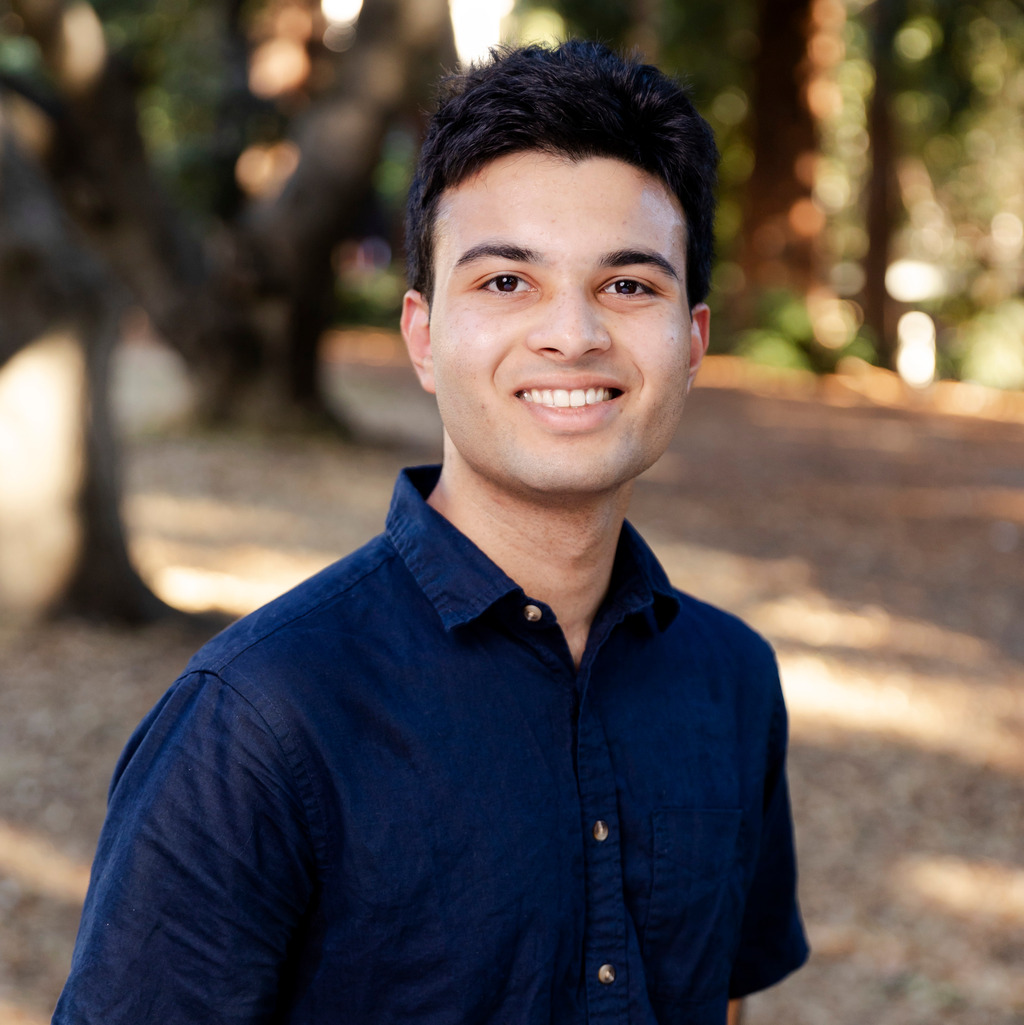
 Aditya Tomar
· 6 previous affiliations
- Nvidia (United States)Since 2026
- Applied Deep Learning Research Intern · Since 2026
- University of California, BerkeleySince 2023
- Bachelor of Science - BS, Electrical Engineering and Computer Science · 2023–2027
- Current
- International Computer Science InstituteSince 2023
- Undergrad student · 2023–2027
- Undergraduate Researcher · Since 2024
- Together2025–2026
- Research Intern · 2025–2026
- Saint Francis High School2019–2023
- 2019–2023
Research Overview
Aditya Tomar focuses on efficient deep learning, specifically targeting memory-efficient inference and scalable parallel training methods for large language models. His trajectory spans from optimizing distributed training on supercomputers to developing novel quantization and speculative decoding techniques. Currently, he investigates the robustness of process reward models and the efficiency of diffusion-based language architectures.
Research Trajectory
Aditya Tomar's research initially engaged with the systems-level challenges of scaling foundation models. In 2024, he contributed to efforts in scalable distributed systems, participating in the development of Democratizing AI: Open-source Scalable LLM Training on GPU-based Supercomputers, which explored methodologies for training large language models efficiently across high-performance computing clusters.
Building on this foundation in large-scale systems, his focus transitioned toward optimizing the memory and computational bottlenecks of model inference. This work intersects with the research direction of KV Cache Compression for Long-Context Inference. With collaborators, he developed QuantSpec: Self-Speculative Decoding with Hierarchical Quantized KV Cache, a framework designed to accelerate generation without degrading quality. By introducing a hierarchical cache that shares bits between a 4-bit draft model and an 8-bit target model, the approach mitigates the memory overhead typically associated with maintaining separate caches. This contribution also advances broader areas such as Selective Token Preservation for Low Precision Inference and Integrating Orthogonal Model Compression Techniques.
In 2026, his research expanded to address both the alignment and architectural efficiency of generative models. Investigating the reliability of reasoning systems, he co-authored Reward Under Attack: Analyzing the Robustness and Hackability of Process Reward Models. This analysis revealed vulnerabilities in the systems used to evaluate intermediate reasoning steps, demonstrating a "fluency-logic dissociation" where models receive high reward scores for mathematically plausible but logically flawed text. This work contributes to the broader area of Generalizing Process Reward Models Beyond Mathematics.
Concurrently, he has explored alternative architectures to traditional autoregressive generation, specifically focusing on Diffusion Large Language Models (dLLMs). In Residual Context Diffusion Language Models, he participated in designing a method to recycle discarded low-confidence tokens as a continuous contextual residual, improving both accuracy and speed on complex reasoning tasks. He further addressed the efficiency of these architectures in LoSA: Locality Aware Sparse Attention in Diffusion Language Models. By recognizing that most tokens remain stable across denoising steps, this work reuses cached attention results and restricts sparse attention computation to a small subset of active tokens. This approach resolves the "KV Inflation" problem in block-wise diffusion models, advancing research directions like Dynamic Sparse Attention for Long Contexts and Scaling Transformers via Information Preserving Sparse Attention.
Current Directions
The most recent papers in the evidence indicate a dual focus on the architectural efficiency of non-autoregressive models and the robust evaluation of reasoning systems. One major thread investigates diffusion-based language models, seeking to overcome their inherent computational bottlenecks through techniques like residual context recycling and locality-aware sparse attention. A parallel direction addresses the alignment and verification of large language models, specifically analyzing the vulnerabilities of process reward models to adversarial exploitation and reward hacking. Together, these efforts aim to make advanced reasoning models both more computationally tractable and logically reliable.
Profile updated
Loading new papers…
Other researchers whose papers cluster into the same research directions — a proxy for overlapping technical interests and shared intellectual neighborhoods.
See something wrong? Report a mistake