

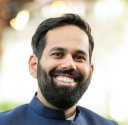
 Adarsh Pyarelal
· 2 previous affiliations
- University of ArizonaSince 2011
- Assistant Professor · Since 2023
- Assistant Research Professor · 2022–2023
- Research Scientist · 2019–2022
- Researcher · 2018–2022
- Postdoc · 2017–2018
- Graduate Research Assistant · 2016–2017
- PhD student · 2011–2017
- Graduate Teaching Assistant · 2011–2016
- Reed College2007–2011
- Undergrad student · 2007–2011
- Student Senator · 2008–2010
- Resident Assistant · 2008–2009
Research Overview
Adarsh Pyarelal focuses on the development of socially-aware AI teammates and the automated assembly of executable causal models from heterogeneous sources, such as natural language text, mathematical equations, and source code. His research integrates techniques from natural language processing, cognitive modeling, and reinforcement learning to improve how artificial agents understand human communication and scientific knowledge. Currently, his work centers on scientific knowledge extraction and the creation of multimodal datasets to benchmark AI performance in complex, multiparty team environments.
Research Trajectory
Pyarelal’s academic trajectory reflects a transition from computational physical sciences to information science and artificial intelligence. His early work involved high-energy physics, specifically the analysis of extended scalar sectors and dark matter candidates in Hidden Higgses and Dark Matter at Current and Future Colliders. This background in modeling complex physical systems provided a foundation for his subsequent focus on "model lifting"—the process of extracting and unifying scientific models from diverse representations.
By 2020, Pyarelal began leading efforts to automate the interpretation of scientific literature and software. A primary contribution during this period was the development of the AutoMATES: Automated Model Assembly from Text, Equations, and Software framework. This work introduced the Grounded Function Network (GrFN), a unified representation designed to allow researchers to compare and reason across models from disparate domains, such as meteorology and agriculture, without manual code auditing. This interest in scientific discourse is reflected in broader research themes regarding Domain Specificity in Scientific Discourse and Argumentation, which addresses the challenges of applying NLP models to highly specialized technical fields.
Parallel to his work on scientific modeling, Pyarelal expanded into the domain of human-machine teaming and virtual task environments. In 2021, he developed Modular Procedural Generation for Voxel Maps, an open-source library (mcg) for generating Minecraft-based environments for AI research. Unlike standard procedural generation, this approach focused on creating both low-level voxel data and high-level machine-readable representations, specifically tailored for empirical research into how AI agents interact with humans in shared spaces.
Between 2022 and 2024, Pyarelal’s research increasingly addressed the interpretability of artificial agents. He served as the senior author on work proposing Deep Reinforcement Learning with Vector Quantized Encoding (VQ-RL). This method introduced a "clustering" layer into reinforcement learning pipelines to group similar states into discrete, human-understandable categories. This line of inquiry continued with the development of the Semantic Clustering Module (SCM), as detailed in Exploring Semantic Clustering in Deep Reinforcement Learning for Video Games, which demonstrated that agents could organize their internal knowledge into clusters corresponding to specific behaviors and skills.
Current Directions
Pyarelal’s current research is concentrated on two major programs: the Theory of Mind based Cognitive Architecture for Teams (ToMCAT) and Scientific Knowledge Extraction and Model Analysis (SKEMA). These projects converge on the problem of making AI systems more effective collaborators by improving their ability to process multimodal communication and extract structured data from unstructured text.
In the area of multimodal communication, Pyarelal has focused on real-time intention recognition in multiparty dialogues. His work on Hierarchical Fusion for Online Multimodal Dialog Act Classification utilizes both audio features and automated speech recognition (ASR) to classify dialogue acts in real-time. This effort is complemented by research into speaker-aware models, such as Who is Speaking? Speaker-Aware Multiparty Dialogue Act Classification, which uses graph neural networks to model interactions between multiple interlocutors. These strands of research culminated in the release of MultiCAT: Multimodal Communication Annotations for Teams, a comprehensive dataset designed to benchmark AI agents in their ability to understand closed-loop communication and emotional states within human teams.
Within the SKEMA project, Pyarelal participates in efforts to recover mathematical models from epidemiological and scientific literature. This includes evaluating methods for Variable Extraction for Model Recovery in Scientific Literature and developing specialized models to identify the temporal and spatial context of events mentioned in technical texts, as seen in When and Where Did it Happen? An Encoder-Decoder Model to Identify Scenario Context. His recent work also touches upon the limitations of modern language models, including the "lost-in-the-middle" effect described in Why Long-Context Language Models Get Lost in the Middle, and the potential for Scaling Human Judgment with LLM Evaluators to replace traditional lexical overlap metrics in NLP evaluation.
Representative Work
AutoMATES: Automated Model Assembly from Text, Equations, and Software This work introduces a framework for extracting scientific models from natural language, mathematics, and source code into a unified Grounded Function Network (GrFN). The system is designed to facilitate the integration and analysis of complex models across different scientific domains.
Modular Procedural Generation for Voxel Maps Pyarelal presents an open-source library for procedural content generation in voxel-based environments like Minecraft. The library is specifically designed for human-machine teaming research, providing simultaneous high-level and low-level representations of the environment for AI agents.
Deep Reinforcement Learning with Vector Quantized Encoding As senior author, Pyarelal proposes VQ-RL, a method that incorporates vector quantized encoding into reinforcement learning. By clustering state features with similar semantics, the framework improves the interpretability and robustness of deep RL agents.
Hierarchical Fusion for Online Multimodal Dialog Act Classification This paper details a framework for real-time classification of intentions in conversation. By fusing raw audio features with noisy text from automated speech recognition, the model achieves improved performance in identifying dialogue acts during active communication.
MultiCAT: Multimodal Communication Annotations for Teams Pyarelal led the development of this multimodal dataset, which provides annotations for dialogue acts, emotion, and closed-loop communication in multiparty settings. The dataset serves as a benchmark for training AI agents to function as effective teammates in search-and-rescue simulations.
Variable Extraction for Model Recovery in Scientific Literature In this study, Pyarelal participated in evaluating methods for extracting mathematical variables (e.g., infection and mortality rates) from epidemiological studies. This task is a critical component of the broader goal of automatically recovering and analyzing models from the vast output of scientific literature.
Profile updated
Loading new papers…
Other researchers whose papers cluster into the same research directions — a proxy for overlapping technical interests and shared intellectual neighborhoods.
See something wrong? Report a mistake